FBI joins hunt for Bali bombers

Bali

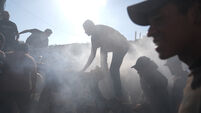
Australian and FBI experts joined the hunt for the killers while forensic experts painstakingly tried to identify bodies many badly burned and mutilated. "Bali used to be known as paradise," said Indonesian Health Minister Achmad Suyudi. "Now, it is like hell in paradise."

Most of the victims were Australians killed when the bigger of two blasts tore through the Sari Club just after midnight on Saturday.

Many of those drinking and dancing inside at the time were members of Australian sports teams celebrating the end of theirs seasons.

Thirty-three Britons are believed to have been killed in the attacks, Foreign Secretary Jack Straw said yesterday.

Mr Straw said "we are as certain as we can be" that 18 Britons were among the dead and 15 Britons still missing were also believed to be dead.

The US embassy in Jakarta, often the target of bomb threats, ordered all non-essential staff and their families to leave Indonesia, the world's most populous Muslim country.

Bali's international airport was thronged by stunned, mostly young travellers looking for flights home. Many camped overnight on beaches, shunning built-up areas in case of more attacks.

"We just want to go back to our families," said Carima Sebba, 26, from the Netherlands. "I am scared, I won't be back for a long time."

Government officials said 181 people died. Hospital workers put the figure at 188. More than 300 were injured.

No one claimed responsibility for the bombing at the Kuta Beach nightlife district the worst terrorist attack in Indonesia's history. But suspicions immediately turned to al-Qaida and an affiliated group Jemaah Islamiyah, which is said to want a pan-Islamic state across Malaysia, Indonesia and the southern Philippines.

Jemaah Islamiyah has already been implicated in a plot at the start of the year to bomb foreign embassies in the region, and Australia says it is a prime suspect in the Bali attack.

"The attack bears the hallmarks of JI," said an expert on al-Qaida, Rohan Gunaratna. "Only the JI has both the intention and capability to conduct a professional terrorist attack like the Bali operation."

US Ambassador Ralph Boyce said while the Bali bombings could not yet be pinned on al-Qaida, there is evidence it is operating in Indonesia and reaching out to local extremists.

Abu Bakar Bashir, a Muslim cleric accused of leading Jemaah Islamiyah, strongly denied involvement.

"All the allegations against me are groundless. I challenge them to prove anything," he said. "I suspect the bombing was engineered by the US and its allies to justify allegations that Indonesia is a base for terrorists," he said by telephone from Solo, a city in central Java where he runs an Islamic boarding school.

Indonesian police refused to say whether Bashir would be questioned despite repeated calls from neighbouring countries that he be arrested.

Security Minister Bambang Susilo Yudoyono said there were signs terrorists were planning attacks against key industrial sites, including Exxon

Mobil's Arun liquified natural gas plant in Aceh and the Caltex refinery in Sumatra.

"We will increase the security alert in those areas," Yudoyono said after a Cabinet meeting.

On Bali, there was no visible evidence of a higher security presence or stricter controls at the airport, though police officials insisted that an elite unite had been deployed.

"We have not caught anyone yet, but when we do, we will announce it," Bali Police Chief Brigadier General Budi Setiawan said.

Balinese officials said only 39 positive identifications had been made, listing 15 Australians, eight Britons, six Indonesians, five Singaporeans, one German, one French citizen, one Dutch citizen, one New Zealander and one Ecuadorean.

Two Americans were killed and three injured, the US State Department said.

At the main hospital in Bali's capital, Denpasar, hundreds of Indonesians and foreigners lined up to donate blood for the injured.

Forensic officials were using fingerprint and dental records to identify bodies. The hospital-turned-morgue was overwhelmed with dead and

injured.

Charred corpses were lined up under sheets in hot rooms, decomposing rapidly in the tropical heat.

Refrigerated containers were being mustered by local and Australian firms to help preserve them.

Bali's normally bustling streets and crowded beaches were largely empty of tourists. Those out complained of little visible extra security.

Governor Dewa Beratha promised to build a monument inscribed with the names of the victims on the blast site.

"We don't want Bali's image to be damaged by this. We want tourists to come back soon," he said.

The explosions and fire damaged about 20 buildings and devastated much of the block.

x

More in this section

Cookie Policy Privacy Policy Brand Safety FAQ Help Contact Us Terms and Conditions

© Examiner Echo Group Limited