Iraq close to chaos, say experts
The warning came as a second audio tape attributed to ousted Iraqi leader Saddam Hussein called for a jihad, or holy struggle, to oust occupying troops.
The voice on the tape lashed out at the new US-backed Governing Council of Iraq and said President George Bush and Prime Minister Tony Blair had lied to the world to justify the war.
A US military spokeswoman in Baghdad said that Deputy Defence Secretary Paul Wolfowitz had arrived in Iraq but could not say what he would be doing.
Wolfowitz is a powerful deputy to Defence Secretary Donald Rumsfeld, who visited Iraq in April, and is seen as one of the most hawkish figures in the Bush administration's Iraq policy.
A team of five experts, invited by Rumsfeld to assess postwar reconstruction in Iraq, issued a 15-page report asserting that "the next three months are crucial to turning around the security situation, which is volatile in key parts of the country".
The experts recommended "the entire effort be immediately turbo- charged" by swiftly increasing funding and personnel for reconstruction, involving many more Iraqis in rebuilding the country and improving communication with them.
"The window of opportunity that we have here is closing. It's not going to be everlasting", former State Department official and Centre for Strategic and International Studies expert Bathsheba Crocker said.
US officials said Saddam was probably alive and hiding in northern Iraq, and that this belief was fuelling attacks on American forces by his loyalists.
An audio tape message claiming to be by the toppled Iraqi leader aired on Arab television on Thursday called for a jihad "to inflict losses and evict the enemy from Iraq".
The CIA was trying to determine whether it was genuine, but US officials said analysts familiar with Saddam's voice believe it sounds like him.
Meanwhile in Baghdad, US forces defused at least one explosive device planted on a motorway leading to the city's international airport, the scene of several deadly guerrilla attacks, witnesses said.
US troops have come under daily attacks in what commanders now call a guerrilla campaign. The American death toll in combat since the war was launched nearly four months ago now stands at 147, equalling the number killed in the 1991 Gulf War.
US troops also blew up a 30ft statue of Saddam Hussein on horseback yesterday. Major Josslyn Aberle of the 555th US Combat Engineering brigade was asked why the statue in Saddam's hometown Tikrit was not brought down on Thursday, on the anniversary.
"We thought about doing that," she said, "but it was more symbolic the day after because they (the Ba'athists) were supposed to come back."
There had been rumours of major attacks planned for yesterday by Saddam loyalists.
"Well guess what, they are not coming back and the statue has come down," she said. But Mustafa Ismail, a 36-year-old grocery shop owner, said the destruction of the statue meant little to him.
"I am more interested in being able to pay my rent. To be honest I really don't care," he said. But for others the removal of the statue was unpopular.
"He was the symbol of Iraq, and this action was like a challenge to us," said Hayam Latif, a 32-year-old woman, who lives opposite the palace. "We are a very simple family, but we are ready to sacrifice ourselves for Saddam."
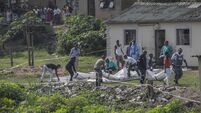
l The US military yesterday announced the discovery of another mass grave, this one believed filled with as many as 400 Kurdish women and children allegedly executed by Saddam's forces.
Soldiers found the grave next to a dry riverbed in Hatra, 200 miles north of the capital. An assessment team was sent to the site. About 25 sets of remains all women and children have been pulled from the grave, each with a bullet hole in the skull.
Since the end of the war, dozens of mass graves have been discovered many of them containing hundreds of bodies. The UN is investigating the killing or disappearance of at least 300,000 Iraqis believed murdered by Saddam's regime.