An absolute right, for some of the people some of the time

THE headline could hardly be more apposite: “Was it something we said?” It was indeed something they said as, even now, a section of American society has still not forgiven the Dixie Chicks for speaking out against George W Bush on the eve of the invasion of Iraq.
It happened during a concert at Shepherd’s Bush Empire in London on March 10, 2003. The Texan bluegrass trio were about to perform ‘Travellin’ Soldier’, a song about a heartsick Vietnam GI, when lead singer Natalie Maines leaned into the microphone and quipped: “Just so you know, we’re ashamed that the president of the United States is from Texas.”
Little could Maines have realised the impact those comments would make.
“Those remarks were picked up by the US media and a firestorm ensued,” wrote Dan Glaister from Los Angeles, “with calls for boycotts of the band’s albums and concerts amid allegations that they were unpatriotic and disrespectful to the office of the President. All three members of the group received death threats.”
Reports of the anti-Bush remarks got back to the US just in time to coincide with the outbreak of war in Iraq.
“Sales of the Dixie Chicks’ records plummeted as US country music stations refused to play them,” wrote Helen Barlow.
Although they became pariahs in their home state of Texas, the Dixie Chicks remained resolute n their opposition to Bush. “We have no regrets,” said Maines.
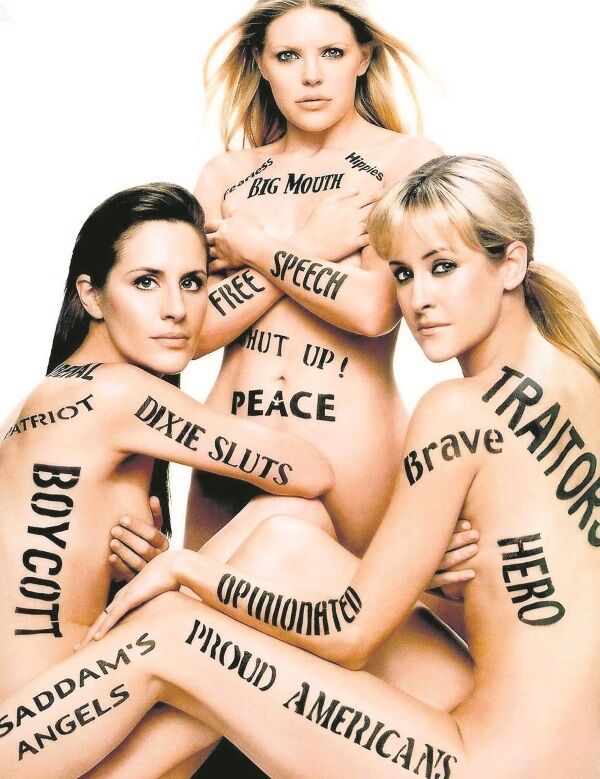
Music journalist Lynsey Hanley described how far their defiance went: “Within weeks of the singer’s innocuous-sounding comment, made to made to an audience of just over 2,000 sitting an ocean away from her Texas home, Maines and her bandmates, banjo player Emily Robison and fiddler Martie Maguire, were posing naked — with strategically placed hands, of course — on the cover of US magazine Entertainment Weekly, mock-tattooed with the most printable of the names they had been called in the previous month: Sluts, Traitors, Saddam’s Angels.”
Later, the photograph would be reproduced on the cover of a 2006 DVD featuring a documentary on the band and provocatively entitled Shut Up & Sing. It carried the following subtitle: “Freedom Of Speech Is Fine, As Long As You Don’t Do It In Public.”
Four years after the controversy, the Dixie Chicks swept the Grammy Awards in Los Angeles as they carried off five prizes as the annual music industry celebration, including the three major categories. As she collected an award, Maines said: “I think people are using their freedom of speech with all these awards.”
In between, the trio had returned to Shepherd’s Bush for another concert. The chest-height slogan on the T-shirts on sale in the foyer proclaimed “The Bush We Trust Is Shepherd’s Bush”, and outside a woman held aloft a large placard declaring: “The Dixie Chicks Were Right!”
The episode illustrates the schizophrenic approach to free speech, especially in a country where the constitution, and its First Amendment in particular, are venerated.
Although the Dixie Chicks won five awards at the Grammys in February 2007, Shane Hegarty wrote in the Irish Times that it didn’t mean that all had been forgiven. Yes, they were the first act to win best record, album, and single in 14 years.
“But it doesn’t represent a triumphal return, because the row continues to represent country music’s proud and undying patriotism, the easily triggered sensitivities that divide the US, that country’s distorted notions of free speech, the cultural gulf between red and blue states, and the power of the broadcasting monoliths. But most of all, it came to represent just how retarded political debate is within certain strata of American culture.”
So what of the much-vaunted right to free speech, without which any meaningful political debate would be impossible?
In his book The Irony of Free Speech, Owen M Fiss tells us that while freedom of speech is among our most cherished rights, it has always been a contested domain: “For most of this century, it has been the subject of countless judicial battles and has sharply divided the Supreme Court.”
Indeed, the Pentagon Papers case of the early 1970s was one of the most fractious episodes in US Supreme Court history, involving a dispute between the Attorney General of the United States and two highly respected newspapers, the New York Times and the Washington Post, and it left the justices at odds with one another.
Freedom of speech has also been fiercely debated within political circles, on the campuses of the nation, and even around the dinner table – in contexts ranging from the 1921 trial of Sacco and Vanzetti to the anti-Communist crusade of the 1950s.”
Fiss acknowledges that, to some observers, the current controversies (he was writing in the 1990s) over freedom of speech may not seem especially noteworthy: “The issue may have changed — instead of subversion and the alleged Communist menace, we now are preoccupied with such topics as hate speech and campaign finance — yet the divisions and passions they engender are all too familiar.”
Were he writing today, he might well refer to the unprecedented assault on our most basic rights (not least the right to freedom of expression) in the name of security (an offshoot of the ‘war on terror’ after 9/11, of which the Dixie Chicks episode forms a part), as well as controversies over pornography.
In an address to journalists in 2003, the film actor and director Tim Robbins sought to highlight how, in the period since 9/11, American democracy was being compromised. “
Our ability to disagree, and our inherent right to question our leaders and to criticise their actions, define who we are,” he said.
“To allow these rights to be taken away out of fear, to punish people for their beliefs, to limit access in the media to differing opinions, is to acknowledge our democracy’s defeat.”
Writing of the “reality and ideology” of free speech, law professor and author David Kairys reminds us that the “basic principle that individuals and groups have the ability to express different and unpopular views without prior restraint or punishment is a necessary element in any democratic society”.
Back in 1927, Justice Louis Brandeis of the US Supreme Court wrote that “freedom to think as you will and to speak as you think are means indispensable to the discovery and spread of political truth”.
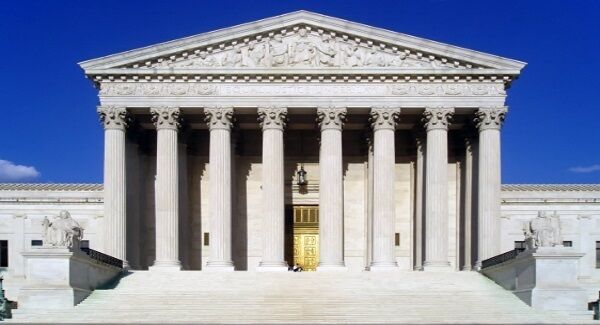
In a more modern context, the European Court of Human Rights stated in 1986 that “freedom of expression, as secured in paragraph 1 of Article 10, constitutes one of the essential foundations of a democratic society and one of the basic conditions for its progress and for each individual’s self-fulfilment”.
That said, we also know that free speech never happens in a vacuum. In describing the exercise of free speech in the public square, we must always be aware that there is always a context. Free speech always has a setting — it is always contextualised, culturally, socially or politically, and this context imposes constraints and limits.
Writing in 1965, Justice William Brennan of the US Supreme Court, who was famously described as the “liberator of the press” in one obituary after his death in 1997, said that even those who held an “absolute” view of the First Amendment would not deny that government had the power to regulate the manner and conditions under which speech protected by the First Amendment is exercised.
He said all schools of thought were in substantial agreement that government has some power to regulate the “how” and “where” of the exercise of free speech.
“Government is not powerless to say that you cannot blare by loudspeaker the words of the First Amendment in a residential neighbourhood in the dead of night, or litter the streets with copies of the text,” said Justice Brennan.
“In other words, though the speech itself be under the First Amendment, the manner of its exercise or its collateral aspects may fall beyond the scope of the Amendment. The disagreements are over whether and to what extent government may regulate or suppress speech at places where the speaker has a right to be.”
We know that the freedom to speak is never untrammelled, unless one is exercising this freedom on a desert island. The right to free speech is not and cannot be absolute. Other rights also have their claims.
In a speech to an Irish Times/Harvard University Colloquium in Boston in October 1998, the then President Mary McAleese dwelt on this. “Indeed, it is clear that the right of free speech is not absolute even within the United States,” she said. “In this country, obscenity is prohibited and indecency circumscribed. There are remedies for libel and sexual harassment.
“Also, ‘fighting words’ which are likely to make the person to whom they are addressed commit an act of violence are inhibited.”
McAleese also drew the attention of her audience to the fact that, for its part, the United Nations Universal Declaration of Human Rights reminds us that freedom of expression is balanced by other obligations.
The declaration states that: “Everyone has duties to the community in which alone the free and full development of his personality is possible” and that in the “exercise of his rights and freedoms, everyone shall be subject only to such limitations as are determined by law solely for the purpose of securing the recognition and respect for the rights and freedoms of others and of meeting the just requirements of morality, public order and the general welfare in a democratic society.”
McAleese was also concerned by what Justice Brennan described as the “collateral aspects” of the exercise of the right of free speech, drawing in particular on experiences in the North.
“If you have experienced the wounding power of symbols and of language, you may not readily agree in adulthood with the sentiments of that reassuring refrain which is used by children and which goes: Sticks and stones may break my bones but names will never hurt me,” she said.
“Name-calling, words, and even tunes, can and do hurt. They can hurt deeply, offend and inflame. Language is sometimes a signal by the aggressive that exclusion and persecution will be tolerated. It can chill dissent and inflict psychological damage.
“Certainly, many legislatures have codes designed to criminalise conduct which steps over a threshold into incitement to hatred or violence. But these codes have often been accused of being inadequate.
“I do not dispute the thesis that to embrace freedom of speech means having to listen to things which we do not like and things with which we profoundly disagree. What I do say is that the right of free speech can be enhanced. How? By ensuring that those who feel wounded by hateful expression have an effective means of being heard and of remedying any harm done to them by the barbs contained in those words.”
While acknowledging freedom of expression is “a precious human right”, McAleese, who served as Reid Professor of Law at Trinity College Dublin, before she entered politics, said our defence of this freedom “can only be enhanced in the end by our concern for the victims of its abuse”.
“Those of us who believe that words can hurt are seeking a balance,” she said. “We do not wish a treasured human right to be hedged in by so many qualifications that the right itself becomes more theoretical than actual.”
The right of free speech is guaranteed in virtually every constitution and relevant international human rights instrument. This list includes the Irish Constitution.
The right of free speech is generally considered to be a key fundamental right and, in this respect, the language of the German Constitutional Court in its celebrated decision in 1958 cannot be improved upon. The basic right to freedom of opinion is the most immediate expression of the human personality in society and, as such, is one of the noblest of human rights. It is absolutely basic to a liberal-democratic order because it alone makes possible the constant intellectual exchange and the contest among opinions that form the lifeblood of such an order; it is the matrix, the indispensable condition of nearly every other form of freedom.
It may be the noblest of rights, yet, as we have seen, it is often hedged around by many qualifications. In crafting the opinion of the US Supreme Court in Chaplinsky v New Hampshire, Justice Frank Murphy wrote: “..it is well understood that the right of free speech is not absolute at all times and under all circumstances”.
In the more local context of the Irish Supreme Court, the same point was made by Mrs Justice Denham (now Chief Justice) in O’Brien v Mirror Group Newspapers: “The right to communicate, the right to information and the right to freedom of expression, guaranteed by Article 40.3.1 and 40.6.1 (i) of the Constitution of Ireland, are similar to the right of freedom of expression guaranteed by art.10 of the European Convention on Human Rights. The rights guaranteed in the Irish Constitution are not absolute, neither are the rights of the European Convention.”
This clearly establishes that the right of free speech may, in certain circumstances, be limited and qualified. The danger is that this hedging around can occur perhaps even to the extent of rendering this right “more theoretical than actual” (to quote Mrs McAleese) in some jurisdictions.
In 2016, freedom of expression faces new and dangerous challenges. The massacre at the offices of the satirical magazine Charlie Hebdo in Paris on January 7, 2015, in which 17 people were murdered by jihadists, has come to be seen by some as an historical turning point.
Islamist extremists were prepared to use Kalashnikovs to enforce the ultimate sanction against freedom of expression. The magazine was portrayed as a symbol of press freedom and Franc’s secular values.
Writing of the those killings in his new book Trigger Warning: Is the Fear of Being Offensive Killing Free Speech?, Mick Hume said: “The murderous attack at the magazine’s Paris office in January 2015 did not really alter the argument about the urgent need to defend free speech, but that massacre and the reactions to it certainly brought the issues into focus,”
The real historical turning point occurred 26 years earlier when, on Valentine’s Day 1989, the Ayatollah Khomeini of Iran issued a fatwa against writer Salman Rhusdie over his novel The Satanic Verses. Dealing with this in an article entitled ‘Assassins of the Mind’ in the February 2009 edition of Vanity Fair, author Christopher Hitchens described the fatwa as “the opening shot in a war on cultural freedom”.
According to Rushdie, we now “live in a climate where every publisher and editor and politician has to weigh in advance the possibility of violent Muslim reprisal”. That possibility has grown ever more real since the killings in Paris in 2015.
Hume, who defines ‘trigger warning’ as “a statement at the start of any piece of writing, video, etc, alerting the reader or viewer to the fact that it contains material they might find upsetting or offensive”, emphasises in his book that “free speech is threatened on two fronts: occasionally by bullets, but every day by buts”.
The increasing use of trigger warnings is due to the “buts” – the problem of people within the West saying “Yes it is free speech, but...” — to signal the limits of their support for the fundamental principle.
“There is no equivalence, of course, between bullets and buts, between violent assaults on free speech and equivocal endorsements of it,” says Hume. “Might it be, however, that the weakening of support for free speech in the West, signalled by the rising chorus of ‘buts’ attached to it, has encouraged those few willing to take more forceful action to put a stop to what they deem offensive?”
Intolerance has now extended to the universities. Student bodies have launched campaigns to ban certain speakers from campus debates. The culture of ‘no-platforming’ is flourishing — in universities of all places. In a recent edition of the Observer, columnist Catherine Bennett addressed the new censorship: “When not dreaming of new kinds of censorship, under the guise of safe-space protection or trigger warnings, students are reviving blasphemy laws, defending pre-Philip Larkin-era sex segregation, piously policing the language so as not to upset local sectarians — objecting vehemently to words and acronyms that their politically correct parents had been assured were one hundred per cent acceptable.”
The most recent high- profile person to be targeted by the ‘no platform’ brigade was Germaine Greer, author of The Female Eunuch. Students at Cardiff University were angered by the issuing of an invitation to her to speak at a seminar on “Women & Power: The Lessons of the 20th Century”.
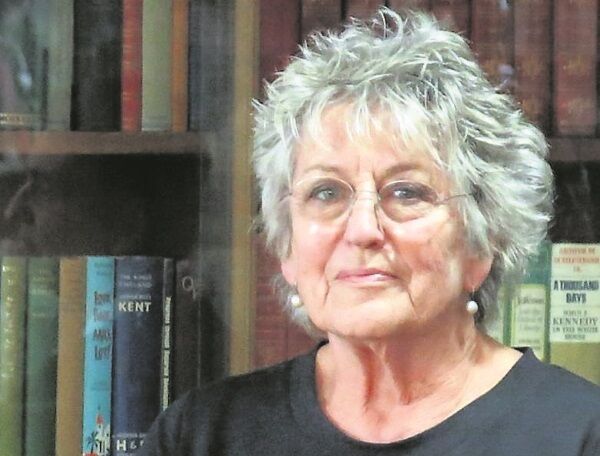
They wanted the invitation withdrawn and no platform provided. Why? A petition signed by several thousand claimed she had “misogynistic views towards trans women”. All of this because a little earlier, Greer, in her usual forthright manner, in a comment on transgender issues, said: “I don’t accept post-operative males as females. I don’t believe a woman is a man without a cock. You can beat me over the head with a baseball bat. I still won’t change my mind.”
The lecture went ahead, but the saga in Cardiff caused a fierce debate about free speech and the practice of ‘no platforming’ speakers who are unpopular with some. Nicola Dandridge, chief executive of Universities UK, said the growing trend of “no platforming” speakers poses a risk to the institutions’ “fundamental mission” by curtailing free speech.
“We are living,” says Hunt, “in the age of the reverse-Voltaires, who would far rather close down debate than suffer others’ freedom of speech, and whose core belief can be summarised as ‘I know I will detest what you say, and I will fight to the end of free speech for my right to prevent you saying it’. The reverse-Voltaires love trigger warnings , which enable them to tell us what we should — and more importantly, should not — see, read or hear, for our own good of course.”
Hitchens is surely right: “The only thing that should be upheld at all costs and without qualification is the right of free expression, because if that goes, then so do all other claims of right as well.”
CONNECT WITH US TODAY



Be the first to know the latest news and updates