The Premier League’s Big Six problem isn’t going away
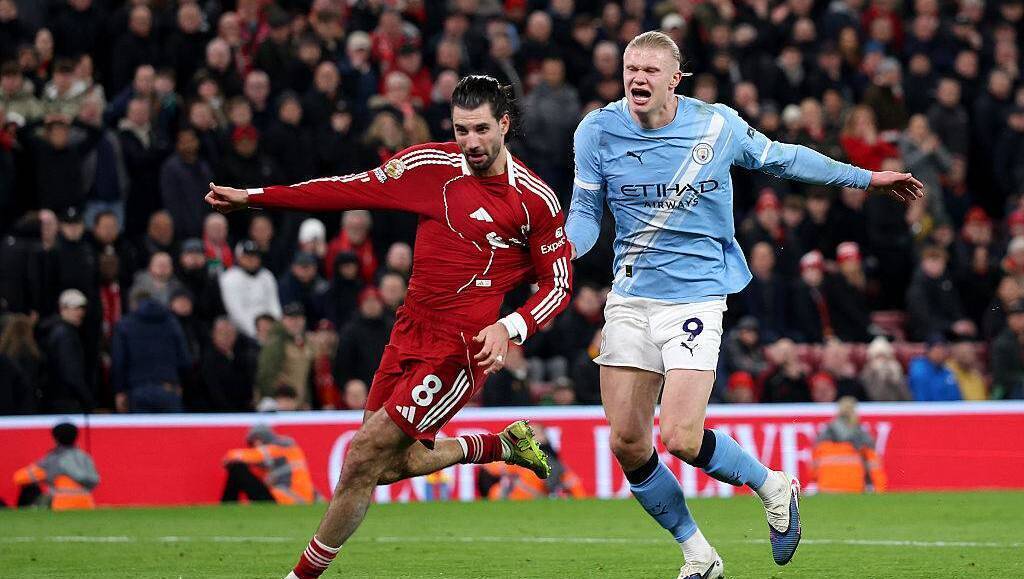
Draw up a league table from September 2006 to today and Man Cit and Liverpool occupy the top two spots. Pic: Michael Regan/Getty Images
It is 17 years since Didier Drogba made a prescient prediction about the shape of the Premier League. The new order would look much like the old one, only with room for a couple more at the top table.
"It will no longer be the 'Big Four', but the 'Big Five' or 'Big Six'," he said before the start of the 2009/10 season. The Chelsea forward could see the game shifting beneath him, towards a larger elite with much the same advantages.
Look where it has brought us. It has been a summer defined by arguments over financial rules supposedly designed to protect clubs, but which Aston Villa and Newcastle United believe are also restricting their ambition in the transfer market.
The Premier League was originally born from a meeting of the 'Big Five' clubs of the 1980s: Liverpool, Everton, Arsenal, Tottenham and Man United. Draw up a league table from September 2006 to today and Man City, Liverpool, Man United, Arsenal, Chelsea and Spurs occupy the top six places, in that order. Make up one covering only the last five years and there is one notable change: Aston Villa are fourth, while Spurs have slipped to ninth. Newcastle United are seventh.
While certain members of the establishment have waxed and waned over the last two decades, their financial advantage has largely endured. Profit and Sustainability Rules (PSR) have prevented dramatic increases in wage budgets while also encouraging the sale of academy graduates. Bruno Guimaraes’ £75million move from Newcastle United to Arsenal only deepened the frustration.
So, first things first: if the current model is flawed, is there an alternative that works?
“I don't think there is, unfortunately,” says Dan Plumley, a Senior Lecturer in Sports Finance at Loughborough University.
“What I mean by that is, and I was an advocate for this type of approach before it came in and that is what I hang my hat on.
“I think it's better than what was, and if you look at some of the things in PSR and it was based around ultimately a profit or a loss figure, and there was that acceptable loss component, but it was based on everything around revenues and cost, and then you got into this scenario where we were looking at clubs selling assets to themselves and selling women's teams to themselves to comply with that, or to at least try and comply with those regulations. That can't happen now with this new squad cost. So there are some things that I think have been made better.
“I think the reality is that the challenge is football doesn't really want to go there. The only thing you're able to do is you can take the handbrake off completely and go to a world of no regulation again, which obviously the leagues and governing bodies don't want because they don't want the clubs to just spend recklessly without any control.
"Or you start talking about more American model principles of salary caps and revenue sharing, and again, we're back to distribution, and I just don't think that's feasible either.”
The conditions that produced the failed breakaway European Super League were laid by a competition which had spent three decades embracing relentless commercialisation and welcoming investment from almost anywhere.
This year, clubs will be bound by a new set of financial regulations, with Squad Cost Ratio (SCR) and Sustainability and Systemic Resilience (SSR) replacing PSR. For Christina Philippou, an Associate Professor in Accounting and Sports Finance at the University of Portsmouth, the difficulty is that every alternative brings complications of its own.
“If you look at hard caps that you've had in rugby union, for example, then the issue is, you set the hard cap in the wrong place, right? It's an absolute number.
“Then everybody uses it as target practice, which is what we saw in rugby union. The hard cap value was set too high. Everybody uses target practice. Three clubs went under. Not great either.
“Other alternatives, obviously, we've got parachute payments, which is a sort of add-on to the side. That has created issues with competitive balance, particularly in lower leagues. The problem you have is it's never going to be a simple solution.”
Previously, the Big Six was defined by league position. Increasingly, revenue dictates membership of this select group. That hardly matters to supporters, for whom being a fan has never meant considering allowable losses.
There is still a route to compete for the rest. Clubs outside that circle can qualify for Europe and tap into the considerable revenues available there. But the overarching problem is one of structural advantage: those already earning the most are best placed to keep earning it.
What of the common rebuttal to these restrictions? Even if football has reverted to something resembling its pre-covid habits, with sizeable operating losses filtering further down the ecosystem, who are regulators to tell a private owner how to spend their money? If an owner is willing to cover a shortfall, why should they not be allowed to do so?
“It's not necessarily that investors or owners are the problem, it's the ones that don't see the bigger picture and spend recklessly,” explains Plumley.
“For instance, I'm a Sheffield Wednesday fan and that's a great example of a club in the last 10 years that have had an owner that has just not paid any general attention to the regulations and has just continued to spend money and then runs out of money.
“At that point, the club is absolutely almost to the wall and you're talking about administration and involvement there. I think what the regulations are always there to do is to protect the catastrophic scenario.”
The sense of how self-perpetuating it has all become only sharpens the anger among the chasing pack. The consequences travel down the pyramid too. Parachute payments have helped create a cycle of relegation and promotion, while those trying to compete with recently relegated clubs are forced to spend simply to keep pace.
But beyond that obvious frustration, the central contradiction remains. The Premier League has rarely been stronger. Broadcast deals continue to deliver enormous revenues, its global appeal endures and its clubs still attract many of the best players in the world. The market power remains, as does the appetite to buy into it.
This is the game now. The hierarchy may be increasingly difficult to disturb, but that has not made the competition itself any less attractive.
“While saying nothing will change is quite a sobering kind of point, all things being equal, you and I could have this conversation in 10 years' time and be talking about the same successful clubs; the show goes on and people still want to buy into the show,” says Plumley.
“That is why I don't see it changing. I think it's bigger than the UK fan argument now. It is a global product and that's just the reality of it.”


CONNECT WITH US TODAY



Be the first to know the latest news and updates