Refereeing at this World Cup has been fine, we don’t need input of Tuchel and Trump
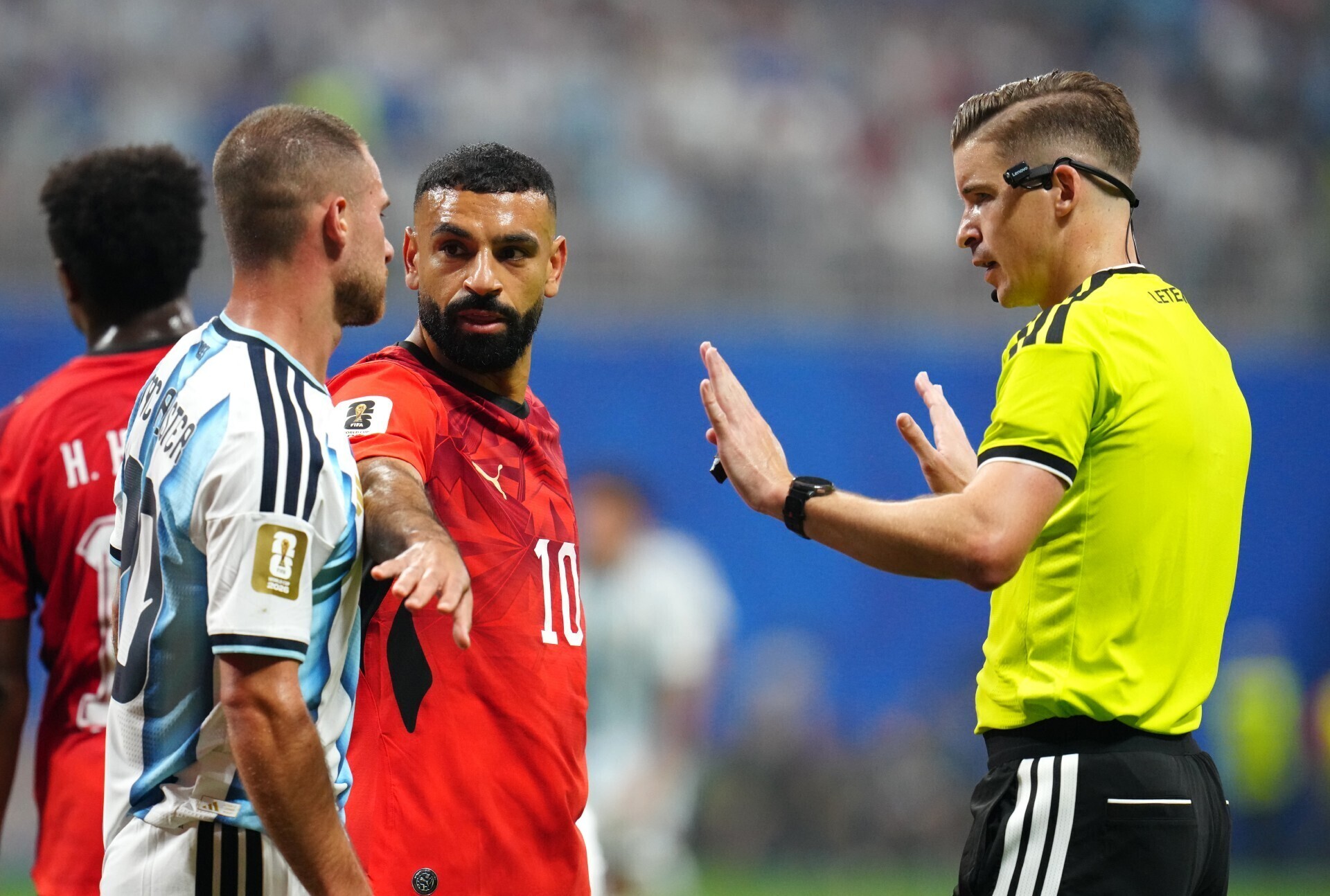
Argentina's Alexis Mac Allister and Egypt's Mohamed Salah appeal to referee Francois Letexier during the FIFA World Cup 2026 round of 16 match at the Atlanta Stadium. Picture: Nick Potts/PA Wire.
Thomas Tuchel was critical of the refereeing at the World Cup after England’s win against Mexico, describing it as unreliable, erratic and not good enough. His comments struck me as reverse psychology – the referees have generally been OK, with some positive decisions made, but there have also been occasions when they have not got things right. Like everyone, referees cannot be perfect.
Egypt claimed they were victims of an injustice against Argentina on Tuesday but the decisions to disallow an Egypt goal and let Argentina’s winner stand were correct. On the first one there was a foul by Marwan Attia on Lisandro Martínez in the attacking possession phase – a shirt pull and studs on Martínez’s right foot – and there is no time limit or ceiling on the number of passes to be taken into account.
One important factor is the ball kept moving forward, with no lateral or backwards passes, until the ball was in the net. It could have been one of the goals of the tournament but the simple fact is it was right to disallow it.
For Argentina’s late third goal Egypt felt there was a foul by Julián Alvarez on Mohamed Salah. People are drawing comparisons between that and the earlier incident because there is boot-on-boot contact, but it is a different situation. Alvarez plays the ball and there is then slight contact which does not meet the threshold for a foul or video assistant referee intervention.
The VAR did make an important intervention in the Mexico-England match – Jarell Quansah’s tackle on Jesús Gallardo was a red-card offence and I was surprised this was not picked up on-field by the referee, Alireza Faghani. After the VAR rightly recommended a review we got the correct outcome.
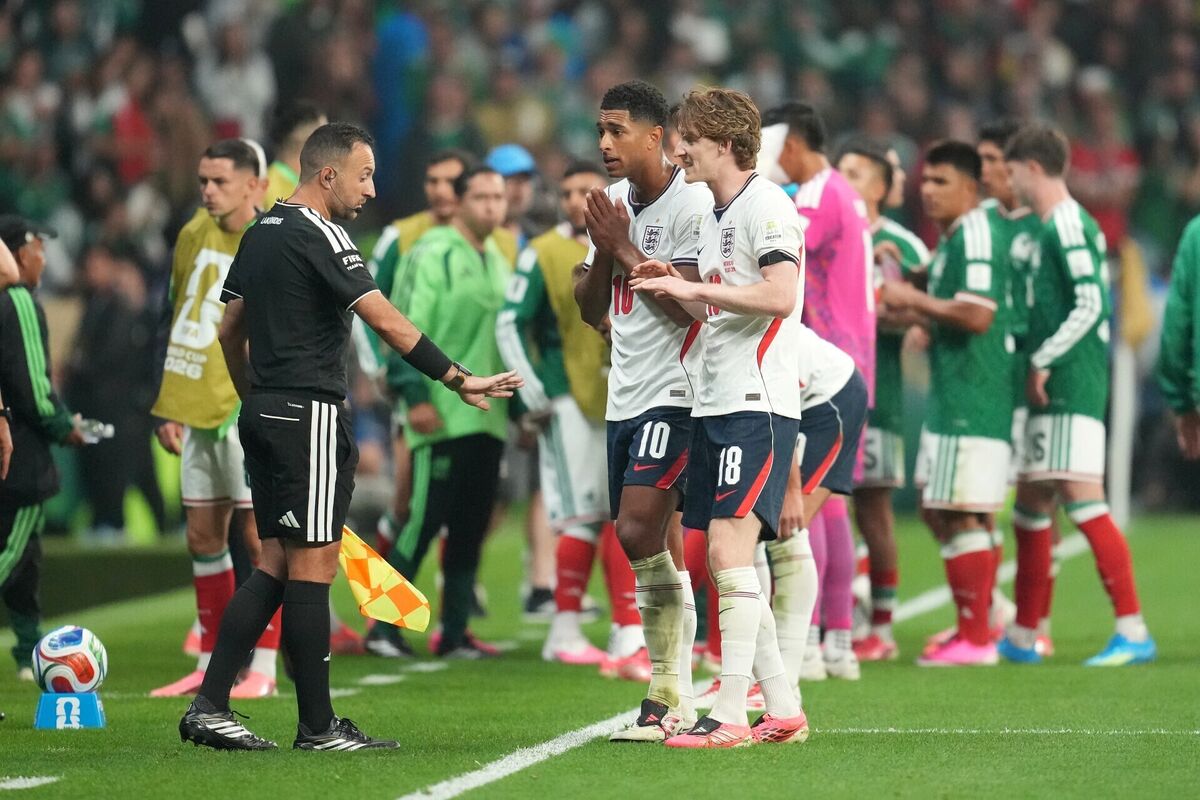
Tuchel was upset at a number of decisions that night. It was never going to be an easy assignment for the referee, what with the hype, weather conditions and the game being at the Azteca Stadium. But some of the players did not help by taking very little responsibility. They were feigning injury, showing dissent and questioning nigh-on every decision – and when the Quansah challenge happened the whole Mexico bench emptied out angrily. England reacted, and that got messy.
Read More
To hear England are considering an appeal against Quansah’s red card is surprising, but the Folarin Balogun situation has completely changed things. Historically there has been no scope for an appeal against a red card at a tournament, with a one-match ban automatically applied. I had never heard of Article 27 of the Fifa disciplinary code, which Fifa says it used to suspend the USA striker’s sanction.
Balogun’s sending-off was certainly supportable with the help of the video assistant. When I saw his challenge on Tarik Muharemovic of Bosnia and Herzegovina in real time I wasn’t sure whether it was a red-card offence, but it was for me on a replay, even if there was no malice. The clue was where the ball was, because it was not at a playable distance.
When you consider a possible red-card offence for a challenge, there are two key elements to think about: excessive force and endangering the safety of an opponent. With Balogun’s challenge the point of contact was on the calf, continued down the calf on to the achilles and caused an ankle roll. That could have caused serious injury.
The intervention of Donald Trump and Tuchel’s comments mean there is heightened noise around refereeing. As a referee you have to ignore that, and in elite officiating sports psychologists are there to help. I was never the best at getting rid of a bad decision – it would stay in my system for three to four days – but that’s different from letting it affect your performance. You have to be boring, and focus on the here and now.
There have been 13 red cards at this World Cup, after four at each of the previous two, but I don’t think there can be too many complaints. Player safety is paramount and Quansah and Balogun are a good example of where to draw the line. VAR has been used correctly for red cards not given on the field.
That is not to say that VAR interventions have been perfect – far from it. Vinícius Júnior’s disallowed goal for Brazil against Scotland, for example, was one where I felt the on-field decision of goal was right. It was minimal contact and not all contact is a foul, because contact is a normal part of football. This was not a clear and obvious error by the referee.
In those circumstances a “check complete” would be appropriate and you don’t need to re-referee. I thought Harry Kane should have had a penalty against the Democratic Republic of the Congo because contact was made on the England captain by the goalkeeper, Lionel Mpasi. But because it wasn’t a clear and obvious error I also felt it was the right decision by the video assistant to stick with the on-field verdict.
Where VAR was right to intervene on a penalty decision was to give France a spot-kick after Désiré Doué was fouled by Paraguay’s Diego Gómez. I was surprised that the referee, Ilgiz Tantashev, didn’t give that one on the field.
That game was another tough assignment, but the referee needed to be a lot stronger throughout. I was shocked that no Paraguay players were cautioned. Referees go out to manage a game but sometimes you have to draw a line and get the cards out. There were a number of incidents where Tantashev should have shown a yellow card, and because he didn’t Paraguay gained confidence. At one point his control of the match was put in jeopardy.
Fifa has clearly tweaked its approach to VAR and adopted a high bar for intervention, which we see in the Premier League. It has been interesting to see different styles of refereeing from different countries and confederations. But there are some fouls that are fouls throughout the world, and it really surprised me when Leroy Sané’s goal for Germany against Ecuador was allowed even after his teammate Aleksandar Pavlovic had kicked Pedro Vite in the head. When a goal is scored, the attacking possession phase is automatically checked by VAR, and for me that was a foul.
Pavlovic’s boot was higher than Declan Rice’s when the England midfielder was booked early in the Mexico game. All I can think is that the video assistant and the referee both felt that it was six and two-threes; that Vite had put his head down and that Pavlovic had put his boot up – and that therefore it didn’t meet the threshold.


CONNECT WITH US TODAY



Be the first to know the latest news and updates