One year on: A first goal, a ghost goal by Diogo Jota 
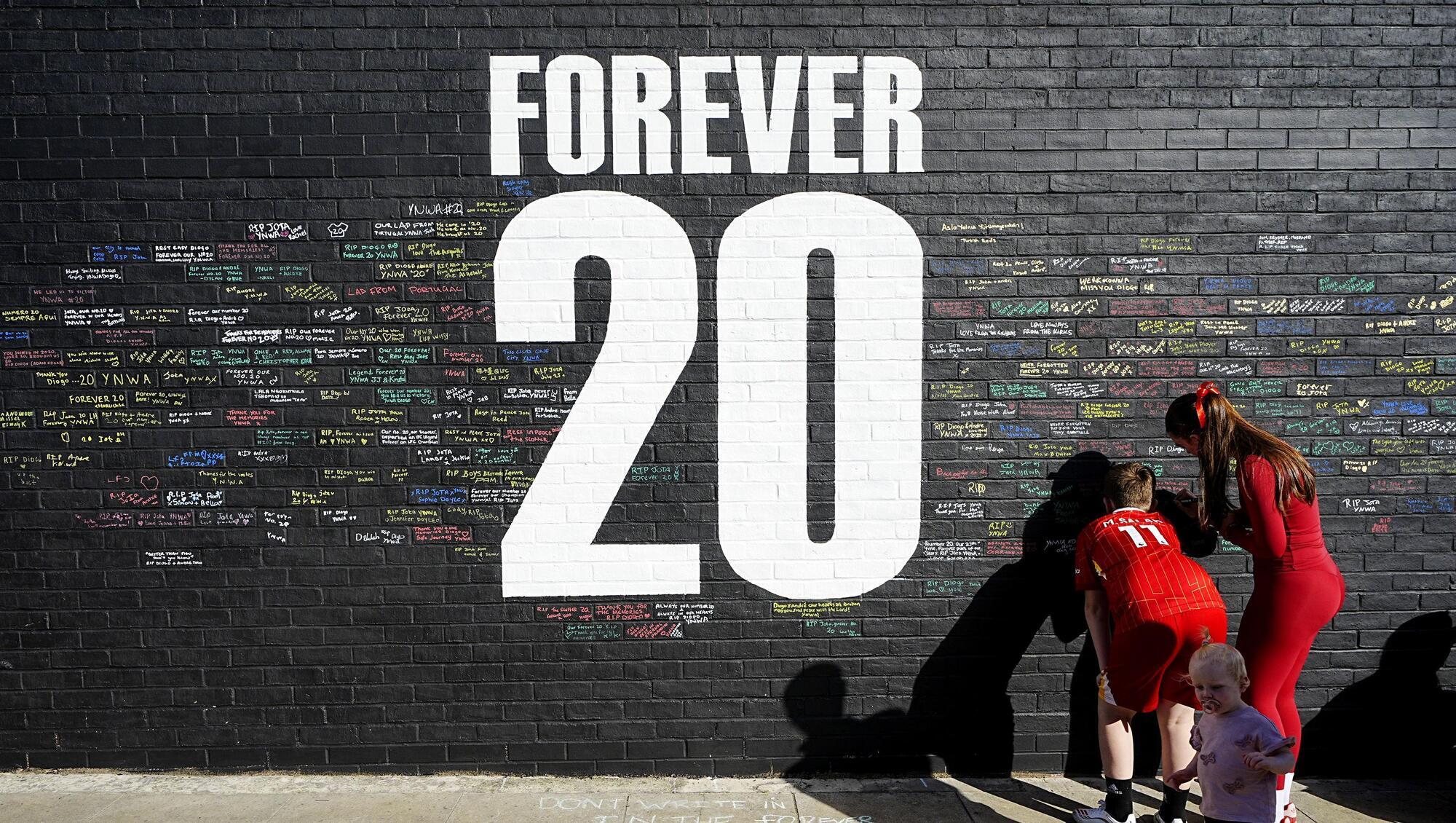
With the first anniversary of Jota’s death, I’ve been thinking a lot about that first goal. I’ve gone into YouTube many times to rewatch.
Fans sign a mural in memory of Liverpool player Diogo Jota, on Sybil Road near Anfield. Pic: Peter Byrne/PA Wire.

Fans sign a mural in memory of Liverpool player Diogo Jota, on Sybil Road near Anfield. Pic: Peter Byrne/PA Wire.

Liverpool’s first Premier League goal under Arne Slot? Where, when, who? No googling.

Over the last completely forgettable league season, I asked fellow reds this question. Brothers, friends in pubs, people in the stands at Anfield. I asked them when the conversation turned to how, after winning the title in Arne Slot’s first season as manager, the team could fall asunder so dramatically. Nobody remembers. You have to remind them, and they all always say “Oh yeah…” as if some painful ghost had been coaxed awake.

The first league goal of Slot’s doomed Liverpool tenure was scored by Diogo Jota at Portman Road, Ipswich, August 17th 2024.

I watched it with friends in a little café bar in the mountains of Portugal’s northeastern corner. We went in our jerseys and sat beneath a portable tv, surrounded by farmers eating lunch and discussing the drought. When we cheered that goal, they laughed and clapped along. It helped that the scorer was from Gondomar just down the road.

That goal would be the first of 86 scored by Liverpool in the league in 2024-25, a season that saw the club equalling the record of 20 league titles. Slot’s second season, as we all now know, was the kind of trainwreck that left fans and pundits alike scratching their heads. Twenty losses in all competition, a club record. How could a team that won the title at such a canter become overnight so easy to beat?

Virgil Van Dijk and Andy Robertson arrive at the funeral,

With the first anniversary of Jota’s death upon us, and Slot’s recent sacking, I’ve been thinking a lot about that first goal. I’ve gone into YouTube many times to rewatch.

Sixtieth minute. Mo drops to receive, lays it back to Trent who takes one touch before sliding a return thread through the old inside-right channel. The weight of the pass is such that Mo can simply square it in his stride to the penalty spot. Diogo lets it run across his body and glances it into the far corner with his left instep. Liverpudlian to Egyptian to Portuguese. 1-0.

All since gone. One, whom the Kop once serenaded as “the Scouser in our team”, left his boyhood club for Real Madrid. One aged suddenly and ultimately said an emotional farewell to Anfield. And one who lost his young life on a roadside in northern Spain.

I have come to believe that the seeds of last season’s implosion can be found in that first goal. It was not only the beginning, but also the beginning of the end. A ghost goal, call it, a goal of ghosts.

Tributes at Anfield Stadium.

Trent, the first link in its chain, put out a statement shortly before the end of the same season announcing his intention to leave. The following Saturday he was booed by home fans. Less than one year after leaving Liverpool, talking up his hopes of becoming the first right-back to win the Balon d’Or and his “legacy”, Trent was conspicuously left out of England’s squad for the current World Cup.

It was Salah who scored the second league goal under Arne Slot, five minutes after Jota scored the first. It was the eighth consecutive season that Salah had scored in the opening game of a league campaign. A new record. The 2024-25 season would be a season of records. His 28 goals and 19 assists set a new bar of 47 goal involvements in a 38-game season, the most by any player in European football. And yet, when UEFA announced its team of the season on June 1st, 2025, the name of Mohammad Salah was bafflingly absent.

Salah’s fall-off in 2025-26 made for stark statistics. Seven league goals, six assists. In Trent, he had lost his principle supplier. He had lost also that crucial yard, and suddenly the ball was bouncing off him.

In December, after an away draw at Leeds, Salah approached journalists to claim that he had been “thrown under the bus”, that he and Slot had zero relationship. At the end of March, he announced that 2025-26 would be his final season at Anfield. In May, between the season’s penultimate and ultimate games, he tweeted that the club needed to return to the “heavy metal” style patented by Jurgen Klopp. Get rid or suffer next season the same turgid fate.

And finally there is Diogo. He joined Liverpool from Wolves during the pandemic season, scoring his first goals in red to empty stadiums and piped crowd roars. Is it disrespectful to recall now that, seconds before he did score in Portman Road, he missed a sitter from six yards out? He could be that kind of player, brilliant and infuriating in equal measure. When the ball hits the net second chance of asking, he peels away towards the travelling fans in shadow on the far side, his big toothy smile and his shark-bite celebration.

Diogo Jota celebrates scoring the first goal of Liverpool's title winning season. Pic: Bradley Collyer/PA Wire.

Recurring muscle injury would mean Jota started only 26 games that season, scoring 6 league goals, his lowest return. He married his childhood sweetheart in June, 2025. In the first week of July, due to report to Liverpool for pre-season, he was advised not to fly since he had just undergone treatment for pneumothorax. He chose to drive in the small hours from Porto to the ferry in Santander, his brother André in the passenger seat to help Diogo stay awake.

The A-52 is a mountainous dual carriageway half an hour from where I live half the year. I’ve driven it many times, reluctantly, to that same ferry.

At half past midnight on July 3rd Jota’s lime green Lamborghini Huracän had a blowout passing at high speed in the fast lane and crashed into the central reservation. Within hours there was footage on social media, 23 horrifying seconds from the dashcam of a passing truck. Tyre marks and bits of debris lit by headlights, before passing an immense car-shaped inferno that had – we now know – Diogo and his brother at its centre.

They were buried in Gondomar two days later. I drove there on the morning of the burial and stood in my Liverpool jersey behind crowd barriers. When the players filed past, black suits and heads bowed, they were applauded. Most of Jota’s Liverpool teammates were present, as were André’s from nearby Penafiel. Virgil Van Dijk and Andy Robertson carried floral tributes. There were also many from the Portuguese national team.

I spoke to locals in my pidgin Portuguese. We listened to the readings and prayers via speakers out the front. I even met the guy who fitted the submersible pump in our well, Senhor Luis. He told me about his lifelong love of Liverpool inherited from his father, about knowing Diogo’s family.

The most notable absences were, yes, the other two points in the triangle of that first goal. Trent, already a Galactico, was playing for Real against Borussia Dortmund in the World Club Championship. Salah was more vague: something about family commitments and religious differences. He was, however, visibly distraught at tributes before and after the first league game of the 2025-26 season.

Are professional athletes allowed to grieve? Apparently not, on the evidence of responses to last season’s hopeless title defence. Ex-pros, pundits, podcasters and Liverpool fans more than anyone, myself included, were quick to brand this team the worst champions ever. Grief, the received wisdom goes, can never be a mitigating factor in diminished performance. Both Slot and his team were scrupulous in refusing to use Jota’s death as an excuse.

Andy Robertson, in the final week of last season, his last as a Liverpool player, recalled the impact of the loss of Jota on the whole squad. “Football didn’t matter,” he told reporters. “We didn’t care about football for weeks. None of us wanted to train."

"I’ve often heard players say they were suffering from depression,” Ibrahim Konate recently told French radio, “and that fans or people on the outside didn’t understand because they were earning a lot of money.”

Konate, whose own father also passed away during last season, echoed Robertson’s sentiments regarding the impact of Jota’s death: “It devastated me,” he said. “I didn’t have any interest in anything else at that point. You go back to football because you have no choice. We’re employees at a club that pays us every month.”

The 2025-26 season, truth is, was haunted by Diogo Jota. For weeks, goal-scorers all over Europe mimicked the shark-bite and FIFA PlayStation celebrations in Jota’s honour. His no20 jersey was retired, the first time the club has done that, and on the twentieth minute of every game Liverpool fans stood in unison and sung “Oh his name is Diogo!”

By the season’s end, that completely sincere tribute had become a weird lull. Every game ground to a standstill and the players, as if conscious nobody was paying attention, ended up passing it around to kill time. Every Liverpool fixture was effectively 89 minutes plus stoppage. Every match had a dead, phantom minute embedded within.

Imagine how strange and unnerving it must have been for those new players arriving between Slot’s first and second seasons. Wirtz, Ekitiké, Frimpong, Kerkez, Isak, Mamardashvilli… Virtually the first act of each in a Liverpool jersey was to stand in silent memory of a someone they presumably never knew.

Caomhín Kelleher had already moved to Brentford by the time of the funeral. In February of this year he told the BBC that he felt being away from Anfield had spared him some of the trauma.

“People expect you to move on quite quickly, and I don't think that’s the case," Kelleher said. “I find it a bit strange and a bit difficult when I hear people speaking about the players at Liverpool and the performances, because I don’t think this season is important from a football aspect for them.”

Last November, immediately after Scotland’s qualification for the World Cup, Roberston spoke perhaps more movingly than anyone about his late friend. “I’ve been in bits all day, I couldn’t get my mate Diogo Jota out of my head,” he said fighting back tears. “We spoke so much about going to the World Cup because he missed the last one with Portugal and I did with Scotland. I know he’ll be smiling over me.”

The more I think about it, 2025-26 was only ever going to be a season of memorials and valedictions. Jota, Trent, Salah, Robertson, Konate… And now poor old Arne Slot, who throughout was at once admirably dignified and hopelessly out of his depth.

Dropping that 20th-minute tribute for the 2026-27 has become, I see, a theme on Liverpool fan sites. I drove past the point of the accident only last week and all the floral wreaths were looking fairly withered.

Time to move on. “Grief, real grief, is relatively short,” Richard Ford reminds us in his great novel, The Sportswriter, “though mourning can be long.” Though the grief must now end, Diogo Jota will be mourned a long while yet.

And he will remain forever in those flickers on a screen, that first goal. Trent threads through to Mo, who squares to Diogo, who ripples the side-netting and peels away towards the cheering shadows.

x

More in this section

Sport

Newsletter

Sign up to our daily sports bulletin, delivered straight to your inbox at 5pm. Subscribers also receive an exclusive email from our sports desk editors every Friday evening looking forward to the weekend's sporting action.

Cookie Policy Privacy Policy Brand Safety FAQ Help Contact Us Terms and Conditions

© Examiner Echo Group Limited