Total Pep has fun but Arsenal will worry about display of collective amnesia
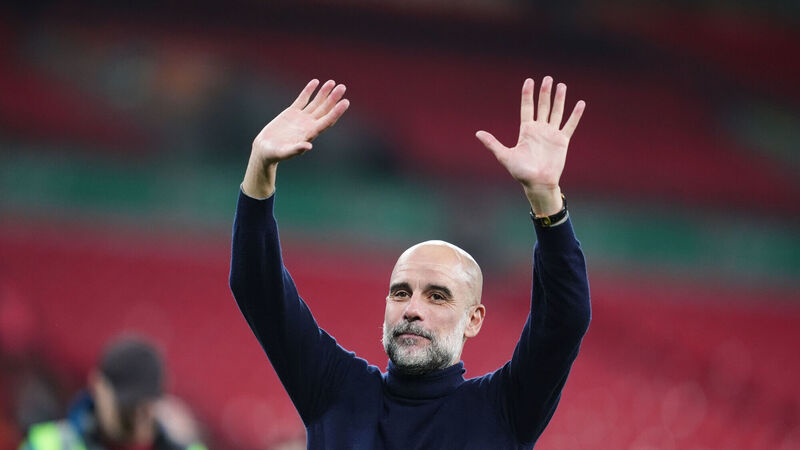
Manchester City manager Pep Guardiola after winning the Carabao Cup Final at Wembley. Pic: Adam Davy/PA Wire.
When the first Manchester City goal went in, with the Wembley clock on 60 minutes, Pep Guardiola’s response was to attack a pitchside hoarding – but to do even this in a very Pep kind of way, methodically, relentlessly trousers billowing, brown lace-ups whirring in perfect concert, like an uncle doing the running man at a wedding.
When the second goal was scored four minutes later, the trophy-clincher, and Nico O’Reilly’s second of the afternoon, Guardiola was up and off down the touchline, bounding, star jumping, revolving his arms. There he goes, out there kicking down saloon doors, karate chopping blocks of concrete, bending iron bars with his bare hands.
And why not? Finals aren’t supposed to be fun. This one was. Finals are supposed to be close. This one most certainly was not. In the event City spent almost the entire live period of this Carabao Cup final victory walking Arsenal around the Wembley turf in a headlock. Above all this was an afternoon of Total Pep.
Guardiola even looked great out there. After the grunge tailoring of Madrid in midweek, Wembley got deep brown high-end baggy slacks and the classic roll neck sweater (think: Captain Haddock at a point-to-point). And for long periods this was like watching peak Imperial City, playing like this is their space, their grass, like the ball is only ever on loan, their opponents a necessary structural peg in the overall design.
City didn’t just dominate the ball but all of the spaces in between when they didn’t have it, the midfield duo Rodri and Bernardo Silva, in full ambling football-dad mode. From here they have a shot at a domestic treble. But of course this is a defeat that will speak to Arsenal just as loudly.
And in many ways the Arsenal arc from here is more interesting. We know Guardiola and this City team are very, very good at winning trophies. How good are Arsenal at losing them?
Before this final the talk of having to win the EFL Cup or face the prospect of total collapse had always seemed ludicrously harsh and over-dramatic. This isn’t what happens. Teams survive every year despite not winning everything. And the wheels may simply snap straight back on in two weeks when the league programme restarts. A poor performance is just a poor performance.
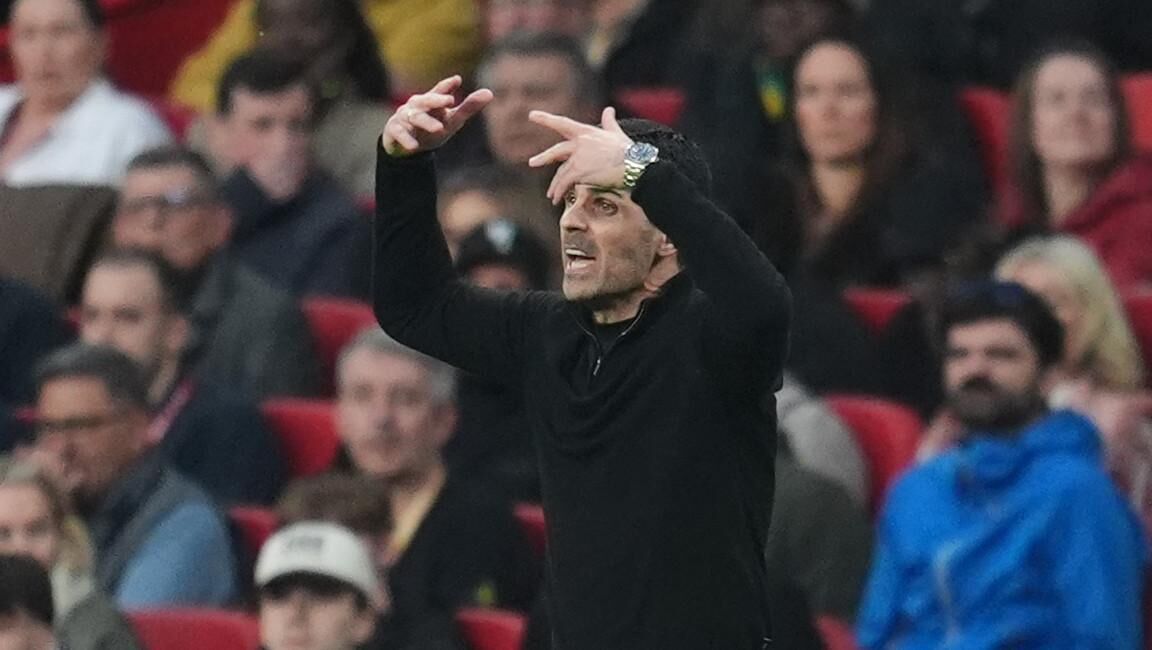
But this wasn’t just that. It was instead a truly dreadful performance, as poor a display from a table-topping, glory-chasing team as you’re likely to see. Being outplayed is one thing. Losing on the details: this happens. Here, in a key domestic final against their closest rivals, Arsenal’s internal architecture just collapsed.
A team built out of intensity and patterns showed: no intensity, no patterns. For the middle period they looked like a team in the grip of a collective amnesia. What, exactly, are we doing out here? Who are these people watching? What is this inflated sphere? At 2-0 down Ben White was booked for hacking down Rayan Cherki, a righteous response to Cherki doing keep-ups by the touchline, and you felt this was probably Arsenal’s best moment of the entire afternoon. At least it felt real and raw and human.
Perhaps more alarming, Arsenal started well. Wembley is always so much more alive on these club football days, transformed from deep grey corporate leisure-drome, basically some people waiting to get on the tube, into a place full of fire and crackle and borrowed electricity.
The blue and red halves. The puffs of fire and smoke. The mess of pre-match flags, carted about by what looked like the entire remains of the standing British military. This had the usual village fete energy, the sense of some cheerful spring rite in train.
And for the briefest interlude we had an actual contest. With six minutes gone Arsenal brought a double save from James Trafford. With 12 minutes gone they had their first corner. And that was pretty much that.
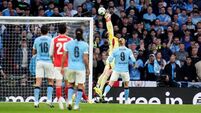
The midfield came unglued almost immediately. Everyone seemed rushed, everyone played badly, in a way that felt chronic and contagious, a collective shirking from the light. Kepa Arrizabalaga had a calamitous role in the opening goal. But it was always, always coming, one way or another. Why, when your keeper is so key to the way you play, would you pick a second stringer for a game like this?
City played with real width, as Guardiola started with two outright wingers. This seemed to throw Arteta’s planning completely. And when their own narrow range of variations fails all you really see are the absences in this Arsenal team. Here they lacked ball carriers, dribblers, anyone who looked likely to beat a man and find some time and space. They lacked any sense of spontaneity or invention. At times like these watching Bukayo Saka is like watching a broken computer game, same patterns, the same run, same steps, like one of those dance crazes in the 1930s you learned from a set of stencilled foot-steps. Do the Saka. Forward, left, left, left, back, left stop.
At the very least a slow-burn season is perfectly poised now. These teams will meet again on 19 April. It will be fascinating to watch how Arteta goes about reviving that internal sense of momentum, energy, team libido before then. They do at least have a chance to show genuine resilience in battling back from a final this bad. How cruel does this game want to be? How steep is that arc? This Arsenal team have, at the very least, become deeply, unavoidably watchable.
Guardian


CONNECT WITH US TODAY



Be the first to know the latest news and updates