Arteta’s ruthless cyborgs malfunction as improvised excellence overcomes the machine
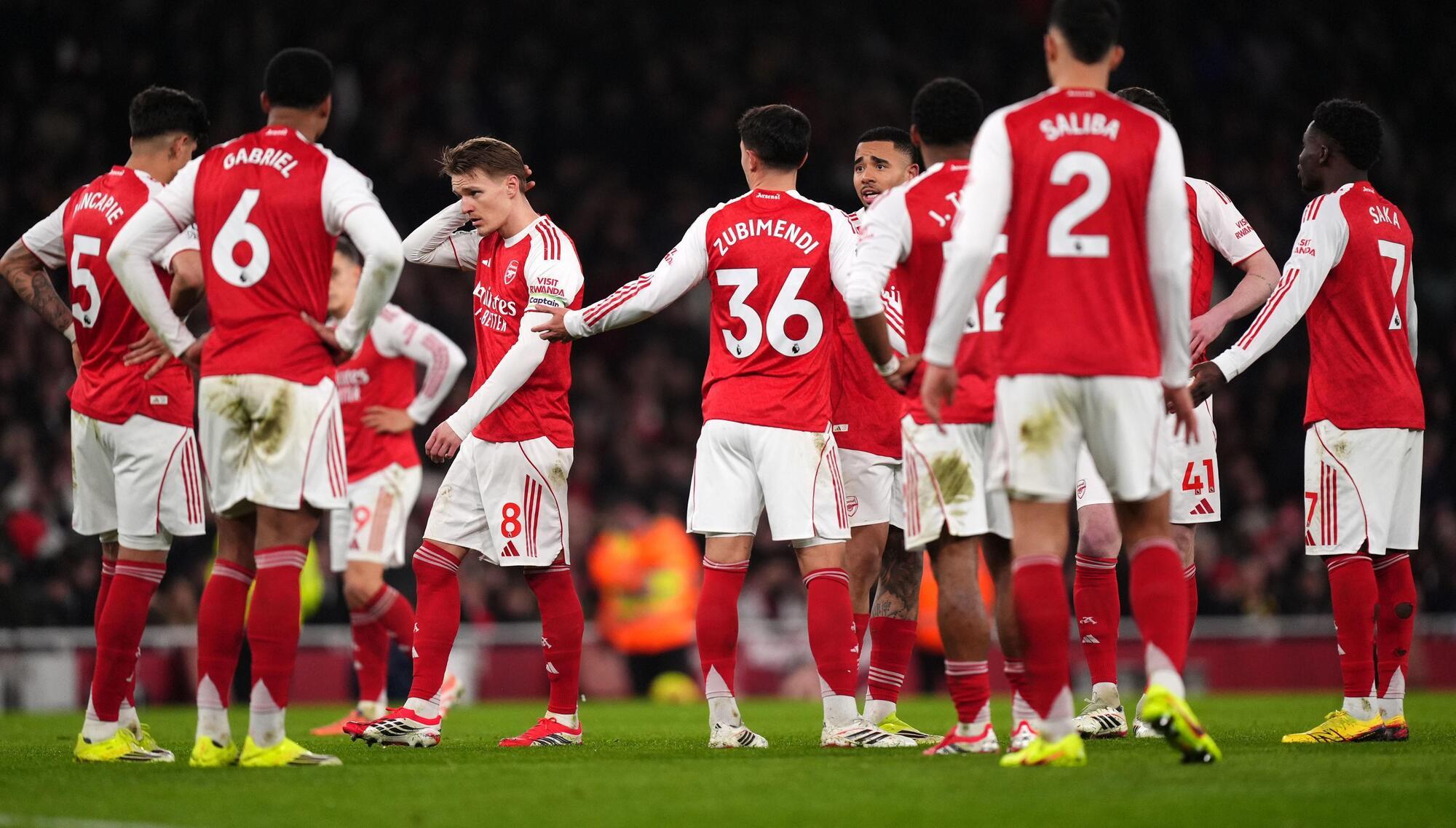
Arsenal's Martin Odegaard (left centre) and team-mates appear dejected after Manchester United score their second goal. Photo: Mike Egerton/PA Wire.
And then the gap was down to four points. It is still four points, but the thought that Arsenal will struggle to suppress is that it could have been more, that it should have been more.
Manchester City have won only one of their past five in the league, but Arsenal have not opened up clear water. Against Liverpool and Nottingham Forest, they failed to take advantage of City slip‑ups, drawing both those games 0-0, and that left them vulnerable to a game such as this. From an Arsenal point of view, the title race is disturbingly alive.
Arsenal should be fine. They have been the best team in the league so far. They’ve been the best team in the Champions League. They’ve lost only three times all season. They have a good claim to be the best side in the world right now. But there will be inevitable nibbles of doubt: Arsenal have still to go to the Etihad Stadium in April; lose that and the gap will be one; and that means the pressure is on; one slip-up and the lead could be City’s …
There is no reason for such negativity; there has been nothing to suggest City are about to embark upon a remorseless winning run. But when a team have not won the league in 22 years, a certain amount of catastrophising is inevitable.
Yet it is also so mystifying. This Arsenal at times feel like a drama in the tradition of Blade Runner or Westworld. They are cyborg killers, ruthless and implacable, but they have spent so long in the company of people that they have begun to develop human characteristics, most notably anxiety, or at least a hyper‑awareness of the consequences of what they are doing.

The tendency is perhaps reduced this season, but they remain a team, conditioned perhaps by the expectations of fans who feel every second of their wait for a title, prone to periods of fretfulness and at times, to almighty, inexplicable ricks.
For half an hour, this felt like remorseless Arsenal. The bioroid army did what it does. They pressed, they squeezed, they suffocated Manchester United. There may not have been many clearcut chances but there was a sense of mounting threat. United’s stress as they struggled to get the ball out of their own half became almost palpable. Eventually the goal came, in the way it had always seemed like coming: a half-cleared cross returned to the box and United, finally, unable to clear, block, or deflect wide or over.
At which, abruptly, the clones glitched. The game was under control. United might not have been back to Ruben Amorim-era fumbling, but neither did they seem likely to get back into the game. But then Martín Zubimendi, under little pressure, duffed an attempted backpass to David Raya, and from nowhere Bryan Mbeumo had equalised.
The breath of City suddenly could be felt on Arsenal necks, and the cyborgs reacted in a way that was all too human.
This used to be a trait of Pep Guardiola sides, the reason they would sometimes concede goals in bursts of two or three. When the central intelligence failed, when the mechanism went awry, there was no individual to wrest the game back. Eyes whirred, lights flashed, warnings systems beeped, sockets smoked. Malfunction! Malfunction!
There was even a smattering of boos at half-time – an expression of nerves, surely, as much as genuine anger. But whatever discomfort was felt then among fans or players was multiplied five minutes into the second half.
Sometimes, football is less about pressing patterns, set-piece drills or mental state; sometimes it’s just about a wing-back, who scored only his second goal for the club last week, thriving on being released into midfield, implausibly controlling the ball with knee and hip and then walloping a finish in from the edge of the box off the underside of the bar. The miracles of the new‑manager bounce continue to resist algorithmic explanation.
Mikel Arteta unleashed a new regiment of cyborgs with a quadruple substitution. But the control he craves was gone. Even when a set piece – obviously – provoked chaos and an equaliser via a series of ricochets off heads and knees, sprockets and springs, the pitiless squeezing in midfield was gone, a clustering allowing Matheus Cunha an inexcusable amount of space to measure his shot into the corner.
Improvised excellence had overcome the cerebral machine, and in that sense it felt like the old days of United-Arsenal clashes. But modern football isn’t supposed to be like that. Modern football is about data and formulae, about repetitions and plans, at least as Arteta sees it.
His cyborg army might struggle to process the evidence that their evidence-based approach is not all‑conquering. And now they face perhaps the greatest test of all for machine intelligence: a test of nerve. Being the best is all very well, but you still have to get over the line – and that requires character.
Guardian
CONNECT WITH US TODAY



Be the first to know the latest news and updates