Paul Rouse: FAI must award caps to 14 pioneers of Irish soccer
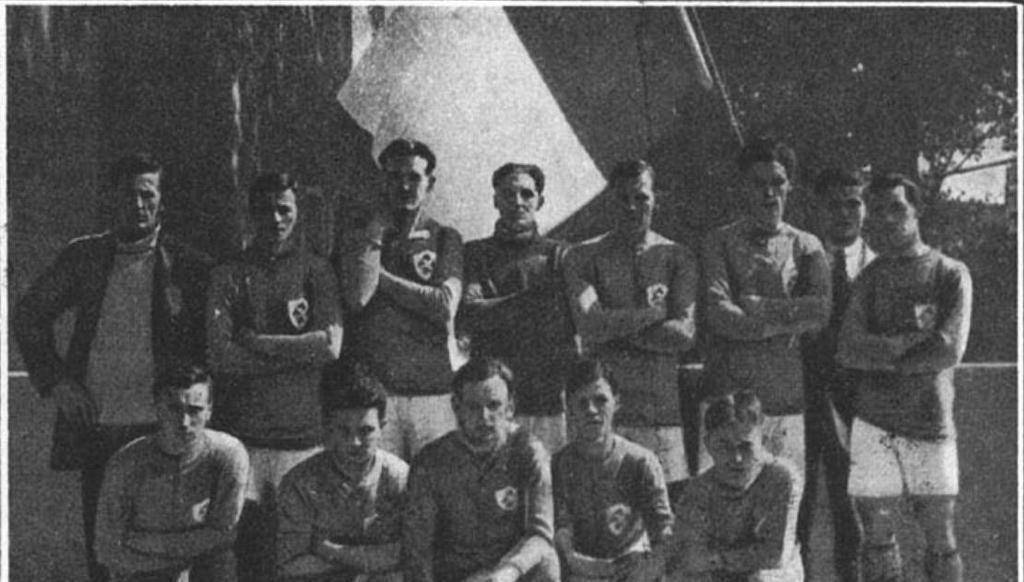
CAPS: The Ireland soccer team at the 1924 Olympics. the players involved were never awarded caps for their performances at the Games, despite being pioneers of the game.
The first players to play for the newly-constructed Irish international team after the partition of Ireland and the establishment of the Football Association of the Irish Free State were never awarded international caps for the matches they played.
There are at least 14 players who were not deemed to be full internationals as a result of this. They are Paddy Duncan, Ernie MacKay, Michael Farrell and Thomas Murphy from St James' Gate; John Joe Dykes, Denis Hannon, Paddy Reilly and Frank Ghent from Athlone Town; Bertie Kerr, Johnny Murray, Christy Robinson, John Thomas and Ned Brooks from Bohemians; and Tony Hanston from Jacobs.
The FAI has an easy decision to make. They must recognise the games played by these men in 1924 as full internationals and present caps to the families of the players.
The games at issue are the ones played in the 1924 Olympic Games against Bulgaria and the Netherlands, as well as two post-Olympics friendly matches played against Estonia and the United States.
The logic appears to be that because no professional or semi-professional players were chosen for those teams, they were not full internationals. It is not a convincing position. Indeed, it was deeply unfair on those pioneers of Irish soccer.
What exactly happened?
The answer lies in the tangled history and politics of the early development of soccer in Ireland – and the battle for control of the game after the partition of Ireland.
That battle for control was between the Football Association of the Irish Free State – (later renamed the Football Association of Ireland (FAI) and based in Dublin, and the Irish Football Association (IFA) based in Belfast.
The IFA – which controlled soccer in Ireland from the early 1880s onwards – was dominated from the start by Belfast-based administrators. This was a consequence of the early dominance of that city as the focal point of the spread of the game into Ireland during the 1880s and of the power of its professional clubs from the 1890s onwards.
This Belfast dominance of soccer assumed a new significance in the wake of war and revolution in the years between 1912 and 1923.
For the men who loved soccer in southern Ireland, the sense that their game was run by unionists was inescapable and in the light of rising nationalist sentiment after 1916 this was to prove a significant point of contention.
This was particularly the case because of the spectacular growth of the game in Dublin in the early twentieth century. Soccer in Dublin was locally run by the Leinster Football Association and it was the men from this Association who led the establishment of the Football Association of Ireland in June 1921 – the context of war, revolution and – ultimately – the partition of Ireland had obvious consequences. Their headquarters and, ultimately, their powerbase would be Dublin.
A letter from Dublin to Belfast confirmed disaffiliation from the IFA. The practicalities of separation were immediately apparent. In June the Football League of Ireland was established and eight Dublin-based clubs were admitted for its first season.
Then, on 2 September 1921, the Football Association of the Irish Free State held its first meeting in Dublin.
There were now two associations vying to control soccer in Ireland as both the Dublin-based FAI and the Belfast-based IFA initially claimed to legislate for soccer across the entirety of the island – and neither recognised the existence of the other.
Something of a working compromise emerged in time in terms of the internal leagues and cups – the IFA controlled internal competitions north of the border and the new FAI performed the same function in the south. While the transition to this new arrangement could not be described as seamless and certainly was not harmonious, it was nonetheless relatively clear.
What proved much more difficult was international recognition. In this respect, two bodies were crucial: the International Football Association Board (IFAB) and the Fédération Internationale de Football Association (FIFA).
The International Football Association Board had been in existence since 1886 and comprised the Football Associations of England, Scotland, Wales, and Ireland. It was never broadened to include countries outside the United Kingdom, even though the spread of soccer had led to the steady growth in international soccer matches, particularly on continental Europe.
Attempts to get the International Football Association Board to reflect this new dynamic were rejected and, in response, the Football Associations of France, Belgium, Denmark, Netherlands, Spain, Sweden, and Switzerland established FIFA on 21 May 1904.
Although essentially boycotted by the teams that comprised the International Board until after the Second World War, FIFA steadily grew in importance. This importance accelerated following the successful staging by FIFA of a soccer competition as part of the Paris Olympics in 1924. This led on to the staging by FIFA of a World Cup for the first time in 1930.
This event was subsequently staged every four years (with the exception of the interval caused by the Second World War) and proved to be the catalyst for the enduring extension of FIFA’s importance.
In the aftermath of the partition of Irish soccer in the early 1920s, the Dublin-based FAI embarked on a tortuous set of negotiations with the International Football Association Board in an attempt to secure recognition. Initial applications for acceptance were rejected after the Belfast-based IFA successfully blocked the move.
Their logic was straightforward: ‘no country could be represented by two Associations’.
Even as those negotiations were proceeding, the Dublin-based FAI also sought recognition from FIFA; this was duly achieved in September 1923 when FIFA informed the FAI that it was willing to accept the membership of the FAI. That FIFA was organising a soccer tournament for the Paris Games in 1924 offered the possibilities of an Irish Free State team taking part.
The Irish Free State government had already given its approval to the FAI and recognised it as the governing body for soccer in Ireland. Now, it acquiesced in the inclusion of an FAI-organized Irish team as part of the Irish Olympic team for the Paris Olympics.
Funding the team was the next challenge: a match played in Dalymount Park between a League of Ireland team and Glasgow Celtic drew 22,000 and cleared £250. Trial matches held in Dublin in April and May 1924 led to 16 players drawn from four League of Ireland clubs selected to travel to Paris; the stringent Olympic rules on amateurism ruled out many players worthy of making the team.
The Irish team wore blue jerseys on which a spray of shamrock sat on a white shield. And they walked onto the pitch to the sounds of Thomas Moore’s ‘Let Erin Remember’.
In the end, victory over Bulgaria was followed by defeat to Holland; it was a creditable performance by a team in its first outings. What mattered more than the results was the symbolism of the moment; the Irish Free State now had its own soccer team competing on the international stage.
Paris did not mark the beginning of a glorious story for Irish international soccer, or even one of steady progress. There was another international match played immediately when the US team came to Dublin on their way home from Paris and played an international at Dalymount Park with Ireland winning 3-1 in front of 4,000 people.
The new Ireland team was unable to secure a regular diet of international matches, however. As it turned out, the FAI’s team – playing as Ireland – did not get to play England until 1946, Wales until 1960, Scotland until 1961, and Northern Ireland until 1978. The reason for this was straightforward – the Irish Football Association in Belfast effectively blocked such money-spinning matches from happening for their Dublin rivals.
The difficulties that the FAI had in establishing itself can be seen by the fact that after the Paris Olympics the FAI Ireland team averaged just a single game a year between then and 1934.
The most significant of these matches was an international against Italy in Turin in March 1926, and when the Italians came to Dublin the following year they were welcomed with an official state reception.
It is that 1926 match that was subsequently deemed the starting point of the Irish international team that represented the Free State.
The campaign to have the pre-1926 matches recognised as full internationals is being driven by the Labour TD and soccer historian Aodhán Ó Ríordáin, who said: “Up until now the FAI has only recognised the 1926 fixture against Italy as the first full international fixture played by the FAI international team. The 1924 games have not been given full senior status because the players were amateurs. However other associations have accepted these Olympic fixtures as full internationals and FIFA have allowed Uruguay, who won the 1924 and 1928 tournaments, to proclaim themselves as four times winners of the World Cup.”
As Aodhán Ó Ríordáin says: “It appears that all of Ireland's opponents in these 1924 matches register them as full senior internationals, but the FAI don't. It would be a fitting way to mark 100 years since the Irish flag was first flown by an international team and it would mean the world to the families of the uncapped men.”
The forthcoming friendly match against Belgium is a perfect opportunity to fix the record and honour men who were trailblazers in their time.


CONNECT WITH US TODAY



Be the first to know the latest news and updates