‘Facts’ or Fiction: Did Rafa’s ‘rant’ cost Liverpool the title?
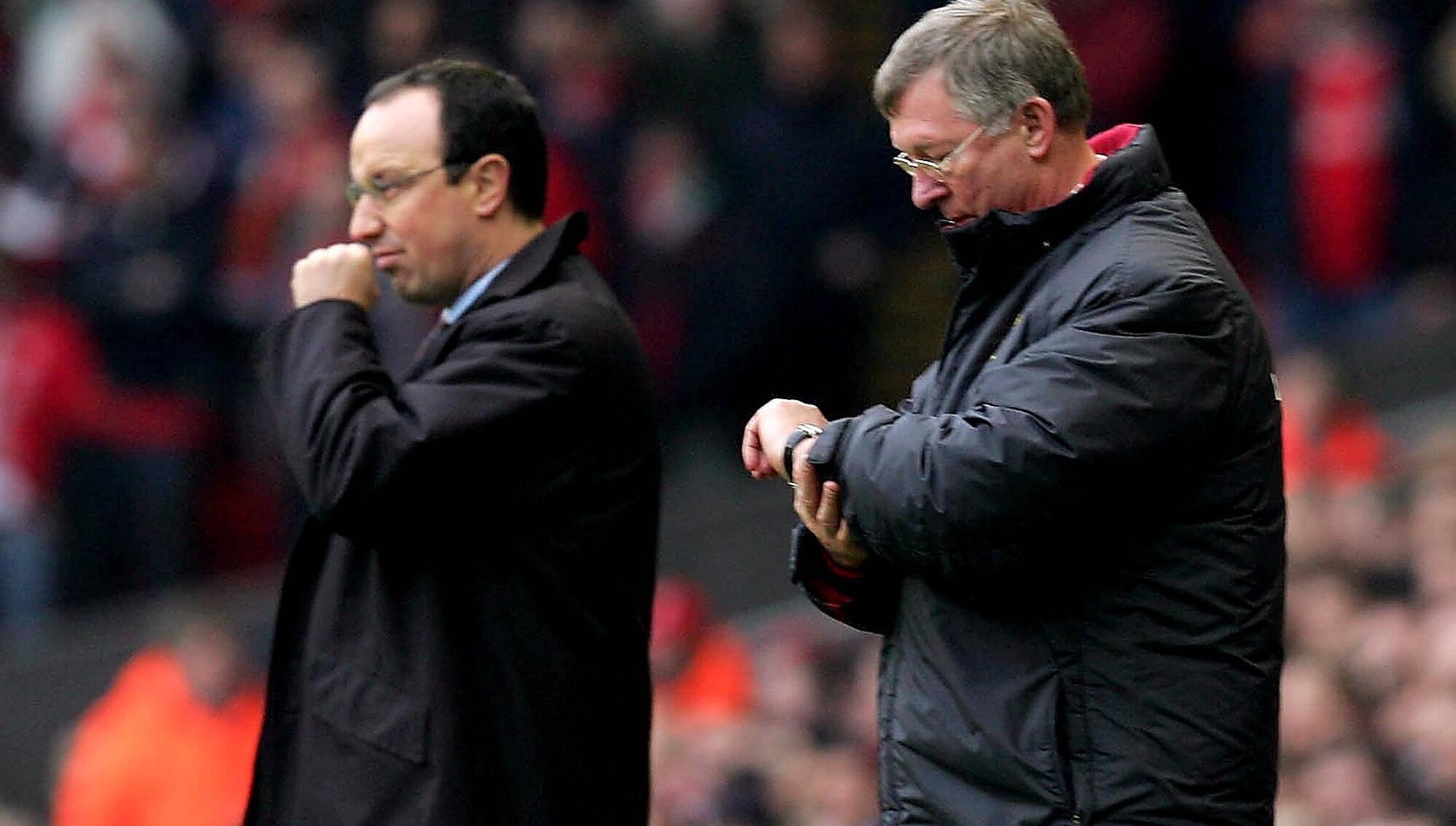
BEST OF ENEMIES: Alex Ferguson checks his watch while Rafael Benitez of Liverpool looks on during a Premier League meeting at Anfield. Pic: Matthew Peters/Manchester United via Getty Images
When Liverpool conducted their search to find a new manager to replace Gérard Houllier in the spring of 2004, there was one principal requirement of the candidates: could they better Sir Alex Ferguson and find a crack in Old Trafford’s edifice?
Could they breach the growing gap with the hated rivals? In short, could they knock United off their perch? The man they came up with was Valencia’s master strategist Rafael Benitez. Benitez’s career at the Mestalla had echoes of Ferguson’s own work at Aberdeen. He had, as the Scot had done with Glasgow’s Old Firm, broken up the existing order by overcoming Barcelona and Real Madrid to win La Liga twice. He then burnished his reputation by lifting the UEFA Cup in 2004 with victory over Marseille in Gothenburg.
So, when Houllier’s tenure ran out of momentum after 6 years, the 45-year-old was Liverpool’s first choice and, with a growing fissure developing between Benitez and Valencia’s hierarchy, he was duly appointed.
Ferguson was initially welcoming. And when Benitez concluded his first full season at Liverpool with the Miracle of Istanbul, Liverpool’s extraordinary 2005 Champions League turnaround win on penalties against AC Milan after being three goals down at half time, he received a letter of congratulation, as well as a tactical analysis of that successful campaign, on the Manchester United manager’s personal notepaper. Flattering indeed.
But what was more flattering was the fact that Ferguson was now alerted to Benitez as a threat. This, as history shows, spells trouble.
Houllier and Ferguson had always been on the best of terms, but not these two. This was a relationship that swiftly grew rancorous. It reached its nadir in 2009 when Benitez’s Liverpool dared to issue a proper challenge to United and raise hopes of the reclamation of the territory they craved most: Premier League champions.
Unlike Houllier, or his own ill-fated successor Roy Hodgson, Benitez cared nothing for friendship with Ferguson. This was a matter of supreme indifference to him. He had no wish to join the club, no wish to bend the knee in deference to the great man. If Ferguson wanted to call it on, Benitez would be waiting – or even prepared to start it himself. Benitez had followed up the Champions League win with the FA Cup in 2006 and come close to a second Champions League – losing in the final against AC Milan two years after Istanbul – but the title remained elusive. Until, that is, it shimmered into sight with Liverpool top of the table at the turn of the year in 2008–09, seven points ahead of United having played two games more.
Benitez had assembled his finest team. Steven Gerrard was still the inspirational leader, while Xabi Alonso and Javier Mascherano were his world-class midfield cohorts. And to top it all off, Benitez’s Liverpool could call on Fernando Torres, arguably the world’s finest striker at that time and a player who revelled in making himself Manchester United’s instrument of torture.
Yet lurking in the back of Benitez’s mind lay the spectre of the laird of Old Trafford. That season United were not only holders of the Premier League title, they were champions of Europe, having beaten Chelsea in Moscow. And now, following Ferguson’s long-held tradition of moving into gear for a title push after Christmas, they were suddenly chasing Liverpool at the top of the table. But Benitez sensed favouritism was behind their charge; he suspected that Ferguson was getting mates’ rates when it came to refereeing decisions.
He regarded the United boss as the instrument of officialdom. Or maybe even vice-versa. With this as the subplot, Benitez decided to launch a pre-emptive strike that has become infamous in the annals of the Liverpool–United rivalry. He was about to talk ‘facts’. The manager was recovering after two operations for kidney stones, and he was to undergo a third within days, when he addressed the media at Liverpool’s Melwood training base on Friday, 9 January, before the following day’s game at Stoke City.
United were at home to Chelsea 24 hours later. Those turning up assumed that this was to be a routine press conference. Nothing to get excited about. Ferguson, dusting off a tried and tested ploy, had earlier in the week suggested that nerves might wreck Liverpool’s renewed title bid. It produced a combustible response from his Anfield adversary. Walking into the media room and taking his place behind the desk, a casually dressed Benitez announced that he would not be taking any questions immediately. He first had something to get off his chest.
‘I have to talk about facts because I think it’s important,’ he began, before producing a piece of paper from his pocket. ‘I think that they,’ and it was clear who he meant by ‘they’, ‘are nervous because we are at the top of the table, so I want to be clear that I don’t want to play mind games too early. I think they want to start, so I was taking some facts so it will be easy to talk about this.
What followed was an explosive push-back against the leader of the managerial pack. Benitez was not about to become another of the acolytes Ferguson inspired among his peers with all their talk about buying the old boy a fine bottle of red to share after games, often after being heavily defeated, doe-eyed while sucking up his sage words. It became known as ‘Rafa’s Rant’, but it was anything but.
This was an anti-rant delivered in icy tones with a written list of grievances as a prop. And to prove this was not some loose-lipped instant reaction to Ferguson’s goading, Jamie Carragher revealed to us that he had prior knowledge of this carefully planned monologue.
The player was scheduled to make one of his early Sky Sports punditry appearances at United’s game with Chelsea the following day and had sought Benitez out in his office earlier in the week to receive official permission.
‘I asked Rafa on the Thursday or Friday could I go on, and he said I could,’ Carragher tells us. ‘But he then told me he was going to say something in the press conference. He’d had a few ding-dongs with José Mourinho and he said something along the lines that Ferguson was more experienced so he was almost weighing up what he was going to say or do. ‘I’d almost forgotten about it, to be honest, and then when I saw it when I got home I was open-mouthed. I can’t deny that. I didn’t think it was the right thing to do at all. I don’t think we gained anything from it.
‘I think Rafa was trying to put pressure on the referee at Old Trafford to help Chelsea get something from the game, but I think there are ways of going about things. I just thought it put all eyes on us. It put pressure on us then and we drew 0–0 away at Stoke City in a terrible game.
‘I don’t think it was like the Kevin Keegan “I’d love it” thing with Fergie where the emotions got to him right after a very important game. Rafa was a very cool and calculating man. It was days before. Nothing had really been said for him to react to. This was pretty much Rafa calling it on rather than him getting wound up by someone. This was him thinking, We’re doing all right this season. We can challenge these. I need to start putting a seed of doubt into referees’ minds.
‘I just think that was maybe something for the last ten games of the season. This was the start of January. There was still half the season to go. It was too early, and the way Rafa is as a person, he is not the most charismatic, shall we say. If Mourinho had done that he maybe wouldn’t have brought the paper out to read from. He would have just reeled it off and said it in a funny way and maybe it would have gone down better. I think the way Rafa delivered it probably didn’t help, and it almost put more eyes on us rather than Manchester United or referees, which I think was the initial intention.
‘Maybe Manchester United took something from that, but I don’t think it was a case of Rafa’s lost his marbles or lost his head. He made a decision to do something that I don’t think was right. It wasn’t a case of mind games. It was too early for all that.’
Gary Neville was also looking on from a distance. ‘I remember I was at home watching Sky Sports News, thinking, Woah, what’s he done there?’ he says. ‘And then you picture Sir Alex sitting at home, thinking, I’ve got him.’"

CONNECT WITH US TODAY



Be the first to know the latest news and updates