Daryl McMahon flying the flag for Irish-born managers in England
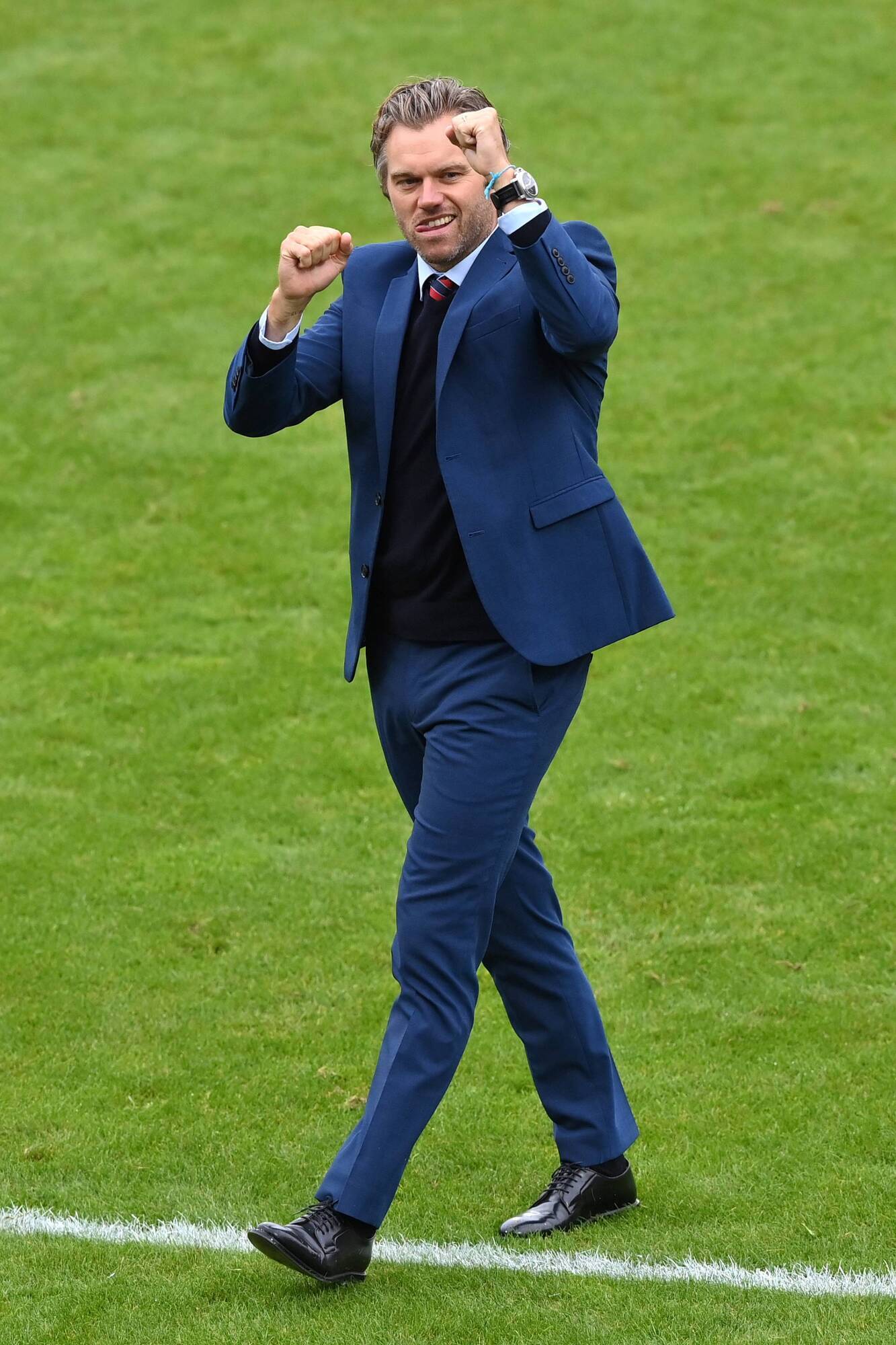
Daryl McMahon, manager of Dagenham & Redbridge celebrates after the Vanarama National League match between Barnet and Dagenham and Redbridge at The Hive in Barnet earlier this season. Picture: Justin Setterfield/Getty Images
Sitting in the bar of the modest training ground Dagenham & Redbridge share with an amateur rugby club on the fringe of East London, Daryl McMahon is trying to put a finger on why he is the only Republic of Ireland-born manager in English football’s top five divisions. “It’s strange,” the 37-year-old says. “You’d like there to be more of us. But no one has sustained it at the top for a period of time. Why?”
Mick McCarthy, Barnsley born, is the only former Ireland international in the top four divisions, at Cardiff City, after Chris Hughton, who grew up not far from the area McMahon has called home since moving to England more than two decades ago, was dismissed by Nottingham Forest last month.
That Ireland is renowned for its ability to produce leaders in other walks of life, has dozens of ex-pros with sharp footballing minds and that natural storytelling ability — “which is basically what giving a teamtalk is”— makes McMahon conclude it is an area where the nation has underperformed for too long.
Then he looks at some of those former players, Irish as well as British, who appear more comfortable in TV studios and, having enjoyed a couple of punditry stints himself in the past few years, can appreciate why they would take the less stressful option and turn down the opportunity to speed up the ageing process.
“It’s not life or death for them, ex-players can take it or leave it and be on TV,” he says. “It can be stressful if you don’t have the right tools. You see Gary Neville or Jamie Carragher have fantastic football brains but trying to do it on the telly or the dugout is very different.”
Life or death may be an exaggeration, and it’s not like flying the flag solo keeps him awake at night, but McMahon’s willingness to get his hands dirty is fuelled by his own past. Six years on from hanging up his boots there are still points to prove, ambitions to fulfil because he considers his playing career a failure.
Having moved to West Ham United as a 15-year-old, where he initially shared a house with 10 other academy prospects including Michael Carrick, there was a loss of commitment and focus. “Nothing too dramatic,” he says, but a dip in application meant his natural ability was never fulfilled.
“By the time the penny dropped I was 24 and it was too late for me to really play where I felt I could have played. It wasn’t anything in particular, more having a life where you grow up in Clondalkin, on a council estate, you go to school, someone sends you a letter to play for a club, play for Dublin. It all just happened and I enjoyed myself.
“But then you start to take it for granted, you think it will always happen for you and if it doesn’t it’s someone else’s fault. It was about not recognising that early enough. I didn’t do anything particularly bad, it was about mental focus and understanding. Dealing with failure and dealing with processing games better.”
As a consequence he decided to go down the coaching route in his mid-20s, initially looking to specialise in youth development and equip the next generation with the skills not to repeat his mistakes.
“Because I’d failed as a player my first instinct was to coach kids and make sure they didn’t do what I did,” he says. “Maybe I could notice the signs? It was a lonely thing when you go into that bubble as a player.
“You could score a hat-trick for the Under-17s against Arsenal and actually play crap. It’s easy to get caught up in the nonsense and think you’re developing as you should be. I got caught up in that. The most important thing for me now is the individual, making a player better on a personal level, bring the best out of them.”
There was a spell, as one of Ireland’s most coveted underage players, when he could have chosen almost any club in England but West Ham and the blue-collar surroundings of their training base in Romford felt more like home.
East London has been home ever since. He met his wife, Alex, in a local nightclub at the end of his first year in town and, despite a spell up north in charge of Macclesfield Town just before the then League Two club went bust, he has spent almost his entire adult life within a few miles of that first lodging on Kingston Road.
That explains why his Dublin accent is now fused with Essex inflections that become even more pronounced when speaking to the born and bred locals on his staff. He can still see the similarities between this no-frills patch of London and the Clondalkin of his childhood.
“I chose West Ham because it was a working-class club at the time, very down to earth and the people were great,” he says. “I settled in the area straight away and I felt more at home here with the way people were, the industrial language. People tell you what to do, you get on with it. There wasn’t any mollycoddling, it was just like the environment I grew up in.”
That forms part of a management style that contains four non-negotiables: honesty, hard work, hunger, and accountability. McMahon has proven a flexible tactician since taking over at Dagenham a couple of weeks before the pandemic, changing the shape regularly to exploit the weaknesses or negate the strengths of opponents, but those principles are a must for a squad he treats like grown-ups.
“We spoke together about having a Dagenham DNA, a way to play,” he adds. “But it wasn’t about me shoving it down the players’ throats. It was a collective decision into how we want to work that I then police. It’s then about me reinforcing it.”
The season has started “reasonably well.” Eight games in, Dagenham are top of the division ahead of this afternoon’s meeting with Altrincham and McMahon was rewarded with a new contract in mid-September. They have been scoring at a higher rate than any team in the four divisions above, averaging 2.75 goals per 90 minutes, and rivals with significantly bigger budgets are concerned.
The squad was revamped in January and momentum has accrued as the months have passed. McMahon is not one for getting carried away and, regardless of the performance his team puts in, having two young children waiting at home brings perspective. “I’m just dad when I go home, expected to play with Paw Patrol toys,” he says.
The grave situation at Macclesfield offers further clarity around what really matters. McMahon had replaced Sol Campbell in the summer of 2019 well aware of the financial difficulties behind the scenes having cut his teeth at Ebbsfleet United.
Yet it proved an opportunity too good to turn down and the team started well in League Two before the off-field situation deteriorated further, the players went on strike having gone unpaid and he resigned in January before taking the Dagenham job 24 hours later.
“I loved the job, the place, the players and the club,” he recalls. “It was tough in terms of travelling and the financial stuff was difficult. I knew some of it when I went in there from the start but I was the youngest manager in the league with the youngest squad in the whole league. It was too good an opportunity to turn down, the chance to do something special.
“I loved the attitude. The players’ mentality was incredible. Monday night we could be told at 8 o’clock that there was nowhere to train, you need to find somewhere else. The players would turn up with no moaning. The majority of them are in the league still, if not all, and doing really well. They were resilient.”
Which brings us back to matters one step shy of life and death. At Dagenham’s training ground car park, currently shared with a mobile covid-testing centre, there are no fancy sports cars. Players have mortgages for two-up, two-down houses, the salaries are not life-changing and everyone is united by a common goal to ascend the pyramid to a level of comparative comfort.
Is it any wonder that some high-profile former Ireland players appear reluctant to dive in?
“It’s about being able to deal with problems,” McMahon says. “Robbie Keane has his badges, Mark Kennedy has managed [replacing McMahon briefly at Macclesfield] but if they had a job in the National League there are problems with training grounds, pitches, or players not being paid.
You can’t wait forever for the perfect thing to turn up and sometimes that perfect job turns out not to be.”
For now, although more than aware of this game’s fickle nature, there is a degree of certainty at Dagenham. A commodity so rare in this job that it must be cherished.
CONNECT WITH US TODAY
Be the first to know the latest news and updates