After another iconic night, football’s coming home or going to Rome
After another iconic night, football’s coming home or going to Rome

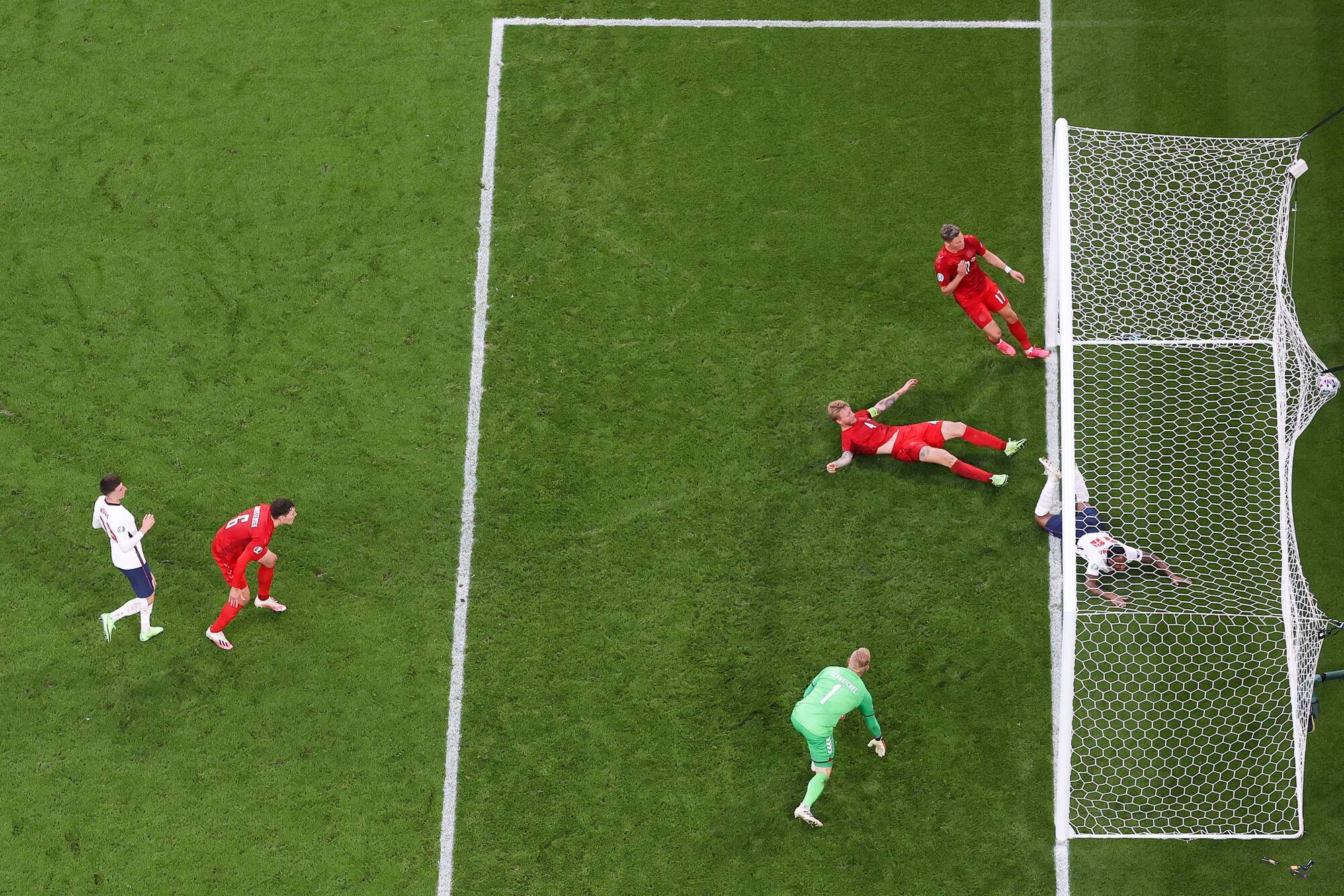
Simon Kjaer of Denmark scores an own goal, England's first, while under pressure from Raheem Sterling of England at Wembley Stadium. (Photo by Laurence Griffiths/Getty Images)

What a joyous and hedonistic carnival of football this wonderful Euro 2020 has become, a heady tonic to soothe the most painful of years, and now it has gifted us one last hurrah — a final that could be the biggest show of all.

England against Italy at Wembley on Sunday has the potential to write a stunning final chapter to what has already a story full of drama, passion, tragedy and intrigue that has lifted and captivated all of Europe.

To set it up we were treated to a heady night of tension and intensity as England came from behind to beat Euro 2020 darlings Denmark with a Harry Kane goal in extra-time, ending their 55-year wait to play in another major final.

The fact that the goal came from the Tottenham man’s follow-up after his penalty was saved by the outstanding Kasper Schmeichel only added to the story, and the roar which greeted it must have been heard across the continent.

What a night and what a tournament.

Coming hot on the heels of Italy v Spain, one of the highest quality football matches you will ever see, England’s job here was to put on a convincing enough performance to suggest they could not only reach the final but win it. A performance that said that football really could finally, after 55 years, be coming home.

They did it, certainly they did it, but oh how they had to work for it — and what a remarkable part Denmark have played in Euro 2020 since the tragic scenes of their opening match against Finland when Christian Eriksen suffered a cardiac arrest on the pitch.

For the neutral, there was always going to be a fairytale ending to his game one way or the other. England’s long and arduous wait for silverware is well documented, whilst Denmark’s emotional run to the semi-final since Eriksen’s recovery has captured the public’s imagination — rightly so considering Denmark was the home of Hans Christian Andersen.

They played a huge part in a game in which the football fizzed and the atmosphere crackled but were eventually overpowered by an impressive England who deserved to go through.

This was another thrilling and tense night in what has become a carnival tournament, a joyous reminder of a world in which people hugged, in which they were happy, in which they were free.

England have waited since 1966 for a chance to reach a major tournament final,.

The air in north London tingled not just with excitement and passion but with the release of almost of so much held-in emotion. Suddenly we were allowed to cheer, allowed think about football as being more important than anything else — something that was impossible to say out loud when every day began with an announcement of how many people had died.

Covid hasn’t gone away, of course, and sadly people are still dying; but hope has tentatively returned, and it was celebrated in London in a way that you hope and pray will come soon to Dublin and all cities across the world.

Football never really went away, either — it kept many of us going in the days when there was a match on tv almost nightly; but it was never the same without fans — and what a difference they have made in this tournament.

There were 8,000 of them from Denmark inside Wembley and 52,000 from England, and we can expect the same again on Sunday in what will be another incredible, tumultuous atmosphere.

Denmark looked dangerous for long periods of the night, passing their way through midfield, but it was England who had the extra fizz with their constant high-energy press and the pace of Bakayo Saka and Raheem Sterling, which the Danes never came to terms with.

Mikkel Damsgaard’s free-kick, which put them ahead, was probably the game’s biggest quality moment but England matched the intensity, forward inter-play and energy of Italy 24 hours earlier, and that marks out Sunday’s final as something special.

It took an own goal from Simon Kjaer to bring them level, but it was Saka’s trickery which made it — another big tick for Gareth Southgate who opted to bring him back into the team even though Jadon Sancho played so well against Ukraine in Rome.

After that, the noise got gradually louder as England searched for a winner, especially once Jack Grealish came off the bench to add another dimension to the attack.

It was, however, an all-round performance that secured it. Mason Mount was once against outstanding as England built up steam, as were Harry Maguire and Kyle Walker at the back and Declan Rice and Kalvin Philips in midfield — and they had to be against a Danish side which never gave in.

It was a game which deserved extra time, and it got it — although Denmark had to bravely survive six frenetic minutes of injury time first.

One there, England’s intensity never dropped, and even though Schmeichel continued his heroic performance with a remarkable save from Kane when the Tottenham striker was clean through, there was one last moment of drama to follow. That conttroversial penalty, won by Sterling, and finished at the second attempt by England’s captain.

The game was concluded by a period of super-calm keep-ball by England which shows how far they have come and how much they have learned.

Cue pandemonium when the final whistle blew, cue remarkable scenes. And cue more of the same back here on Sunday. Football is either coming home or it’s coming Rome. What a final chapter we have in store.

More in this section

Sport

Newsletter

Latest news from the world of sport, along with the best in opinion from our outstanding team of sports writers. and reporters

Cookie Policy Privacy Policy Brand Safety FAQ Help Contact Us Terms and Conditions

© Examiner Echo Group Limited