Niall Quinn, his dazzling dad, and the roads not taken
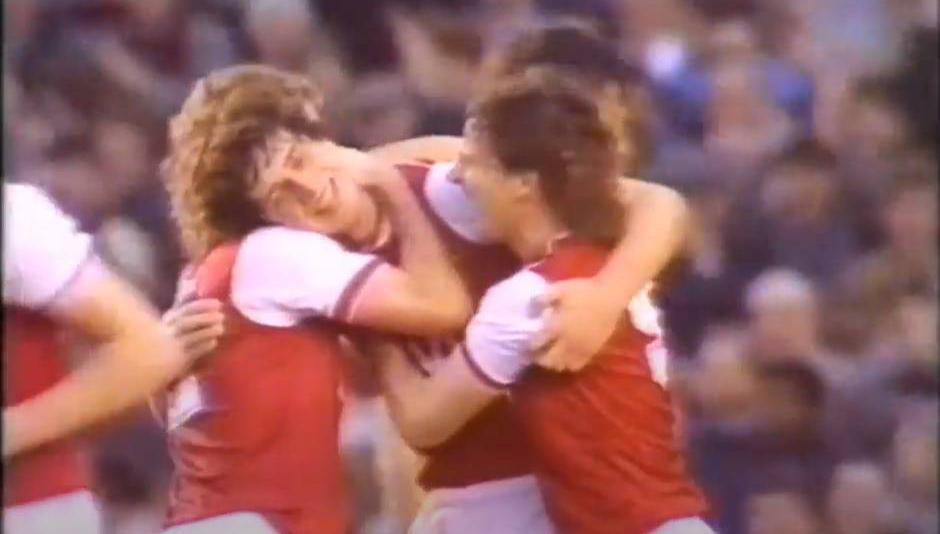
Niall Quinn celebrates scoring on his debut for Arsenal against Liverpool.
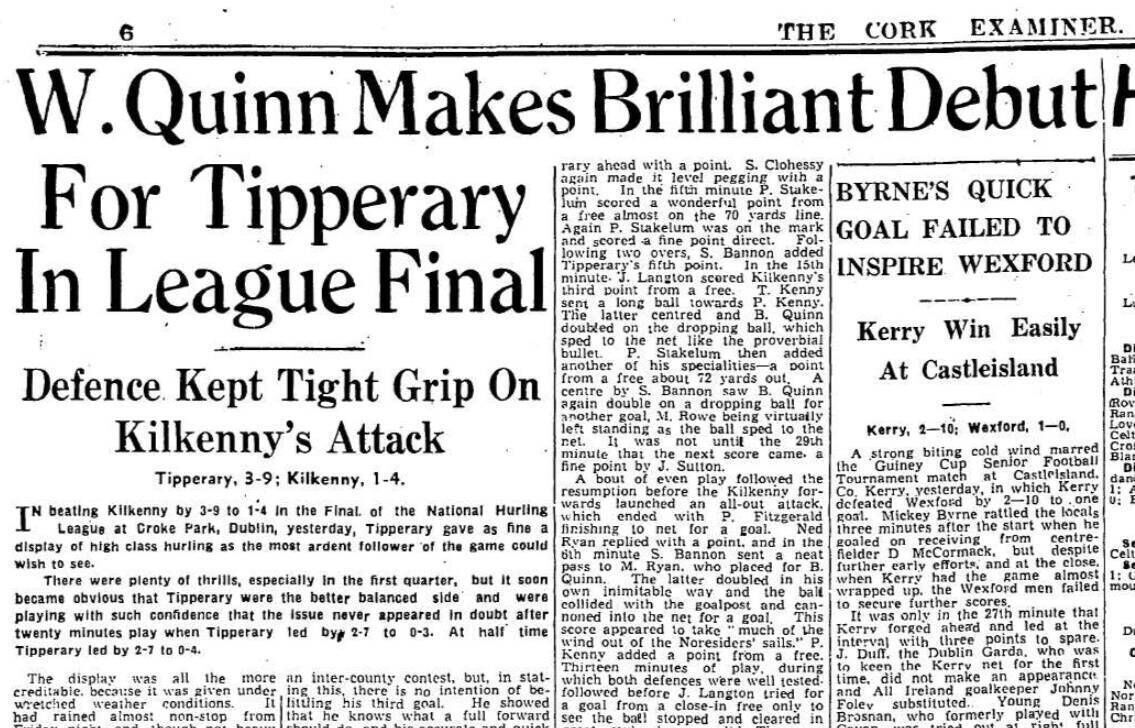
May 3, 1954 — an extract from the Cork Examiner report of Tipperary’s Hurling League Final win over Kilkenny, by 3-9 to 1-4. In a team of stars — Tony Reddin, John Doyle, Jimmy Finn, Theo English — brightest on the day was Billy Quinn from Rahealty.
This 19-year-old — Tipp’s winning minor captain the year before — held his place at full-forward for the Munster semi-final win over Clare. He scored Tipp’s early goal in the Munster final, when an extra-time goal and Christy Ring’s brilliance saw Cork sneak it by three points.
A year later, Billy Quinn was working on the docks in East London.
His famous son Niall elaborates, in the story of his football life, ‘Niall Quinn – Bootroom to Boardroom’, with Tommy Martin, the first part of which airs on Virgin Media Two tomorrow night.
“You would never know my dad had any disappointment in his life such was his love for hurling. He won an All-Ireland medal as captain. In those days they gave out the cups together to the senior captain and minor captain and he received it with Christy Ring (Cork’s winning captain in 1953), and it was shown around the world.
“Within a few months, he made his Tipp senior debut and scored three goals in that league final, when league finals were probably bigger than they are now.
“So he started to become the up and coming superstar. But you look back at Ireland at the time… within a year, my mam and him decided to go and make a living in England and he turned his back on it.
“He came home some years later, Tipperary had changed, a new team of selectors, the way things used to work in those days.
“He shacked up with Faughs hurling club in Dublin. And to show how important Faughs was in his life, when he passed away almost five years ago now, his coffin was draped with the Faughs flag.”
Four children inherited devotion. “If there wasn’t a match with Faughs, we were brought to county finals in Cork and Limerick and Clare. It was a passion and love that knew no bounds.”
Thirty years after his father, Niall Quinn played in an All-Ireland minor hurling final, his Dublin team losing to Galway. He had scored three goals in the Leinster final win over Wexford. But there was no resistance at home when the son left hurling behind too for a life in London, albeit with Arsenal rather than on the docks.
Just how good Niall Quinn was as a hurler? Here's his point from the 1983 All-Ireland minor final. A doubled strike John Fenton would have been proud of... pic.twitter.com/W39buUWMgD
— Philip Lanigan (@lanno10) September 14, 2019
“My dad never said a lot to me and the one thing he did say to me — and I remember it as long as I live — ‘just don’t do a Jack Doyle on it’, that was his advice. That was all he said to me going to England.”
The cautionary tale was of Cobh’s superstar boxer, actor, and tenor, who was floored by alcoholism and bankruptcy and destitution in London.
“I made it my business to read about Jack Doyle. It was the best advice I could have got. I was fond of a pint, I could drink, I was tall, I could drink more than other lads, I could hide it better.”
A goal on his debut against Liverpool in 1985 settled Quinn in beautifully.
“For 18 months it was perfect. George Graham came then and I played every game for him. My contract was running out and George kept at me to sign a new one, but I was always reading the papers that he was after Kerry Dixon, so many players he was meant to be after. And I had no agent. In the end, he brought me in, gave me a rise, said I haven’t had to sign anybody, and I was delighted. I signed, and two days later he signed Alan Smith.
“It was the first big marker in my life that you have to fight battles here. This isn't as pretty an existence as you think. And for three years I only ever played when Alan Smith was out. And he never got suspended — he was booked once in his career I think — and he never got injured.”
Reserve team football brought lack of direction. There were friendships with Tony Adams and Paul Merson, who would later fight public battles with alcoholism.
“I had two social lives, a football social life with Paul, Tony and the other players. We famously had the Tuesday club, we’d have Wednesday off if there was no midweek game. Down to King’s Cross and we’ll start there. And then the yuppie wine bars of the 80s.
“But then, when they were falling home at 6 or 7 o’clock, I’d go back to my mates, who were back from work, and we’d go to the Dog & Duck on Winchmore Hill. At best we’d stay there all night, or we’d go up to one of the halls that would host the bigger Irish music bands, the Galtymore, the National, the Gresham.”
I didn’t lose the run of myself, Quinn insists, it never got out of control. Though it didn’t go unnoticed.
“George Graham said to me once in a huddle when we were training, ‘you’ve got a smell of beer on your breath.’ And all the players looked at me and froze.
“I had one second to answer and just went, ‘so would you, boss, if you had as much to drink as I did last night’.
“He started laughing and everyone went, ‘thank God, Quinny, I thought you were going to get sacked there.’ That was the nearest I think I got to being carpeted for it."
Merson describes their friendship in his book .
“I’d always go into an Irish boozer around the corner from the ground. The Bank of Friendship it was called. In those days, my drinking partner was Niall Quinn.
“We’d often play games in the stiffs together, which took place in midweek. On the day of a match, we’d spend hours in the bookies before heading back to Niall’s place for a spicy pizza, which was our regular pre-match meal.
“If you had said to me then when I was 17 or 18, ‘Oh, Niall’s going to be the chairman of Sunderland when he’s 40-odd,’ I’d have thought you were having a laugh. He wasn’t that sort of bloke.”
“Anything that Paul was doing, I was doing, in the early days,” Quinn says.
“He’s someone that I really, really admire. But when I got in touch with Paul’s dad when Paul’s stories broke, Paul’s dad asked me never to have anything to do with him again. That was kind of a tough one for me to take as if I was to blame. So I backed off Paul for a number of years.”
Drink claimed his friendship with Adams too.
“We had a bit of a falling out over a book he wrote afterwards. I believe the papers were the ones responsible — for the serialisation of it, they ramped up the headlines and went, ‘Quinny and I on the piss for three days and we lifted the league trophy that night.’ There was a two-week gap that he forgot about, or the papers had forgotten about.
“I had a little falling out with him over that and that lasted too long. That lasted 15 years.”
Drink might have claimed a lot more. By the end at Arsenal, he was out the night before reserve games. The day Howard Kendall came and watched him for Manchester City, he had stayed in.
That move got him back on track to being the kind of bloke who’d be chairman of Sunderland at exactly 40.
It was only in the northeast that he rebuilt bridges. With Adams: “He was up with Portsmouth and we sat together and we had a right good chat and we’ve stayed in touch since, which is great.” And Merson: “He came up to Middlesbrough and I met him once or twice and we got back.”
“We’d all have done things differently of course,” he says now.
But he never forgot a few quiet words from a man whose life could have taken a different path.
“I always knew when to pull back. And it all stems from my dad’s only few words for me.”
The programme covers Quinn’s Ireland exploits, his Manchester City and Sunderland days, life in the boardroom, Roy Keane. Promoting it yesterday, he is happy to talk about his father.
“Thanks for asking about him.” He thinks again about whether Billy Quinn ever let slip any regret at a stellar life not lived.
“When he opted for Dublin, no sooner had he done that and trained and played a few matches that Dublin brought in a rule that country lads couldn’t play, so he had nowhere to go and he couldn’t play.
“I think the frustration came out one time during 1990 when my mother told me, ‘you’ll never guess what your dad said on the radio today’. The radio had got in touch with him, after the goal I scored against Holland, and Gerry Ryan said to him, ‘you must be very proud of your son’.
"And he said, ‘I’d rather he scored in the Munster final for Tipperary’.
“And that probably spoke to where his heart lay.”

CONNECT WITH US TODAY



Be the first to know the latest news and updates