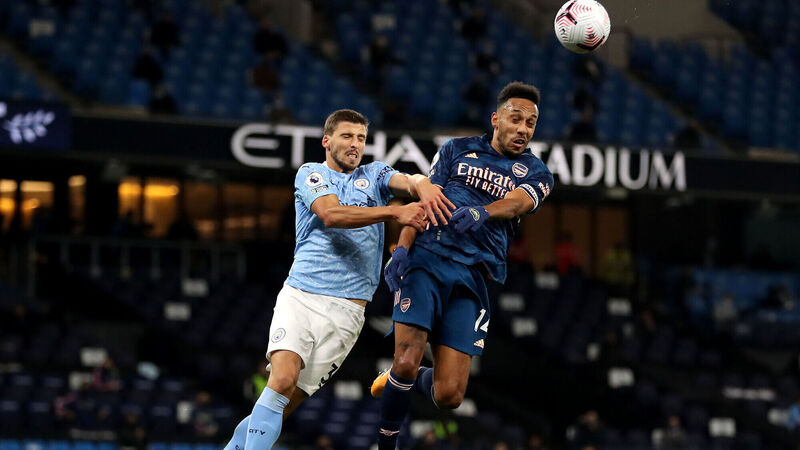
For Mikel Arteta, the final frontier turned out to be territory he knew well. The Spaniard’s transformative effect on Arsenal has been apparent in their improved results against their peers and superiors, sealed by a hat-trick of triumphs over Liverpool in three months.
He has prevailed at home and in Wembley’s neutral surroundings, on penalties and in cups. What he has not done is won away in the league at the big six. He is not alone in that. Arteta was Arsenal’s injured club captain when they last triumphed on enemy territory; it was January 2015, sufficiently long ago that Tomas Rosicky, who played then, is now in his 40s. Arteta has overseen a win at the Etihad Stadium since then, but as the assistant to whom Pep Guardiola delegated tactics against Arsenal in December 2016.
Denied a landmark win by Manchester City, Arteta sought solace in the details of defeat. “I am extremely proud of how we played individually and collectively,” he said.
“I have been in that dressing room for four years and to play with the attitude and belief we did is really difficult.”
Perhaps the margin as well as the manner offers consolation: this was the first time since 2015 that Arsenal limited City to a solitary goal and even a late defensive reshuffle, with David Luiz in an unfamiliar role on the right of a back three, did not strip them of solidity.
The problem is not the performance but the bigger picture: 29 visits to the elite spread over almost six years and under four managers that have not yielded victory.
Arsenal have often been at their worst when they have needed to be at their best. They have 10 points from a possible 87, one from 15 under Arteta. But they have become more streetwise under him, starting to shed an inferiority complex and showing tactical nous. They have acquitted themselves well at Anfield and the Etihad in their last two away league games.
The next, at Old Trafford, feels more winnable.
“To get a win here everything has to go your way and you have to be so clinical,” Arteta reflected. Arsenal scored twice from four shots on target when they beat City in July’s FA Cup semi-final and, after encountering an inspired Ederson, none from three on Saturday. That reliance on potent finishing is less failsafe when Pierre-Emerick Aubameyang is on his joint longest Gunners goal drought, though of only four games, and when Arteta benched his in-form goalscorer, in Alexandre Lacazette. Arsenal, near the foot of the table for shots, cannot always expect to be efficient.
But making them less open helps them be more competitive. Arsenal are soft touches no longer.
Perhaps the deadline-day signing Thomas Partey will allow a team who were penned into their own final third for much of the first half to win the ball higher up the pitch, but he was limited to a seven-minute cameo in which, in a sign of his combativity, he got booked. “He only trained one day and it is a completely different game model for him to understand,” said Arteta.
Another of his battle-hardened recruits was Willian. A big-game talisman for Chelsea — indeed, one with a winner against City to his name in 2020 — rather floundered as a false nine. Arteta suggested the experiment will not be abandoned. “He will grow and understand that position,” he said.
Willian’s deployment came as footballing intellectuals tried to use their inside knowledge to out-think each other. Arteta had the Guardiola-esque false nine, Guardiola a 3-3-4 that was one of the few formations he and Arteta never tried together. If there was an irony in one of the season’s boldest tactics coming in among its lowest-scoring games, those four forwards were all involved in Raheem Sterling’s winner.
Perhaps it was not a kamikaze display of boldness as much as original thinking required by depleted resources. Lacking his premier playmaker, in Kevin de Bruyne, Guardiola bolstered the attack instead. If Joao Cancelo, the Premier League’s most expensive fullback, may not be a natural in midfield, Philipp Lahm-style, Guardiola has an excuse for his leftfield decision.
Invention has been necessitated by absentees, whether due to injuries or coronavirus. A shortened summer means City lack sharpness. Guardiola does not expect his side to produce a high-class 90-minute performance yet, while his defence has to change by the game.
Countering Arsenal’s split strikers with wide centre-backs, he in effect used Ruben Dias as a lone central defender. “A type of leader,” he said, shrugging off comparisons with the “unique” Vincent Kompany before inadvertently generating more. The forceful Dias looked the future. Sergio Aguero may soon be part of the past. The striker made his first appearance for four months, but there are only eight left on his contract.
“He has to show like everyone, me first, that we deserve to continue here,” said Guardiola. It was scarcely a warning: Aguero’s say will matter most. “We don’t have any doubts about his quality,” he added. “He is a player to stay until he decides [to go].”
Arteta stayed as his assistant until he decided to go. The challenge he took on was huge: Arsenal took 90 fewer points than City over the last three seasons. If managerial excellence is closing the gap, now old allies both find themselves making compromise and creative choices to try and camouflage shortcomings. And, in Arteta’s case, to get that elusive scalp on the road.
MANCHESTER CITY (3-3-4): Ederson 8; Walker 7, Dias 7, Ake 7; Cancelo 6, Rodri 6, Silva 7; Mahrez 7, Aguero 7 (Gundogan 65, 6), Sterling 8, Foden 7 (Fernandinho 86, 6).
ARSENAL (3-4-3): Leno 7; David Luiz 7, Gabriel 7, Tierney 6; Bellerin 6, Ceballos 6, Xhaka 7 (Partey 83, 6), Saka 8; Pepe 5 (Nketiah 83, 6), Willian 5 (Lacazette 69, 6), Aubameyang 6.
Referee: Chris Kavanagh
CONNECT WITH US TODAY



Be the first to know the latest news and updates