Monday morning quarterback: Alli must learn the line between physicality and aggression
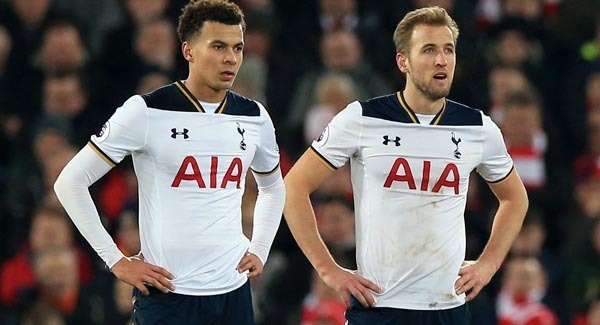
Dele Alli was incredibly fortunate not to be sent off by Craig Pawson, and the yellow card issued dictates that he cannot be subject to further FA investigation. But there may be a longer-lasting legacy of his latest poor challenge.
Alli is getting a reputation not just for nasty tackles but for lashing out in frustration.
In June, he insisted that he had learned from his mistakes, but that he would not be looking to eliminate tackling from his game. That’s thoroughly appropriate, but Alli must learn the line between physicality and aggression, particularly at times when he is under-performing and under pressure.
It isn’t hard to envisage a situation when England are trailing in a match in Russia next summer, and opposition coaches will instruct their midfielders to rile Alli at the World Cup.
In the space of two weeks, Manchester City have faced two potential title rivals. One sat back and barely tried to attack their opponent. They were outplayed and outfought and lost the game. The other attempted to press City and effectively match them at their own game. They were outplayed and outfought and lost the game.
If the difference in scoreline between Man Utd and Tottenham’s defeats suggest that United laid more punches than Spurs, it’s a hard argument to back up. Not when United were at home and their supporters, players, and coaches expected to make this a title race rather than procession. City coasted through both games.
The only questions are by how many points City will win the title and how many records they will break along the way? Last season, Jose Mourinho de-prioritised league form in favour of European competition with United faltering domestically. This year, Pep Guardiola could do the same thing in wholly different circumstances. The league could be virtually wrapped up by March.
Roy Hodgson deserved better than his managerial career ending in Euro 2016 calamity at the hands of Iceland. For 40 years, he had achieved extraordinary success with provincial clubs and flown the flag for British coaches abroad.
Crystal Palace was the fitting end. At the age of 70, Hodgson was appointed by the club closest to where he grew up. His father was a Croydon bus driver and Hodgson worked as a teacher at a local school. Having been released by Palace without making an appearance for the first team, he was back home.
Palace are now unbeaten in seven league games, their longest ever run in the Premier League. Hodgson has a collection of sometimes excellent players at his disposal, but the key to his success was persuading those who often performed in the moments, but too regularly went missing, to operate as a cohesive, consistent unit. It has taken only two months. A happy ending is coming into view.
Admitting culpability is a difficult thing for football managers to do. Doing so in hindsight, when you are back at peak performance, is doable, but conceding that you are under-performing in the present is to call into question your competence and thus your continued employment. Thus everything becomes a blame game to deflect attention.
Mark Hughes is better at this blame game than most, but even he is running out of options. After Stoke lost for the fifth time in six league games, a week after supporters had protested against Hughes and his players after shambolic defeat to Tottenham, Hughes conceded that their angry reaction was “understandable”. He is the overwhelming favourite to be the next Premier League manager to lose his job.
Hughes cannot argue that he is the victim of impatience. Stoke have now taken 64 points from their last 62 league games, possibly enough to survive relegation but hardly a guarantee. Their manager is failing to even break through the lowest ceiling of Stoke’s ambition.
One of the inevitable effects of one team being so emphatically dominant in a league is that it diminishes the efforts of those below them. Man United supporters have (quite reasonably) pointed out that their form would see them top in most other Premier League seasons.
The same phenomenon occurs with Chelsea, who we have been regularly told are in crisis. Yes, Antonio Conte sees four defeats after less than half the league season played as disappointing. Yet Chelsea have won eight of their last 10 league games, lost once since October in all competitions and won five home league games on the spin since defeat to Man City. It is a point Conte himself made after victory over Southampton.
“If someone asks me if I want to have this again for the next 10 games, I’m ready,” he said. “Someone is forgetting this run because there is a team winning every game. My players in the last 10 games did a good job.”
Not being as good as Manchester City is hardly an insult.