Sexism — the game’s last great hurdle
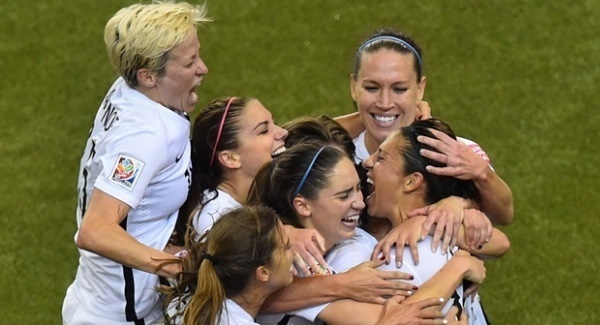
Many of the most high-profile players, including USA stars Abby Wambach and Alex Morgan, put their weight behind a lawsuit that challenged a decision to play the tournament on artificial pitches at venues across six different Canadian cities.
They maintained it was gender discrimination, that the same treatment would not be meted out to men. But in January, the group decided against pursuing the legal action.
Disillusioned with the responses from the requisite authorities, the players’ lawyer, Hampton Dellinger, made a prediction: “Fifa and the Canadian Soccer Association... will fail to host a discrimination-free tournament,” he said.
“They have embarrassed themselves.”
So, has the prediction rang true?
Well, it’s a complex issue. Firstly, the good news. The key buzzword used in advance of the competition was expansion, and this has been the biggest Women’s World Cup yet, in terms of teams and interest.
On the pitch, 24 sides have taken part — a substantial increase on what’s gone before. There have been plenty of feelgood stories, like those countries represented for the first time. Some of those tales were equal parts unsettling and inspirational.
For anyone new to the world of women’s football, the group-stage meeting of Brazil and Spain seemed a mouthwatering prospect. But for the Spaniards, this was a debut World Cup appearance.
In the context of the recent, remarkable advances made by the men’s teams, it seemed almost nonsensical. How could a country that has earmarked itself as revolutionary and progressive, in terms of their philosophy and development of the game, have failed their female footballers so much?
In the team’s poster-girl and captain, Veronica Boquete, you had the perfect answer.
Growing up in Santiago de Compostela in the north-west corner of Spain, she tagged along to the local football team as a kid and watched her father coach and her older brother play.
But she was obsessed with the game too, and grew frustrated with merely being a spectator. She wanted to be involved, and soon was taking part in training. But there was a problem. Girls weren’t allowed to play with the boys.
So, despite working as hard as everyone else during the week, Boquete was forced to sit on the bench when match day came along.
When the rule was eventually changed and Boquete was allowed feature in games, she was overjoyed. But it still didn’t feel right.
When she turned up to play, she had to get changed in the car or in a separate dressing room to her team-mates. And when she walked onto the pitch, she was jeered. Not by her opponents, but by the parents.
They couldn’t understand how a girl was playing with boys. It wasn’t right. It wasn’t normal.
Always, the shadow of the men’s game looms overhead. Everything in women’s football is compared unfavourably and unfairly with it, despite there being so many fundamental differences. And that’s not just in how the game is played but with how it’s covered too.

During England’s recent gut-wrenching semi-final loss to Japan in Edmonton, a TV commentator spoke about Steph Houghton — the uncompromising, resilient and commanding English captain. But it wasn’t about her prowess as a footballer or the crucial equaliser she had conjured in the round of 16 clash with Norway. Instead, we heard of how she is obsessed with David Beckham, met him once and immediately afterward phoned her mother to tell her “he was perfect”.
It was a cringeworthy reminder of an uncomfortable and inconvenient truth that permeates women’s sport generally. At times, the male-dominated media coverage can embarrass itself with its lack of understanding and awareness.
Why, for instance, are there not female football commentators covering a Women’s World Cup?
Are there any?
Jacqui Oatley, who the BBC briefly used as a commentator on Match of the Day before they quickly abandoned the idea amid widespread consternation and ridicule from its viewers, is in front of camera and anchoring the station’s broadcasts.
The logic appears to be that the masses are okay with watching women presenting sports. But listening to women describe live action just isn’t normal. Just like Boquete playing with the boys in Spain.
Earlier this week, Alex Morgan, the USA’s supremely-gifted attacker, was the focus of a profile on the official Fifa website.
The opening paragraph described her as “a talented goalscorer with a style that is very easy on the eye and good looks to match”. Back in February, CNN suggested Morgan was “football’s answer to Ursula Andress” and poured over her having posed for Sports Illustrated’s Swimsuit Edition.
They offered up the following opening paragraph describing her magazine photoshoot.
“She looks every inch a Bond girl, reclining in the Caribbean shallows, the breakwater washing over her bronzed body as she runs her fingers through her long, lustrous tawny locks. Slim, toned with rock-hard abs, she has a physique that 007 himself would probably kill for.”
Morgan, who turned 26 on Thursday, is the biggest name in women’s football and she earns about €2.6m per year. But her looks had little to do with her becoming a star.
She illuminated the 2011 World Cup, coming on as a substitute and scoring in both the semi-finals and final. Young and brilliant, America fell in love with her.
She exploded online. Her Twitter followers increased 10-fold — from 10,000 to 100,000 overnight. Fast-forward four years, and Morgan now has a network of followers and fans close to five million deep across various social media. It’s quite the imprint.
An inspiration to so many women because of her talent, accomplishments and savvy, she’s still consistently undermined and patronised by those who obsess over the way she looks and not the way she plays.
And in many ways, she’s the perfect metaphor for how the sport continues to be treated.
From an organisational perspective, this summer’s World Cup opener was scheduled for June 6 — the same day as the Champions League final. Even when the women get their moment, something’s not quite right. Like Boquete playing with the boys in Spain.
Before the US and Germany — the two highest-ranked teams in the world — faced each other in a highly-anticipated semi-final in Montreal earlier this week, it became apparent that both groups were staying at the same hotel.
At the pre-game press conference, German coach Silvia Neid was quick to criticise. “I believe this doesn’t meet the level of professionalism you should expect at a World Cup. You run into each other all over the hotel, stand together in the elevator, in the lobby. Even if you know and like each other, it’s not easy always having to make small-talk.” After the US won 2-0 in a dramatic and controversial tie, they celebrated back at their hotel and bumped into the German players once again.
Of course, there have been plenty of positives too. There is a massive TV audience for this World Cup, particularly in North America, with various records broken north and south of the border in recent weeks. Across Europe, in Germany and France mainly, there have been plenty of eye-catching television figures too, with encouraging progress made in China and Japan also.
In the US, Fox are the host broadcasters and their coverage of the country’s enthralling semi-final against the Germans raked in an average of 8.4 million viewers, making it the network’s most-watched programme since an April 1 airing of American Idol. And that is a sizeable statement to make. But still, the attitudes remain an issue.
It’s 11 years since Fifa president Sepp Blatter outlined his thoughts on how best to make women’s football more popular.
“Let the women play in more feminine clothes like they do in volleyball,” he memorably said. “They could, for example, have tighter shorts. Female players are pretty, if you excuse me for saying so.”
The common perception is that such opinions are a thing of the past, that we’ve all moved on a lot since then. But during this tournament, Marco Aurelio Cunha, the coordinator for women’s football in Brazil, told Canada’s Globe and Mail newspaper: “Now the women are getting more beautiful, putting on make-up. They go in the field in an elegant manner,” he said. “Women’s football used to copy men’s football. Even the jersey model, it was more masculine. We used to dress the girls as boys. So the team lacked a spirit of elegance, femininity. Now the shorts are a bit shorter, the hair styles are more done up. It’s not a woman dressed as a man.” Even when things are good, there’s something not quite right.
Germany face England in tonight’s World Cup play-off for third and fourth place at 9pm. Tomorrow night’s final between USA and Japan kicks off at midnight.
The Women’s World Cup has been an unqualified success but sexism still remains a huge challenge for the sport and its players.