Simon Baker: ‘It’s the same principle: you’ve got to get the ball into the back of the net’
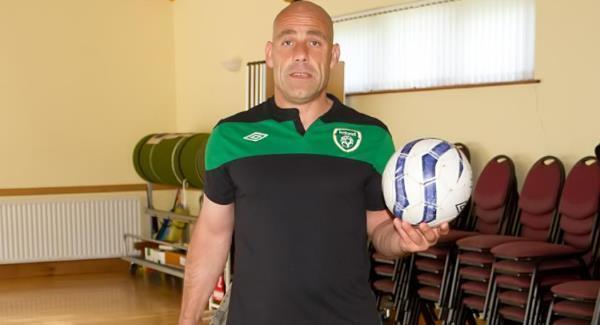
A: It’s the same game except in amputee football you have one bit missing! That’s either your leg, or your arm if you’re a goalkeeper. It’s the same principle though: you’ve got to get the ball into the back of the net. It’s seven-a-side and you’re not allowed to control the ball with your crutches; you can only control the ball with your one and only leg. You can’t even control the ball with your residual limb because some people are above the knee, some people are below. So it’s leg off, game on!
A: My accident was in 2004 and, after a couple of years of depression and feeling sorry for myself, I turned my life around. In 2008, I did the Dublin Marathon on crutches, because I wasn’t together with my prosthesis at the time, and entered into the Guinness Book of Records for the fastest marathon. Sport was a fantastic medicine to get out there and feel good. Plus sport was a way of breaking down that barrier. So I knew there must be other amputees out there the same. Then I came across amputee football and got in touch with Oisin Jordan of the FAI and Paddy Power, who had sponsored me for the marathon. Between them, we were able to get it off the ground.
A: In 2004, I had a work-related accident whereby I fell about 12 feet. I spent about 22 weeks in hospital, I had eight operations and, for a finish, it still wasn’t knitting together. So I said, ‘you’ve had eight months, now it’s my turn — let’s get rid of the leg.’ To be honest I never looked back, because then it was down to me.
A: Within the team there’s that camaraderie but we’re only there to talk about football. It was two years down the road before I even knew how some lads had lost their legs because we don’t compare prosthetics. We train hard, we play hard and we work very hard to get rid of that ‘disabled’ label. With the juniors, it’s great for me to see a kid who’s five years of age on crutches, with no prosthesis, out football training. Then you go to the other end of the spectrum and you have me, 48, and can’t wait for these young kids to come up so I can stop playing!
A: It has to be the World Cup in Mexico last year, which was fantastic. But a close second would be sitting down earlier this year with Uefa and getting the recognition for our sport with the setting up of the European Amputee Football Federation, of which I’m secretary general. That’s been an amazing thing because it means we’re going in the right direction.
A: Russia won the World Cup this year and won it really well. You’ve also got the Turkish League, which has 24 teams and two leagues. The first league, which has 12 teams, pays their players. The average player is on $1,000 per game. We’re a long way off that but if they can do it, there’s no reason why we can’t. The biggest thing for us is always funding.
A: This weekend will be tough for the lads because we’re flying out on Friday and we don’t get to where we’re going until 12 o’clock at night. 10am the following morning is the opening ceremony and at 10.30am we’re playing Poland. We’re playing three international games over two days but we’re professionally prepared.
A: Once a month we come together in the University of Limerick for a full weekend but the lads are given a three-week training programme to adhere to. We don’t want players to get an Irish cap for the sake of getting an Irish cap; you’ve got to earn it as well. Just to give a rough idea, we do the 20-metre bleep test over 15-metres, to allow for the crutches, and the benchmark among our lads is 10 plus. We have lads who will get to 14 or 15.
A: I only stay at the back and look ugly! I don’t understand all this technical stuff — I lose it when they start putting all these cones down. But if you tell me, ‘see this section here? Nobody can come past this with the ball…’ Then I understand that.
A: We’re hoping to run a European International Junior Amputee Soccer Camp, where we’re going to bring 20 to 50 young amputee football players from across Europe here to play football with professional coaches. Next year there is a World Cup and in 2017 we need to prepare a team for the European Championships. We’re in the process of trying to start our league up now, so we’re hoping to take that on the road later this year and try to recruit players. But the main thing, working with the organisation across the world, is to get into the Paralympics. That’s our goal.
A: No, no — I work full-time as a housing manager but this is my passion. After we come back from Poland, I’ll probably have used 12 or 15 holiday days. As my fiancée said to me, ‘every single one of those days has been taken because of amputee football.”

CONNECT WITH US TODAY



Be the first to know the latest news and updates