Leader Cafu hasn’t forgotten favela out in swanky suburbs
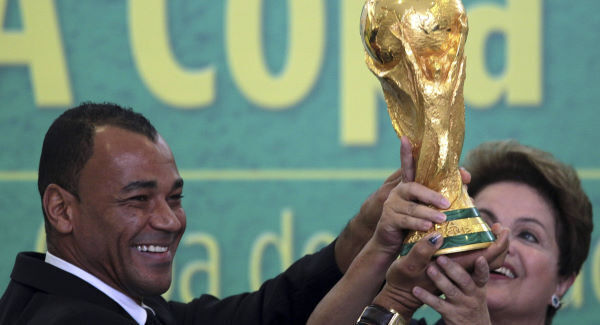
Instead, he is the only man in history to have played in three World Cup finals, captaining the side to victory in 2002.
In doing so he became one of the most celebrated figures in Brazilian public life, in part because he never forgot where he came from: the favela, the street.
You could say he escaped the Jardim Irene favela he was born into, but he doesn’t see it like that.
“I learnt a lot from my favela,” he tells me as he sits in the cinema of his house on the outskirts of Sao Paulo.
“I learnt respect, education, hard work, and that is why I am here talking to you. If you are born somewhere where there are no conditions for you [to prosper] it doesn’t mean you cannot overcome these difficulties.”
Yet Cafu is aware of the vast divide between rich and poor in Brazil. He has long since bridged that chasm and his house is something to behold. Security is tight, with passport numbers sent in advance and checked by armed guards when you arrive.
As a genuine man of the people it seems odd to see Cafu in these circumstances, but Brazil is not a country where you can afford to take chances — and the guards mean he can play football with his friends (ie former Selecao team-mates) on his pristine football pitch.
The schism in Brazilian society is plain to see though, and less than five miles from where we meet an anti-World Cup protest ends with vivid pictures of demonstrators with blood pouring from their faces.
Despite the marvellous football we have been treated to so far the tournament is in danger of being remembered for events off the pitch, with Sao Paulo repeatedly brought to a standstill by strikes.
Firstly it was the bus drivers, then the teachers, and finally the metro workers. Everyone with a grudge — and everyone has a grudge in Brazil these days — is using the World Cup to ensure they are heard.
Cafu, for one, is adamant they should be.
“We live in a democratic country so it is fair to ask for what we need,” he says. “We have to know what the people need from the government. That is important. The Brazilian people are not against the World Cup, they are against the way it was done and the public expenditure, the structures of the stadium that would benefit the public if they didn’t happen [and were spent elsewhere].
“Everyone is happy to have the World Cup and the nation would be glad if we won, but it won’t solve the problems of our country. We cannot give the responsibility of all this to 23 players. The responsibility they have is to play, to try to be the best, not just to make the country proud but because they want to.”
The figures involved are stark. Some €8.6bn has been spent on the tournament, with the stadiums accounting for 31% of that figure and only 7.28% going on public services, according to reports in the local press.
The public are muted in their support of the Selecao, but that has started to change since the opening victory over Croatia. Over the space of 24 hours Sao Paulo — a concrete megalopolis which has commuter towns that are double the size of Dublin — went from being in a state of mild indifference to fervent support of their national team.
That was largely due to Neymar, whose two goals against Croatia went some way to proving he can live up to the hype and expectation that have been placed on his slender shoulders.
Cafu, a vocal cheerleader for the national team, says he never had any doubts the Barcelona man would rise to the occasion, but takes umbrage at comparisons with the last Brazilian striker to have such a responsibility — Ronaldo. The reason for this is not because of the talent, but because Neymar must do it all on his own.
“Today Neymar is the best player in the Brazilian team,” he says. “He has become a reference point in world football.
“It is different [with Neymar] to what happened in the past with Ronaldo. There is much more pressure on him. In 1998 it was split between the players but now no, it is totally different.
“When Ronaldo played in 2002 there were a lot of other players who had responsibility. They could handle pressure, and now just one person has a huge responsibility. He is able to deal with that, hopefully.”
The smart money must be on either Brazil or Argentina being victorious in the Maracana next month. Holland and Italy may have started well, but Cafu believes the climate and the travelling will prove too much for any of the European nations.
“It is very hard for a European team to win this World Cup,” he explains. “The South American teams are used to it [the conditions] due to the various championships they have as preparation for the World Cup. For the European teams it must be very difficult — and there is a tradition that in Brazil a South American team must win the World Cup.”
That is a reference to Uruguay’s victory in 1950, at the expense of Brazil, the hosts. Cafu does not expect a repeat performance, saying repeatedly that Luiz Felipe Scolari’s men will win the tournament.
But as I pack up my things, shake hands and catch the bus away from Cafu’s house and his gated community, it is hard not to think the biggest fight Brazil faces is off the pitch.
As a player there were few battles that Cafu could not win. It is far from clear whether his country can do the same.
CONNECT WITH US TODAY



Be the first to know the latest news and updates