Colombia finally able to dream once more
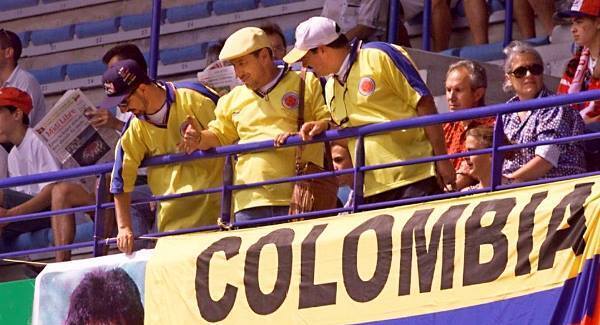
Colombian football seemed to die with Andrés Escobar and drug dealer Pablo Escobar, says Ewan MacKenna.

Colombia finally able to dream once more

At the end of the brilliant documentary, The Two Escobars, there’s an unsurprising sense of regret and mourning from its cast. For some, it was aimed at Andrés. For others, it was thrust towards Pablo. But the one uniting feature was the sorrow at the passing of an era in Colombian football that took much day-to-day hope with it. The national team captain and king of cocaine represented two key strands which made that side so good but by the time the 1994 World Cup reached its second round, a place they presumed they’d be before being crushed under expectation and threat, both were buried in their nation’s soil.

Colombia hobbled to one more World Cup but the heart and money had been ripped from their game.

Too often, we say that sport can transcend life. It can’t. It usually tends to mirror it and not always positively. The birth, existence and passing of that Colombian side is the perfect example as it’s one of the clearest reflections of a nation at any one time. And perhaps it all began with Pablo.

Back in the 1960s, as a teenager on the streets of the north-eastern city of Medellín, his cousin once recalled a conversation. “How can we fix inequality?” Pablo asked himself. “We steal from the rich.” Before long he was robbing gravestones and sanding them down for resale while drug trafficking was the natural destination of such a journey. As for the scale of his eventual empire, his net worth was said to peak at $30bn, he would write off 10% of profits mostly because rats would eat the cash, while his cartel spent $2,500 a month on rubber bands to tie bank notes.

There’s a tendency in the story of such criminals in impoverished countries to paint matters merely black or white, but the reality is usually grey. There’s no ignoring the many acts of butchery that extended from innocent Avianca passengers to presidential candidate Luis Carlos Galán. But in a city that had the highest murder rate in the world at the time, there was another side. In the 1980s, Pablo gave about 1,000 homes to families who had lived on a garbage dump and then there were the football fields he built in poorer neighbourhoods.

That, so often, can be vital to a player’s progression in Latin America as for young boys here, need — rather than the scientific approach of modern European football best illustrated by the present-day production lines in Germany, Spain and Belgium — is what forces you to be good. On such pitches, top players from Colombia’s rise like Chonto Herrera, René Higuita and Leonel Álvarez learned their art. But it wasn’t just at the bottom that Pablo Escobar influenced and forwarded the nation’s game.

With match tickets bought in cash and transfer fees easily exaggerated, narco-football became an important form of money laundering. Pablo bankrolled Atlético Nacional, Jose ‘El Mexicano’ Gacha became involved with Millonarios while Miguel Rodriguez got behind America de Cali. But as the latter’s nephew, Fernando Mondragon of the Cali Cartel, noted, “My uncle would kill someone to win a soccer game, Pablo Escobar would kill anyone to win a soccer game. That was the difference.” It played out that way as well. Between 1985 and 1987, America lost three Copa Libertadores finals. But in 1989 Atlético Nacional became the first Colombian club to win the South American title with Andrés scoring in the penalty shoot-out.

Within Colombia there’s a feeling that during that era, the money druglords invested combined with a special generation meant some serious talent stayed at home. By extension, the familiarity they had with each other helped lead to the tiki-taka-esque style that had Pelé tip them for the 1994 World Cup. Of the 22 players in that squad, just four played outside Colombia, with half the entire party contracted to America and Nacional. The result of it all coming together was illustrated in their final qualifier against Argentina with an automatic World Cup place on the line.

Colombia travelled to Buenos Aires in September 1993 and won 5-0, with Colombia’s leading newspaper printing, “We are living a collective feeling of belonging and nationalist ardour not seen since the war against Peru.” It was 60 years previous.

But that was as good as it would get, as reality was always lurking in a country where you could contract a kill for as little as $75. Even Pablo Escobar couldn’t afford his life. While on the run, he listened to qualification games on a portable radio with gunfights taking place, but he’d never see that World Cup as he was shot by government forces on December 2, 1993. He was buried under a Nacional flag while thousands from the poorer classes cried.

It was supposed to be the start of a clean-up operation for Colombia as the US government pumped money into the country to stop cocaine production and Colombia’s government pumped money into advertising its team as its new face. The reality on and off the field was different. Pablo’s death cracked and fractured the order of crime and in the vacuum there was a squabble for power between government, cartels and militias. Meanwhile the team kicked off their World Cup with a surprise 3-1 defeat to Romania and when they returned to their California hotel, there was no escaping home.

Chonto Herrera’s brother had died in a car crash. Manager Francisco Maturana who previously managed Nacional to a Libertadores title was warned of bomb attacks on his home if Gabriel Gomez wasn’t replaced by Hernán Gaviria for the crunch tie against the USA.

Four days after that, Andrés Escobar scored an own goal that stunned more than a nation and sent them packing. Ten days after that, he was gunned down in the parking lot of a Medellín car park. Why is still not clear, with some suggesting it was as the result of the massive money wagered and lost on the tournament by the cartels.

What is clear is that the captain had gone out that evening, spoken with a girl, been taunted by two men over his own goal and was called a homosexual based on a TV advert he’d appeared in. When he went to have words with them outside, after his own friends left, their bodyguard shot him six times to the words, “Gol, gol, gol, gol, gol, gol.” Colombian football seemed to die with him.

Twenty years on and as the nation embarks on another World Cup with so much justified expectation, it’s hard to say how much life is better as the tale of modern-day Colombia is of good, bad and ugly. Once considered a failed state as the world’s murder capital and producer of 80% of the world’s cocaine, it has at least doubled its oil production, its middle class has grown and banks have taken on the South American market. Yet from 2009 to July 2013, an estimated 7,000 people were killed in the Medellín mafia wars, criminal peace has only happened due to a truce between rival gangs and coca production continues to grow. All the while, Pablo Escobar entered pop culture, with his son profiting from a clothing line with items such as t-shirts with a picture of Escobar’s arrest documents as well as his father’s face. Granted, he’s also met with the son of murdered presidential candidate Luis Carlos Galán and preached reconciliation.

Football has moved on too, and if the three domestic players in the Colombian squad is a sign of a poorer, weaker home league, it’s also a sign of their player strength. Porto striker Jackson Martinez is predicted to be one of the stars of this month. “This national squad, with a new generation of players, is making history,” he says. “Nearly all of us are playing in Europe and we’ve got a wider variety of players and talent than at the 1994 World Cup.”

That remains to be seen and the past still shadows over them. But if the team of 20 years ago is a reflection of that Colombia, perhaps the team of today is a reflection of the hope and the will to move on.

The two Escobars are still lying in the ground, but Colombia’s football has finally risen again.

More in this section

Sport

Newsletter

Sign up to our daily sports bulletin, delivered straight to your inbox at 5pm. Subscribers also receive an exclusive email from our sports desk editors every Friday evening looking forward to the weekend's sporting action.

Cookie Policy Privacy Policy Brand Safety FAQ Help Contact Us Terms and Conditions

© Examiner Echo Group Limited