High and mighty: Belfast's famous Harland & Wolff cranes to be refurbished at cost of €3.6m
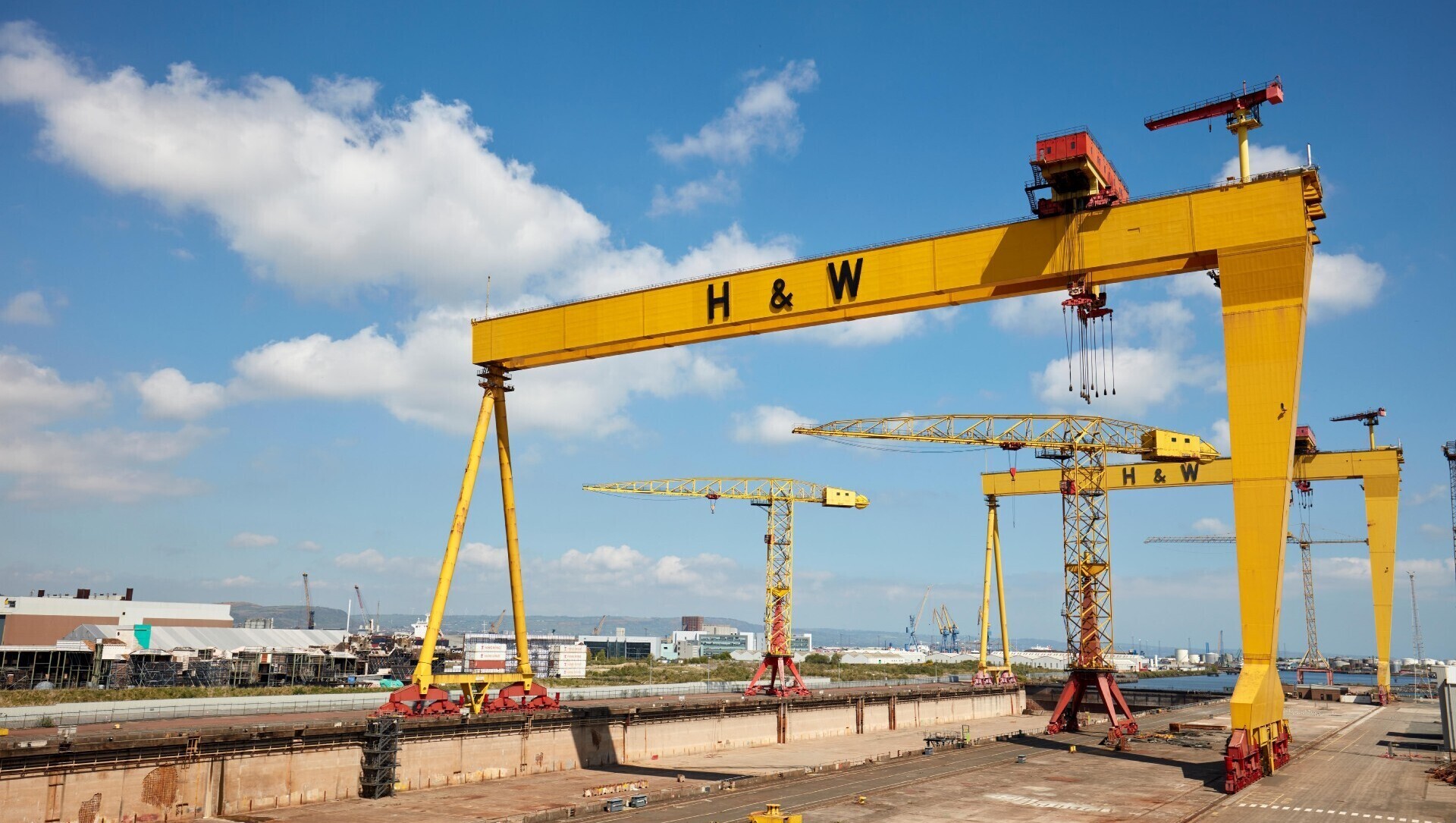
Samson and Goliath, the two yellow Harland & Wolff cranes in Belfast's docks. Picture: Navantia UK/PA Wire
The famous Harland & Wolff cranes in Belfast will be “at their busiest for many years”, after a comprehensive modernisation.
The yellow gantry cranes, known as Samson and Goliath, will be refurbished to the tune of £3.1m (€3.6m) by owners Navantia UK.
The engines of the two cranes will be overhauled and their catenary cables, which supply them with power, are to be replaced.
Engineers will make structural and electrical repairs to them both.
Work has already begun on Goliath, the older of the two cranes, built in 1969 with a height of 96m.
Once complete, the refurbishment will move to Samson, which is the crane closer to the sea and which was installed in 1974 with a height of 106m.
Each crane is capable of lifting 840 tonnes — equivalent to four Boeing 747 jumbo jets.
Work on Samson and Goliath is part of a £98.5 million (€115m) recapitalisation of Harland & Wolff Belfast, which will prepare the yard for naval and commercial shipbuilding projects.
Harland & Wolff has begun a programme to build three fleet solid support ships for the Britain's Royal Fleet Auxiliary.
Carlos Lopez Carregado, general manager at Harland & Wolff, described Samson and Goliath as “symbols of Belfast”.
“We know that the city is proud of them, and this major mechanical, electrical, hydraulic and fabric maintenance project will restore them to their absolute best,” he said.
“We will be replacing parts, updating technology and testing them to see that they can lift at full capacity, and we will be treating them with utmost respect.
“The cranes are sophisticated pieces of machinery capable of carrying enormous weight.
“They will need all of their strength to lift blocks for the fleet solid support vessels, and for future ships which we anticipate building in Belfast.
“You can expect to see Samson and Goliath swing into action soon — they are about to be at their busiest for many years.”


CONNECT WITH US TODAY



Be the first to know the latest news and updates