France’s rhapsody in blue
In Brazil, another generation of France’s mix of ‘black, blanc, beur’ (black, white, Arab) will try to unite the country through football, writes Eoin O’Callaghan.

France’s rhapsody in blue

When the French players celebrated their World Cup triumph on the streets of Paris in the summer of 1998, an elderly woman approached Thierry Henry and thanked him for giving the country its greatest moment since the Liberation. France, however briefly, had been unified by the success of a football team.

On the morning of the final, Le Monde commented on the ‘bonheur precaire’ (fragile happiness) of the occasion and how the divisive topic of French multiculturalism was, at last, being looked upon as something positive. In the midst of other social concerns like rising unemployment and racially-motivated violence, the World Cup odyssey provided some respite for the French public. After the 3-0 win over Brazil, they danced on the streets. On the Champs Élysées, the face of Zinedine Zidane, the team’s hero, was beamed across l’Arc de Triomphe against a backdrop of the tricolor. Zidane, a child of Algerian immigrants, become France’s unlikely poster-boy.

Running parallel to the national team’s success was the increasingly influential extreme-right National Front party and its anti-immigration policies and controversial leader Jean-Marie Le Pen, who questioned the legitimacy of the French squad. He argued it was an ‘artificial’ group with too many foreigners. Marcel Desailly was born in Ghana and adopted by a French diplomat. Lilian Thuram came from the French-Caribbean island of Guadeloupe, Youri Djorkaeff, like Zidane, had Algerian heritage. Patrick Vieira was Senegalese-born.

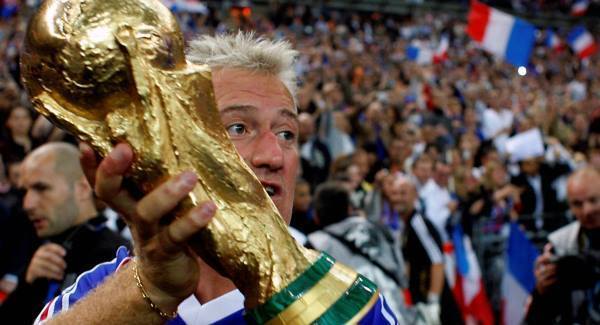
Christian Karembeu was born and bred in the Pacific French island of New Caledonia. But, it mattered little. As the French team was presented with the trophy, Laurent Blanc, reached out and held it in his hands, caught in a haze of disbelief. Desailly did likewise, wrapping his fingers around the golden statue. Zidane, with one arm around Desailly, placed the other on the trophy’s base. France, a country of various colours and backgrounds, together in victory.

But, the unification was fleeting and though Le Pen’s credibility had taken a beating following the World Cup success, his demise was greatly exaggerated. By 2000, an annual French survey that gauged attitudes to race had 36% of people claiming there were too many foreigners in the national team. The following year in Paris, a historic and deeply symbolic friendly between France and its former colony Algeria was abandoned after a pitch invasion. The French anthem was booed and Zidane was abused. He would describe it as the worst moment of his football career. In 2002, Le Pen challenged Jacques Chirac for the French presidency. The team released a statement and urged voters to not be seduced by “attitudes that endanger democracy and freedom”.

Le Pen, incredibly, defeated French Prime Minister and Socialist party leader Lionel Jospin to make the second round of voting. There, as expected, he was beaten by Chirac but still claimed five and a half million votes.

Ever since, the far-right has enjoyed steady support while the country has struggled to recapture the optimism and openness which greeted the 1998 World Cup success. The football side has ebbed and flowed, struggling for consistency, struggling to define itself and descending into a mire of impudence and mistrust, echoing the political landscape.

Four years ago, the French team did unite and staged a mutiny during the World Cup in South Africa. After Nicolas Anelka was sent home for clashing with manager Raymond Domenech, the rest of the squad refused to train. Patrice Evra, the captain, engaged in a heated argument with fitness coach Robert Duverne, with the pair having to be separated. A photographer’s lens captured the moment. France, a country of various colours and backgrounds, were together in defeat.

In Brazil, France will seek redemption and, in the face of the far-right movement becoming ever more influential, attempt to promote the merits of inclusiveness once again. Like 1998, the squad has a rich immigrant nucleus. Paul Pogba, the talented central midfielder, could easily have declared for Guinea, like his two older brothers did. Eliaquim Mangala’s parents are from the Congo while he spent his formative years in Belgium. Moussa Sissoko’s family moved to Europe from Mali before he was born. Blaise Matuidi is of Angolan and Congolese descent. Raphael Varane, like Thierry Henry, has a parent from the French Caribbean island of Martinique. Rio Mavuba was born on a boat off the coast of Angola, as his parents fled the civil war there. Mamadou Sakho, who comes from a Senegalese background and was raised in a Parisian suburb known as ‘Little Africa’, spoke about the team’s DNA, eerily echoing Thuram’s words years before when he said the 1998 team was “the image of the nation, the image of France”.

“This jersey is something wonderful. The team really reflects society — it’s truly multicultural. We all come from different backgrounds or have different religions but together, hand in hand, we’re achieving great things.”

But they very nearly failed to make it to Brazil. Under Didier Deschamps, who as skipper, led his side to World Cup success 16 years ago, France missed out on automatic qualification. Though second-place was acceptable given the reigning World and European champions Spain were in the same group, France struggled in their play-off against Ukraine, losing the first game 2-0. The public was aghast and lost faith. A poll in Le Parisien found 84% were resigned to France being eliminated. On the morning of the game, a familiar name opined why the team was doing so badly. Marine Le Pen, daughter of Jean-Marie and who succeeded him as National Front president, believed “ultra-liberalism applied to football” was to blame, calling the players “badly raised” and “no longer made French people proud”.

But in front of a sell-out crowd, Sakho scored twice while Karim Benzema, who has strong Algerian roots, grabbed another. The crowd was stunned and exhilarated. There was a connection again, a closeness between players and fans that had been sorely missed.

Sakho hopes the performance against Ukraine will help repair the fractured dynamic and that the atmosphere inside Stade de France can be replicated in Brazil.

“Something special took place. The supporters felt it and so did the players. I hope it was the starting point of a new chapter for France.”

At the full-time whistle, the players gathered in the centre-circle. Someone handed Olivier Giroud a microphone. He launched into a rousing rendition of La Marseillaise, backed by his team-mates. The crowd joined in. In 1998, the far right criticised the players for not singing the anthem with enough gusto. Now, a new generation of ‘black, blanc, beur’ (black, white, Arab) delivered each line with vigour. Fans raised their French flags high and proudly. On the pitch, Sakho and Bacary Sagna, born to Senegalese parents, did likewise.

With Franck Ribery out of the World Cup because of injury, it leaves Evra and Hugo Lloris as the only likely starting survivors from 2010. The omission of Samir Nasri said much about Deschamps’ attitude towards a World Cup — it’s no place for disharmony. Instead, he puts his faith in a young, spirited, optimistic group that may go some way to unifying the country again.

More in this section

Sport

Newsletter

Sign up to our daily sports bulletin, delivered straight to your inbox at 5pm. Subscribers also receive an exclusive email from our sports desk editors every Friday evening looking forward to the weekend's sporting action.

Cookie Policy Privacy Policy Brand Safety FAQ Help Contact Us Terms and Conditions

© Examiner Echo Group Limited