Beautiful game, rotten underbelly
It’s amidst the rubble of World Cup selection that there was an interesting release at the Cannes Film Festival the other week. Entitled ‘United Passions’, the synopsis says it’s about “a group of passionate European mavericks who join forces on an ambitious project: FIFA. An epic, untold story that brings to life the inspiring saga of the World Cup and the three determined men who created it. Driven by their vision and passion, Jules Rimet, Joao Havelange and Sepp Blatter overcame their doubts and fought obstacles and scandals to make the World Cup a reality…”
At a cost of €16m to football’s governing body and with Tim Roth, Gérard Depardieu and Sam Neill portraying the three main characters, your first thought is does it includes Blatter’s presidency of the World Society of Friends of Suspenders — an organisation which tried to stop women replacing suspender belts with pantyhose. But when you shrug off the amusement and bemusement of it all, nothing gives a better insight into what awaits us here in Brazil. It’s less than a week to kick-off at the latest World Cup but this is the perfect example of how capitalism has stripped the tournament of its soul and ego has stripped the tournament of its meaning. What we are left with is merely a moral void and local indifference to the games themselves as the result.
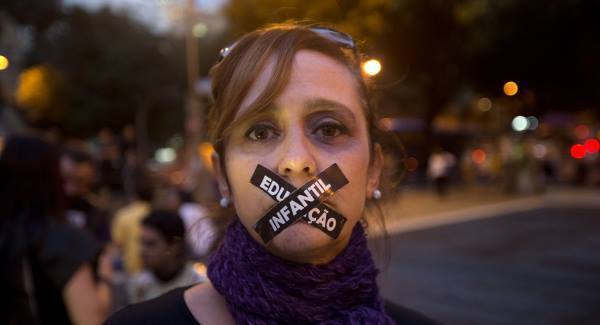
By now you’re well aware of this nation’s forceful feelings but here today, gone tomorrow. The opposition to the tournament is only newsworthy for a short window because when the circus packs up, we’ll all forget.
How many people have since wondered what became of South Africa after the final whistle, when financial reports, profit and loss charts and economic indicators were released? The truth is very few and that is a great shame because it gave a perfect insight into the lies, spin and deceit that overwhelm a tournament once about celebrating the beautiful game.
To be ready for the 2010 version, the South African taxpayer spent nearly €4bn on what is, after all, only a five-week sporting event. But while Fifa earned €2.6bn and returned to Switzerland with €470m profit, South Africa’s own government report assessed the tournament saw them lose more than €2.3bn. As Patrick Bond, director of the University of KwaZulu-Natal centre for civil society put it, “A World Cup could be held at much less expense if Fifa looked at a society’s needs. The tournament gave us a dizzy high, but the hangover, the inequality we have here and social unrest over economic problems, is brutal.”
Beyond brutal. The country was 33% short of the 450,000 visitors that were predicted and by the time everyone went home, the nation recouped just 10% of their outlay. When KPMG surveyed 100 of its top clients, it found just 22% of businesses felt they had gained from the World Cup. Worse again, its clients are the ones who still make most, increasing the social divide all in the name of sporting unity.
During that last World Cup, South Africa’s economic growth actually slowed during the June-July period and since then their stadia have struggled to find a new use. It all shows up the myth that hosting such events is great for a chosen country. Indeed when looking at the Olympics, a 2009 paper by researchers from the University of California Berkeley in collaboration with the Federal Reserve determined nations that lost a bid to host the Games saw their economies grow just as much as those that won. The same principles hold true here. And if you think South Africa was bad, consider that Brazil has spent around three times as much on this World Cup in a country where economic growth is just 0.7%, where the working-class live in poverty and where the middle-class is built on Celtic Tiger-style credit.
Fifa, of course, always promises returns before scampering off with its own accounts very much in the black. This time they are expecting to make €1.5bn tax-free, all the while stopping those less well-off using their initiative to profit from even making souvenirs. As was the case four years ago, such operations will be shut down due to licensing issues yet general-secretary Jerome Valcke still talks a good game.
Just two weeks ago he celebrated the fact record crowds had been drawn to the Mané Garrincha in Brasilia but forgot to mention its €660m cost, making it the second most expensive soccer stadium ever.
At worst, if Fifa want to dump their bloated tournament onto a people, at least let them be able to afford it. And if they want to dump it onto those that can’t afford it, at least let them want it. Neither is the case here. But at best, why not just scale it down because bigger is most certainly not better and international moans about 4G networks and special budgets being passed to suit construction companies building temporary media centres show what it’s become. Instead we just need football, plain and simple, but are left with Valcke criticising people for taking to the streets.
But Valcke and his organisation are the ones who are wrong. So much so that the real winner at this World Cup could be the tournament itself if protests and raw anger makes Fifa realise what they’ve turned it into. Their vision of the tournament has grown too big and too expensive, and deluding themselves on the big screen can’t change that. They’ll learn as much from this week on.
CONNECT WITH US TODAY



Be the first to know the latest news and updates