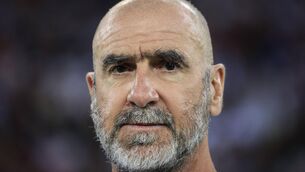
Daft Diego becomes Maradona the messiah
However, as Argentina edge ever closer to World Cup victory, critics are having to look past the madness to once again see the genius behind the man.
For those in Argentina, of course, Maradona has never been anything less than a genius; a mercurial player – perhaps the best the world has ever seen – and a national legend whose contribution to his country goes way beyond the explainable.
But for the rest of the world his behaviour since retiring as a player in 1997 left his reputation, already sullied by the Hand of God in 1986 and a ban for drugs abuse in 1994, open to serious debate.
His weight ballooned, his behaviour deteriorated and he came close to death just three years ago after being admitted to a psychiatric hospital for hepatitis and alcohol addiction.
“They were all crazy in there,’’ he later recalled. “One guy said he was Napoleon and they didn’t believe him. I said I was Maradona and they didn't believe me, either.’’
Since then, however, people are re-discovering the real Maradona, the football genius who lit up so many lives in the 1980s and 90s with his mesmerising skills on a football pitch.
It has taken time because when he was first appointed manager in November 2008, with almost no coaching experience, there was widespread scepticism that his stewardship would last anything more than a few weeks.
But, slowly, Maradona has weaved his magic in a different way.
The new era began, ironically, at Hampden Park, the same stadium where Maradona scored his first ever international goal 29 years before, and it has survived a rocky road to South Africa. That included a serious falling out with the critical Argentinean media and a 6-1 defeat against Bolivia when he refused to acknowledge the problems altitude could pose and flew his team into La Paz on the day of the game.
The frequent bouts of madness have not dissipated, either, whether in his legendary post-match rants, caustic insults aimed at arch-rival Pele, or bizarre off-field antics that have bemused and amused in equal measure.
Here in South Africa he ran over a photographer and called him an “asshole” for getting his foot in the way; told Pele to ‘‘go back to the museum’’ when the Brazilian dared to criticise him, and vowed to run through Buenos Aires naked if Argentina win the World Cup.
Memories of his infamous abuse-filled rant at Argentina’s bewildered media on the day the team qualified for the finals (the monologue began with “you can suck on this and keep sucking” and got gradually worse) will never truly die.
But now contemplate the other side of the coin – the sane side, the inspired side, the side that proves there is method in the madness.
Much of the criticism faced by Maradona over the last year has been ill-judged and twisted, so much so that a closer look at the facts reveals a successful style of leadership that perhaps Jose Mourinho would identify with and a distraction technique that is not wholly dissimilar to that used by the new Real Madrid manager.
Accusations for instance that Maradona used 107 players in qualifying, a statistic which has spread like wildfire, are simply not true. In fact he used only 36, just three more than England, and has settled on a steady squad for the World Cup with a collective spirit that is the key to their success.
His nomination of Javier Mascherano as captain has been inspired and his clever management of Lionel Messi at this tournament – including copious public praise and encouragement – has ended criticism that the Barcelona man cared more for his club than country and has seen him flourish in international football. Messi was named captain for the final group game against Greece, drawing him ever closer to his idol.
With Argentina in the quarter-finals nobody now is complaining about Esteban Cambiasso and Javier Zanetti being left out of the squad because the team’s spirit, not to mention their tactical excellence, is the talk of South Africa.
Maybe we shouldn’t have doubted him. It’s all too easy to forget that as a player, particularly at Napoli, Maradona was tactically aware on the field, directing team-mates in the heat of battle, and it seems his football brain has not suffered the same battering as his physical health.
Although his leadership style is heavily reliant on his own inspirational qualities, it’s fair to say his tactics, and in particularly his substitutions, have been increasingly influential and there is more than enough evidence to suggest real managerial talent.
The real test comes against Germany in Cape Town today, of course, and potentially against Spain in the semi-final and maybe even the Netherlands at Soccer City on July 11.
If he gets that far then method rather than the madness will be the talk of the day at last. At least until we get to see those famous tattoos, and a whole lot more that we’d probably rather not see, running through the streets of Buenos Aires.