One French giant is felled, another looms in Marseille
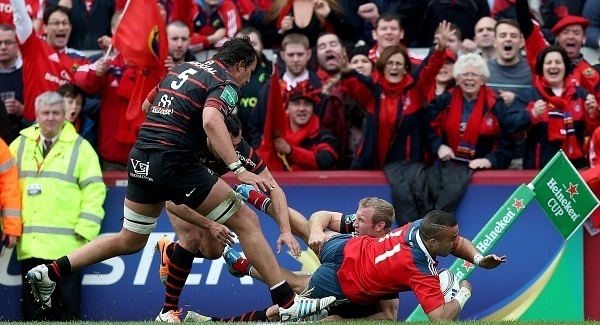

Unfortunately, playing against a Toulon side blessed with power, pace and more than a sprinkle of star quality in the blistering heat, it just proved a step too far.
As a consequence, Munster now carry Irish hopes into the last four when a legitimate claim for all three Irish quarter-finalists could be made after Munster set the ball rolling with that excellent win over Toulouse in the weekend’s opening quarter-final.
Ulster’s fate was decided as early as the fourth minute with the sending off of influential full-back Jared Payne after a clumsy midair collision with his opposite number Alex Goode. A yellow card would have been a sufficient sanction. That, coupled with the fact Ulster also lost Rory Best to an ankle injury minutes later and Ruan Pienaar was operating on half steam due to a shoulder problem, sealed their fate. Their performance in adversity deserved better and losing this one will hurt even more than their reversal in Twickenham last season.
As Munster found to their cost at the pool stage back in 2011, the Stade Felix Mayol is a very difficult place to go and win. Leinster competed manfully in an engaging opening half, despite being under siege for long periods. Their famed scramble defence kept them alive, miraculously at times, when they managed to hold their try line intact to reach half-time on level terms.
Given the pressure they were under, that was some achievement, but when you travel to the rugby heartlands of the south of France, it is imperative that you hang in there and weather the storm. That is exactly what Leinster achieved, showing the character that has landed silverware in each of the last three seasons.
It seemed inevitable, however, that the dam would burst at some stage and the fact that it happened in those championship minutes just after the break, with Toulon bagging 10 unanswered points, heaped enormous pressure on the visitors.
It didn’t help either that Toulon were doing to Leinster at the breakdown what Leinster have achieved against all comers for years in manufacturing turnovers. In this respect, Toulon open side Steffon Armitage was outstanding. For how long more can England coach Stuart Lancaster afford to ignore his talents on his self-imposed policy of not selecting foreign-based players? He was superlative and Rob Penney will have to devise a plan for dealing with his particular skill set if Munster are to have any chance of advancing to the final.
The manner in which Toulon pulled away from Leinster, despite a heroic scrummaging effort from Mike Ross and Cian Healy, will also send alarm bells ringing. Even with a decent set-piece platform, Leinster never got Brian O’Driscoll and Gordon D’Arcy into the game.
Their traditional game is all about retaining possession, taking the opposition through multi phases until the gaps appear, when they normally have the facility to put you away. It never looked like happening in this contest due to a mix of kicking away far too much possession and their inability to generate any speed in recycling possession at the breakdown. That killed them and they were never able to impose themselves for long enough periods.
Toulon were also very disciplined in their defensive organisation with their line speed causing Leinster all kinds of problems. A try in the corner from a well constructed lineout maul offered Leinster a glimmer of hope with 10 minutes to go but they never managed to gain a foothold in the Toulon 22 to narrow a 12-point gap further.
The tenacity with which the outstanding Toulon back row of Armitage, Juan Smith and Juan Martin Fernandez Lobbe hunted the ball in the tackle saw to that and thus O’Driscoll’s great love affair with the Heineken Cup has come to a sad end. Just like Leinster, he gave it his best shot but Toulon were not the willing accomplice that France proved to be at the Stade de France a few weeks ago.
How fitting that Munster should sign off on their Heineken Cup odyssey at Thomond Park with a try from the irrepressible Paul O’Connell. The Limerick rugby fortress has served Munster’s cause well over the 19 years of this tournament before a new chapter opens next season. The bookies had this one at a four-point spread in Munster’s favour so to end up beating the mighty Toulouse by a margin of 24 points was a spectacular outcome.
When Clement Poitrenaud spoke about the honour of playing in Thomond Park for the first time two months ago, he also expressed a fear that Toulouse could be humiliated. You dismissed that reaction with scepticism at the time but in the end this once mighty force were all but humiliated, saved only by flashes of genius in attack in the second half from Hosea Gear, Luke McAlister and Yoann Huget.
Guy Noves selected his forward unit based almost exclusively on the weighing scales. In Louis Picamoles, Yoann Maestri, Patricio Albecete and Joe Tekori, Toulouse had forwards of beastly proportions. The one area of vulnerability however without the injured Thierry Dusatuoir and Yannick Nyanga was an ability to compete on the floor. That proved crucial, with Munster engineering several crucial turnovers.
The task for Munster was to sow a seed of doubt in the vulnerable mindset of the Toulouse players as quickly as possible. They achieved that as early as the fourth minute with an explosive start that yielded a superb try for Keith Earls. The gauntlet was thrown down to this gargantuan Toulouse pack but they had no stomach for the fight.
This was evident from the early scrums where Dave Kilcoyne was rewarded for his dominance over Census Johnston’s tight-head replacement, Yoann Montes. Kilcoyne had the Toulouse tight-head in his pocket and Munster got the rewards, unlike what happened in similar circumstances against Leinster the previous week. The psychological effect was immense.
With their scrum in trouble, Toulouse were forced to place a heavy reliance on Louis Picamoles to get them over the gain line. The fact that Munster restricted the explosive number eight to two carries in the opening 40 and turned over possession on both occasions was critical to the outcome. That just doesn’t happen to Picamoles and was a testimony to the work rate of the nearest Munster player, be he a back or forward, who took it upon himself to attack the ball and hold up the big man in the tackle.
If Munster’s dominance in the set piece and on the deck laid the foundations for this spectacular win, the deciding factor was the strength and choreography of their maul, which tore the heart out of the visitors’ challenge. At times, despite their international experience and class, Toulouse looked disjointed and clueless in terms of what to do next.
So Munster sign off on Thomond Parks Heineken Cup tenure in a manner befitting the legacy of those who set the ground rules against French teams travelling to this demanding setting. Eleven French clubs embracing 22 competitive outings travelled to Limerick in an attempt to overturn the hosts. All have failed. Munster now advance to the semi-final for the second successive year under Rob Penney’s direction which forces me to ask the question once again.
Why is he leaving?