Comment: Ireland were on shaky ground long before referee's controversial call
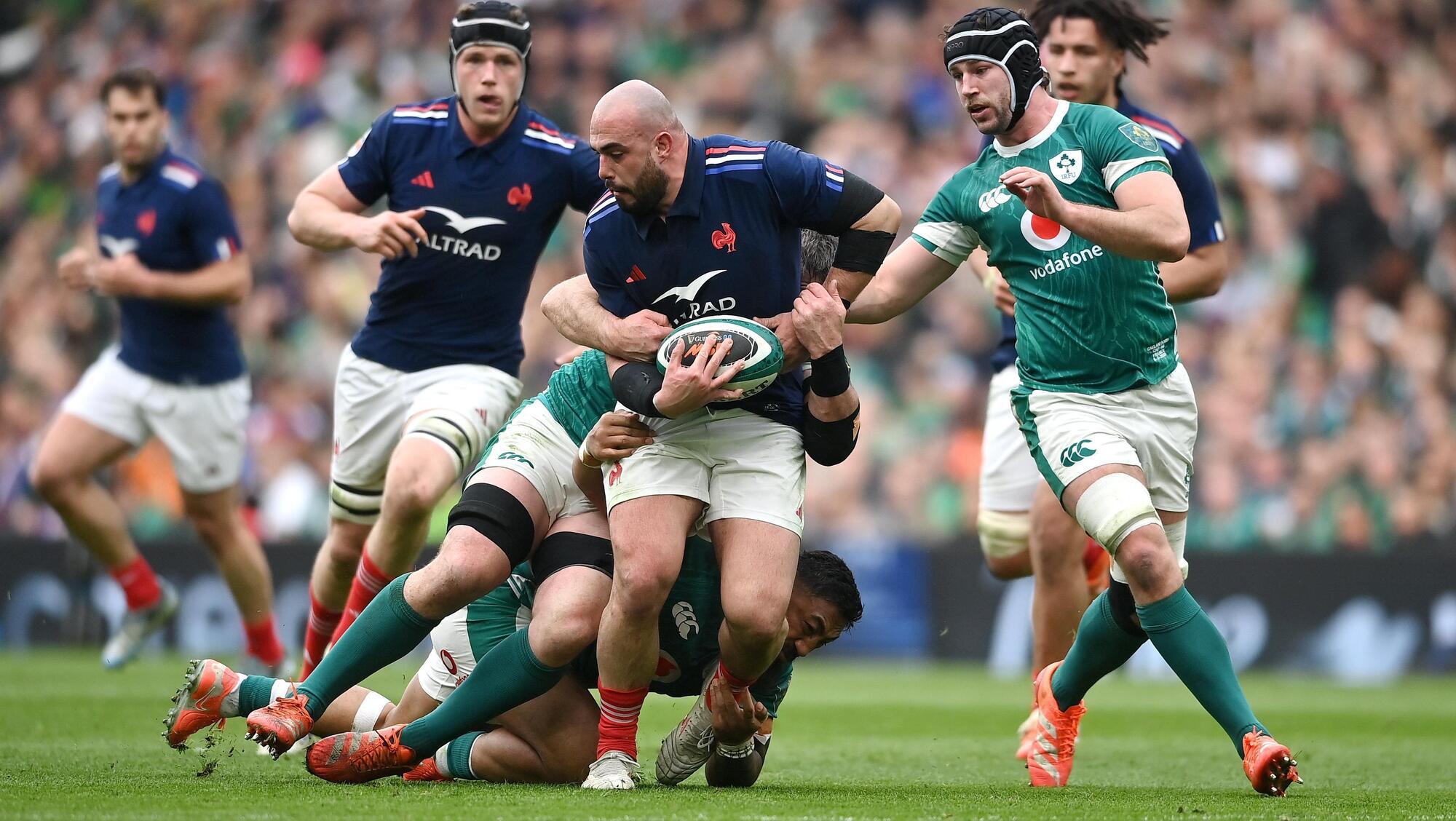
Jean-Baptiste Gros of France is tackled by Peter O'Mahony, left, and Bundee Aki of Ireland. Pic: David Fitzgerald/Sportsfile
Five words, one small sentence, impact unknowable. The first thing to say here is that France were sublime in victory over Ireland at the Aviva Stadium on Saturday afternoon.
It’s hard to imagine a parallel universe where they weren’t the ones celebrating.
But we’ll never know how far referee Angus Gardner’s baffling call tipped the scales 47 minutes in.
Dan Sheehan hadn’t long given the hosts the lead with a try on the restart, and on the back of a first-half that had thrown up all sorts of warning signs for Simon Easterby’s side, when the French responded with a score of their own through Paul Boudehent.
The try carried a trail of evidence that needed sifting. Calvin Nash was sent to the bin for a high tackle on Pierre-Louis Barassi.
Then Gardner and his team of officials turned their attention to an off-the-ball tackle by Thibauld Flament on Peter O’Mahony.
The Munster man was miles from the ruck and directly in the path of the ball carrier when Flament emptied him to the floor and created an unimpeded path through the defensive line for Jean-Baptiste Gros. Seconds later and Boudehent was over the chalk.
“The number six was retreating,” said Gardner in sticking to his decision.
Howls of derision and disbelief followed.
The Australian referee had given Caelan Doris short thrift in their dealings all afternoon up to that.
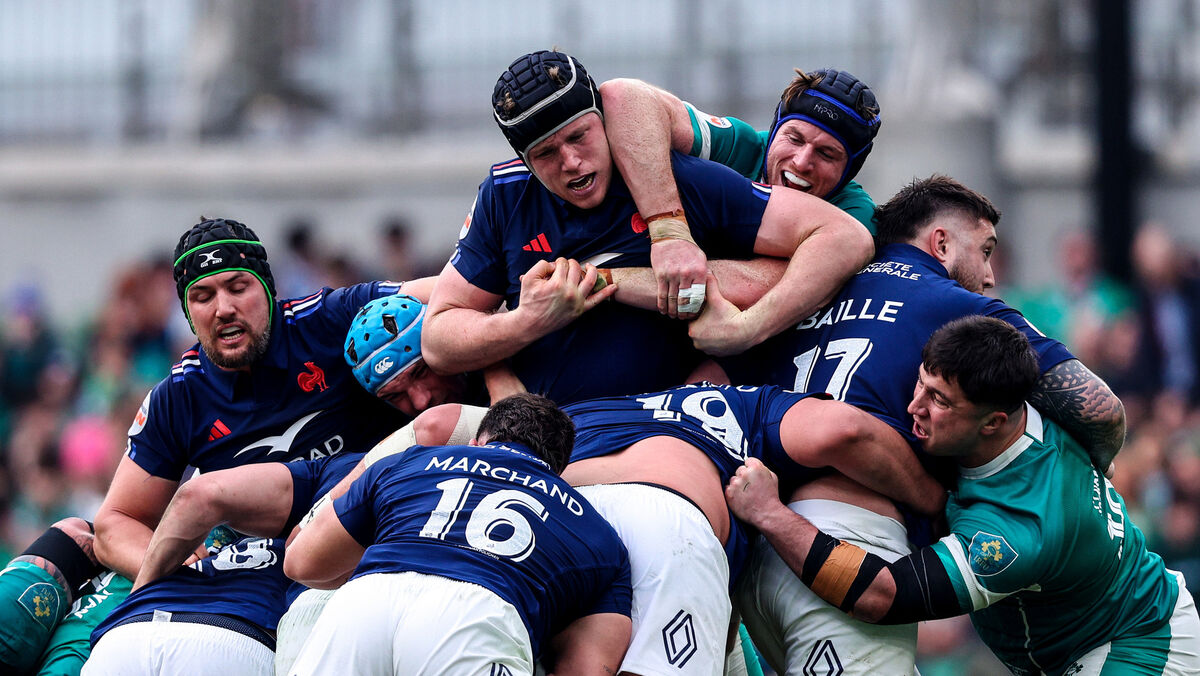
Some of his urgings to speed up at lineout time was hard to argue with but this was the sort of call that lands like a punch to the solar plexus.
The instinct is to present the next five or six minutes, as France added another ten points and cut a swathe through the reduced Irish defence, and argue that the dye was all but set anyway.
The fact is that moments swing games, and momentum, and this was seismic.
It’s not beyond reason that Ireland could have bolted the door for the next ten minutes, that they could have seen out the approaching storm and come back at the visitors with a less daunting gap between them on the scoreboard.
As it was, France put the game to bed before Ireland found the smelling salts, tries from Louis Bielle-Biarrey and Oscar Jegou, and two Ramos penalties, pushing the advantage out to 23 points at a stage when everyone expected a titanic end game.
They racked up 24 points in just 12 second-half minutes but, like Hemmingway said about bankruptcy, this had been coming gradually before it happened all of a sudden because if Ireland are being honest then they struggled all day.
The hosts had possession and territory stats in the high-80s through the first 15 minutes but couldn’t put a point on the board.
France, even in those stages, looked lethal on the break with next to no ball to call their own and with a first try disallowed.
Ireland picked up two yellow cards, one utterly needless by Joe McCarthy and the other for Calvin Nash who caught an opponent high in the tackle, and they conceded 15 points while down to 14 men in a game that they lost by … 15 points.
Even the departure of Antoine Dupont to an injury in a 29th-minute ruck couldn’t derail France or kickstart Ireland into something approaching a rhythm on a day when all their intricate patterns and direct running didn’t pay off until two garbage-time tries.
As a game, it leaves us with plenty to unpack but that theory about how France’s defeat in Twickenham would only stiffen their resolve here in Dublin and make them more dangerous again turned out to be all too true.
Boil it all down and they hit a hapless Wales for 43 points at home in round one, then put 42 on an Ireland team going bald-headed for what would be an historic third straight Championship title, in Dublin.
Simon Easterby had spoken about his side’s “sticky patches” in the first three Championship games, against England, Scotland and Wales, and Ireland had ticked the box pre-match here in declaring the need to play their best game of the spring this time.
They didn’t come close. They really only have themselves, and France, to blame for that.
CONNECT WITH US TODAY



Be the first to know the latest news and updates