Former Test ref Jaco Peyper backs crucial TMO calls against Ireland
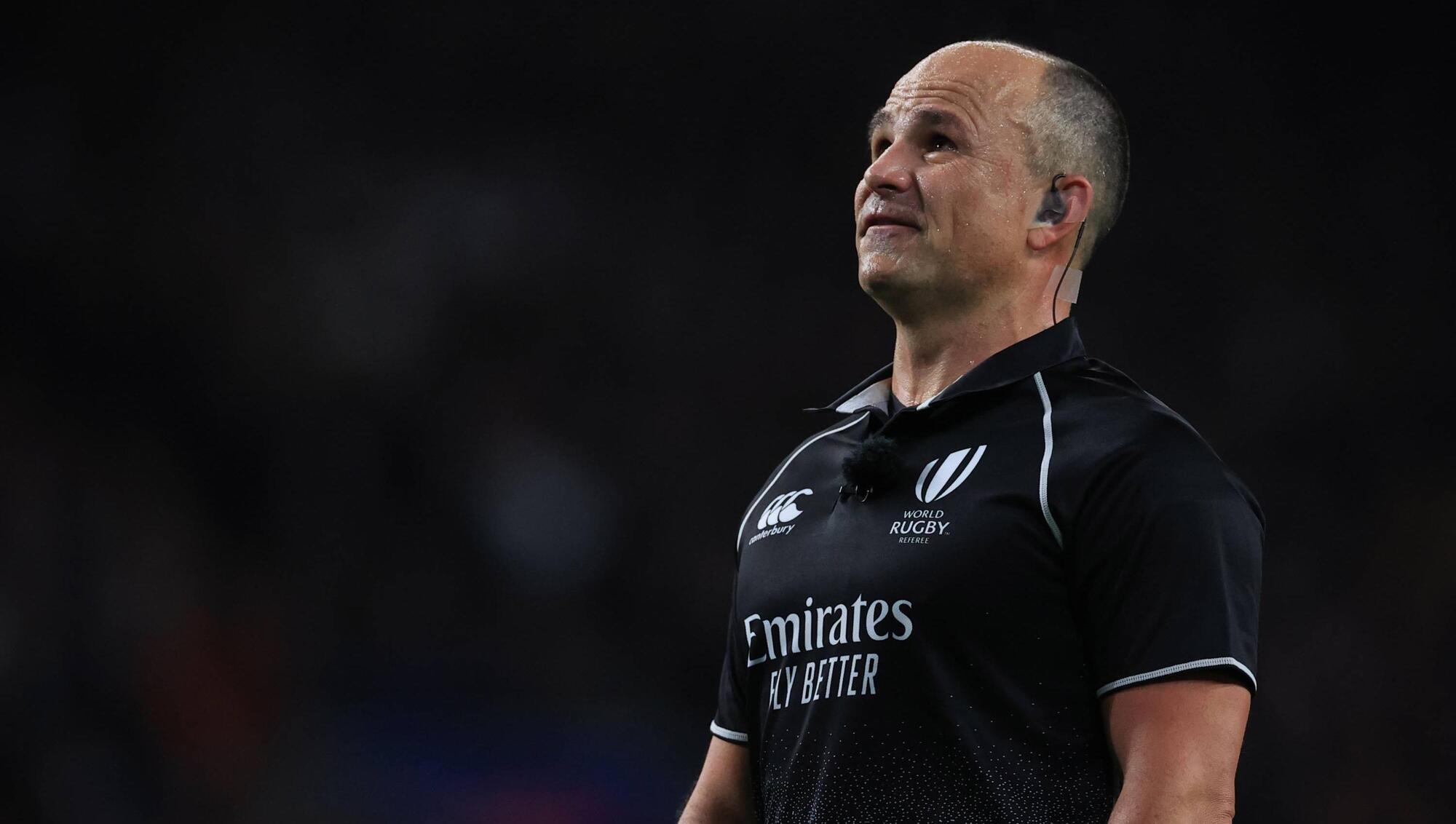
BOKS CLEVER: Referee Jaco Peyper faced the press on Monday.
The Springboks put out former Test referee Jaco Peyper, who is also their recently appointed laws consultant, for media duty in Durban on Monday.
Peyper’s appearance was to address some marginal television match official (TMO) calls in the first Test between the Boks and Ireland, which the home team won 27-20. The second Test is at King’s Park in five day’s time.
Two crucial calls, both involving wing James Lowe, went against Ireland in the space of a few second half minutes, that swung the balance of the contest inexorably the way of the Boks.
Ireland thought they had scored in the 58th minute when Lowe streaked down the wing from 60 metres out after the ball emerged from the side of a ruck to dot down.
TMO Ben Whitehouse intervened, asking referee Luke Pearce to have a look at the ruck and assess how the ball popped out. The conclusion between the officials was that Ireland hooker Ronan Kelleher had hooked the ball back with his foot while lying on the ground.
Peyper, of course, is employed by the South African Rugby Union and part of the Bok management, which does certainly put an asterisk next to his impartiality in the matter.
Speaking purely in technical terms though, it was hard to put holes in his argument for the individual incidents, although the entire set of protocols regarding TMO intervention is a bigger discussion worth having.
“The TMO has the same ability as the coaches, he’s got eight angles at the same time and would have seen a few of those types of actions in the lead-up in different rucks,” Peyper explained.
“It’s got to be factual based. If you get points scored from that, they’re going to have to look at that turnover. Factually, the player is off his feet and he turns over possession.
“Sometimes you don’t want to step in touch but you’re in touch.
“Sometimes you don’t want to make that turnover when you’re off your feet, but you still do it, even though you don’t mean it. Factually: off his feet, turnover made. So the try can’t be scored.
“Then it becomes a debate whether it should be a penalty to Ireland because he was touched to the neck. That is debatable.
"Maybe the officials are trying to stay consistent because a few minutes earlier, there was exactly the same scenario on Kwagga Smith which was played through, so maybe that’s even-handed.
“That’s all in the game of rugby, you can’t referee everything, but you can’t leave stuff that’s high impact.” Six minutes later Bok wing Cheslin Kolbe scored the match-defining try when Lowe attempted to keep a Handre Pollard touchfinder from a penalty, in play.
Lowe flipped the ball back in-field and Kolbe pounded to hack ahead and score. The TMO checked to see if Lowe’s foot had touched the ground outside the field of play, which would have meant a lineout.
Pearce’s on-field decision was a try, and therefore there had to be compelling evidence to overturn the referee’s ruling. While it was extremely tight, no angles could conclusively show Lowe’s foot in touch while he was in contact with the ball.
“It’s fine margins, so they have to be very clear,” Peyper said. “It’s a big Test match so you’d rather have one replay too many than two too little. If the on-field decision is a try, that means it stands until there’s evidence that proves otherwise.
“If it’s suspicious or maybe, play through and the try stands. If they couldn’t prove with facts that he touched the ground, you have to stay with the on-field decision. If we (the Boks) were on the other side, we would have felt aggrieved but if there’s a clear process it would have been followed.”
Both teams agreed to altered TMO protocols before the series and after these incidents it raises the question of whether there is too much influence from the fourth official.
“I think if it’s a technical infringement, but if it’s a player making a decision to go off his feet, I think that’s under a cynical infringement rather than a technical infringement,” said Peyper.
“A player going off his feet, that would be my understanding of it. But if you look at that, I think 10 seconds earlier there was a clear knock-on by Casey (Ireland scrumhalf Craig Casey) behind the ruck, so I think we shouldn’t have got there.”
Read More
Last week Peyper explained how the process would work.
“We are trialling the new television match official protocol. Thanks to Ireland for being willing to go into that space where we all recognise that we have to do something. So we have to get some data and trials and be innovative,” said Peyper at the time.
“The protocol takes you back to the last attacking possession, allowing you to review technicalities up to the last attacking possession, excluding set pieces. Which in the past could only be two phases.
“This gives the TMO a chance in real time to look at something and if there is a clear knock on or clear foot in touch you don’t have to let it play out and then go for a big referral.
“They (TMO) have to have factual proof and then they can just stop the officials and they can go back (to the infringement). So hopefully that will speed up that process.” It appears to neither have sped up the process (it took an age on Kolbe's try), or clarified marginal calls in any significant way."


CONNECT WITH US TODAY



Be the first to know the latest news and updates