Jacques Nienaber: 'I lost a lot of time with my family, that's why I made the decision'
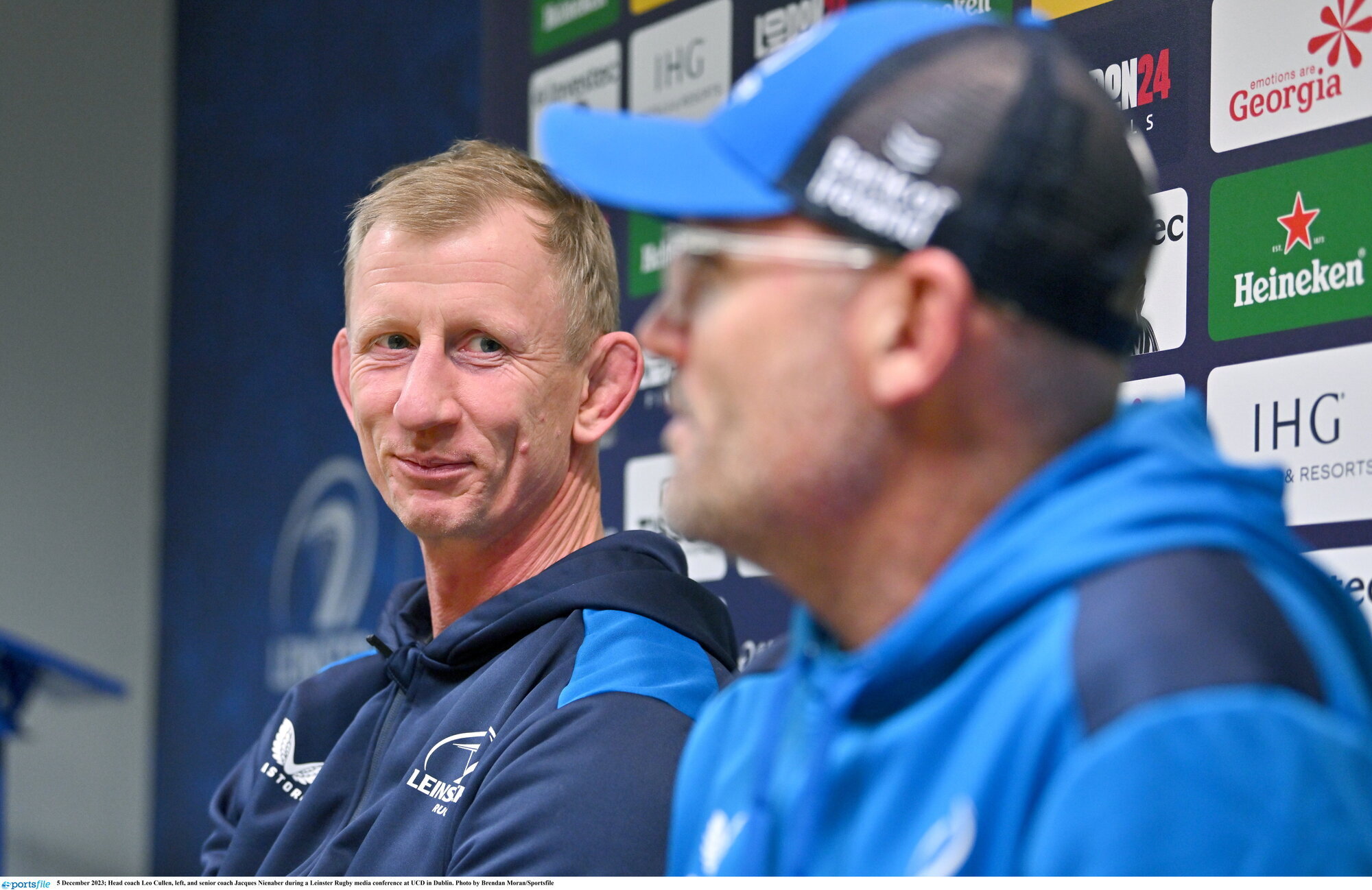
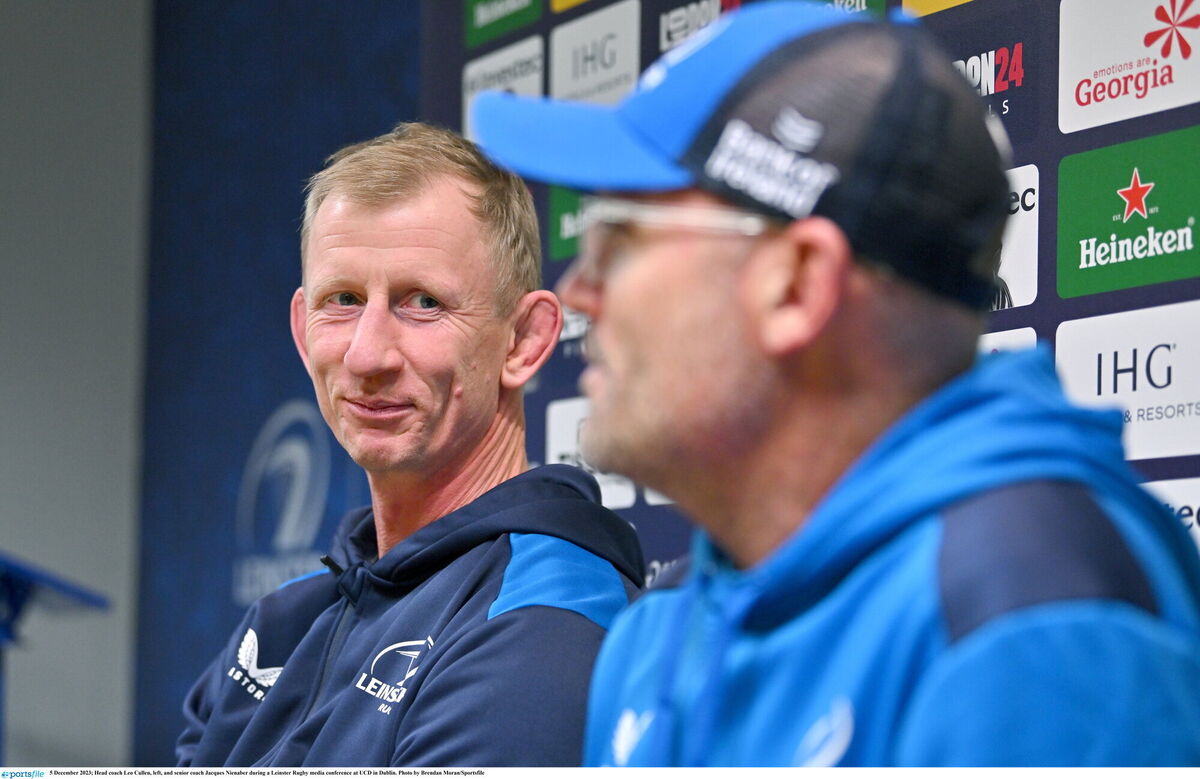
Head coach Leo Cullen, left, and senior coach Jacques Nienaber during a Leinster Rugby media conference at UCD in Dublin. Photo by Brendan Moran/Sportsfile
Jacques Nienaber walked in for his first Leinster press conference on Tuesday and he wasn’t looking back.
The natural impulse was to ask for his reflections on a World Cup where his Springbok side retained their title but he had already cut that cord adrift.
“No, it's gone! Water under the bridge,” he explained just seconds after sitting down.
“The past is the past and the future… You can't change that. One day when you're older maybe you'll enjoy the memories, but it's done.”
Memories. The future. The present. Being present. This is actually the nub of the reason why he is here now in Dublin preparing for Leinster’s opening Champions Cup game against La Rochelle at the weekend and not back home plotting a hat-trick of global conquests.
Like, why Leinster and why now? Why leave the Boks at the peak of their powers? And why would their World Cup winning coach take a job as ‘senior coach’ alongside/under Leo Cullen and not look to be the main man at another Test-level gig?
The answer spools over 600 words and it boils down to time. The 2023 Test season spanned just 13 matches but one of his sons pointed out that he had spent six months and a day of the calendar year to that point away from his home in Cape Town.
So, while Leinster have close to 40 games per season, he can still go home to have dinner with his wife after training. Or he can take up an invitation from his daughter to go see her play netball on a Saturday afternoon.
“I just felt I had lost a lot of time with my family. That's why the decision was made in January/February. My wife said, ‘listen, I don't think we can do another four years of this’. The kids said, ‘dad, we need you at home’.”
That’s where Leinster came in. He needed a change but didn’t want to lose his cutting edge. He needed somewhere he would be challenged, somewhere with big expectations, and this was what he told Rassie Erasmus and the South African union.
“They were happy with it. They gave me their blessing and then, when the opportunity came up, we announced it as quickly as possible because it was never for me [that] I didn't want to work in South Africa anymore.
“There was other offers from other internationals. It wasn't for me to change, or to move, or to come north. It wasn't anything like that. It was just that I needed to get away from international rugby. That was the reason.”
He’s already neck-deep in the club scene.
The players have rhapsodised over a man who was using their own in-house jargon and technical terms on day one last week and he loved everything about his first game, away to Connacht, even the bitter cold, the double-layer socks and the banter with the locals.
He feels at home at Leinster where the expectations shouldered and the standards in preparation and coaching and a squad that demands the best of themselves and everyone else feels very much like the collective he has left behind.
“I don't think mediocracy is something they will endure, so the product I have to deliver as a coach should not be mediocre. Yes, it doesn't mean there won't be failures, [but] you must be well-prepared as much as you can in the timeframe that you have available.”
Most of his career to date has spent as Rassie Erasmus’ right hand. One of the challenges in Dublin will be working his own, compatible groove in the Cullen coaching ticket and a massive part of this will be his expertise in the defensive brief.
“Let me start this way,” he explained, “I don’t think you can copy and paste.”
The blitz that the Boks bring is dependent on a specific set of players with their own skillsets and athletic profiles. Some of Leinster’s will be better, others not as good, in those areas but Nienaber will point out that the Munster team he helped coach defended differently too.
The fact that he is coming to grips with all this mid-season isn’t ideal, and he admits that the process of figuring it all out will be the frustrating part, but some things stay the same regardless of nationality or team colours.
That narrative about Leinster and Ireland having trouble with the biggest boys? Nienaber counters by explaining that Ireland’s pack was ever so slightly the heavier when they faced the Springboks in Paris back in September.
The goal remains the same too.
His South African side clinched a World Cup by winning all of their three knockout games by a single point. Leinster have let slip their last four trophy bids by a combination of six points. And many of their players lost to New Zealand in a one-score game two months ago.
If there is a secret to that success he isn’t sharing it. Luck, he says, is oftentimes the grain of sand that tilts the scales. Or one moment, like when Cheslin Kolbe charged down that Thomas Ramos kick in the quarter-final win against France.
“Sometimes you’re one foot away. Maybe a pass sticks and you score and you win and nobody will ask questions. But sometimes you knock the ball and it just didn’t go your way. You lose and everybody will ask questions. Sometimes you just need a little bit of luck.
“The thing is, in big games, it’s going to be that tight and you must try and play the big points well, if I can put it like that and you must try and nail the big points.
"Hopefully I can add value to that, but there is no silver bullet.”


CONNECT WITH US TODAY



Be the first to know the latest news and updates