No reason France can't go the whole way at the 2027 Rugby World Cup in Australia
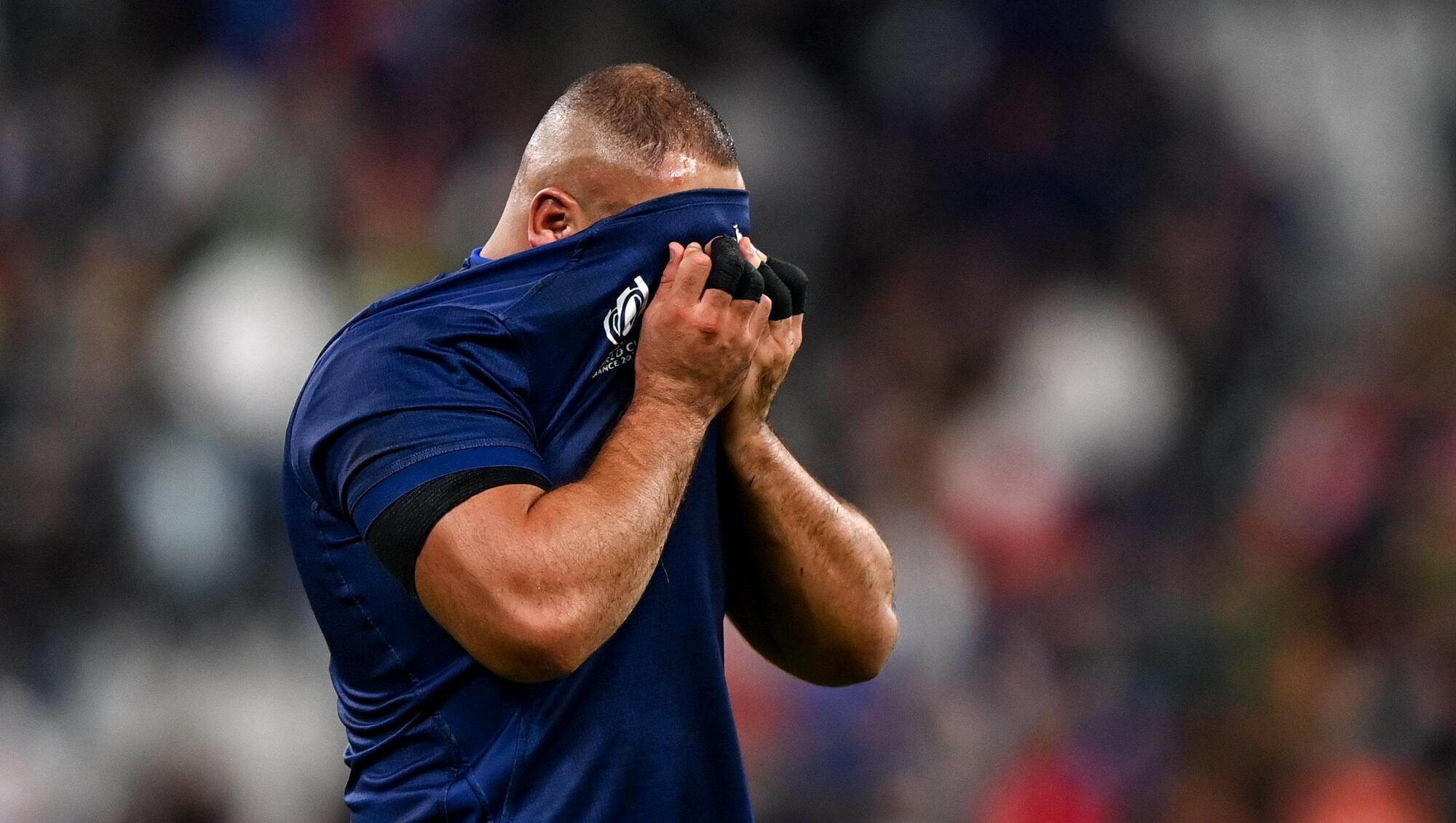
SACRE BLEU: Reda Wardi of France after the 2023 Rugby World Cup quarter-final. Photo by Ramsey Cardy/Sportsfile
Defeat is nothing if not picturesque. Of all the images over the weekend, it was the sight of the French woman with the smudged face paint, squeezed forlornly into a corner of the metro carriage as it wound back into Paris after midnight, that stands out.
Thousands of people had shuffled patiently, meekly, towards the station next to the Stade de France on Sunday evening. The day had been filled with laughter and colour and bounce but there was nothing now so much as near-silence as people and life drained from the stadium and from the World Cup at large.
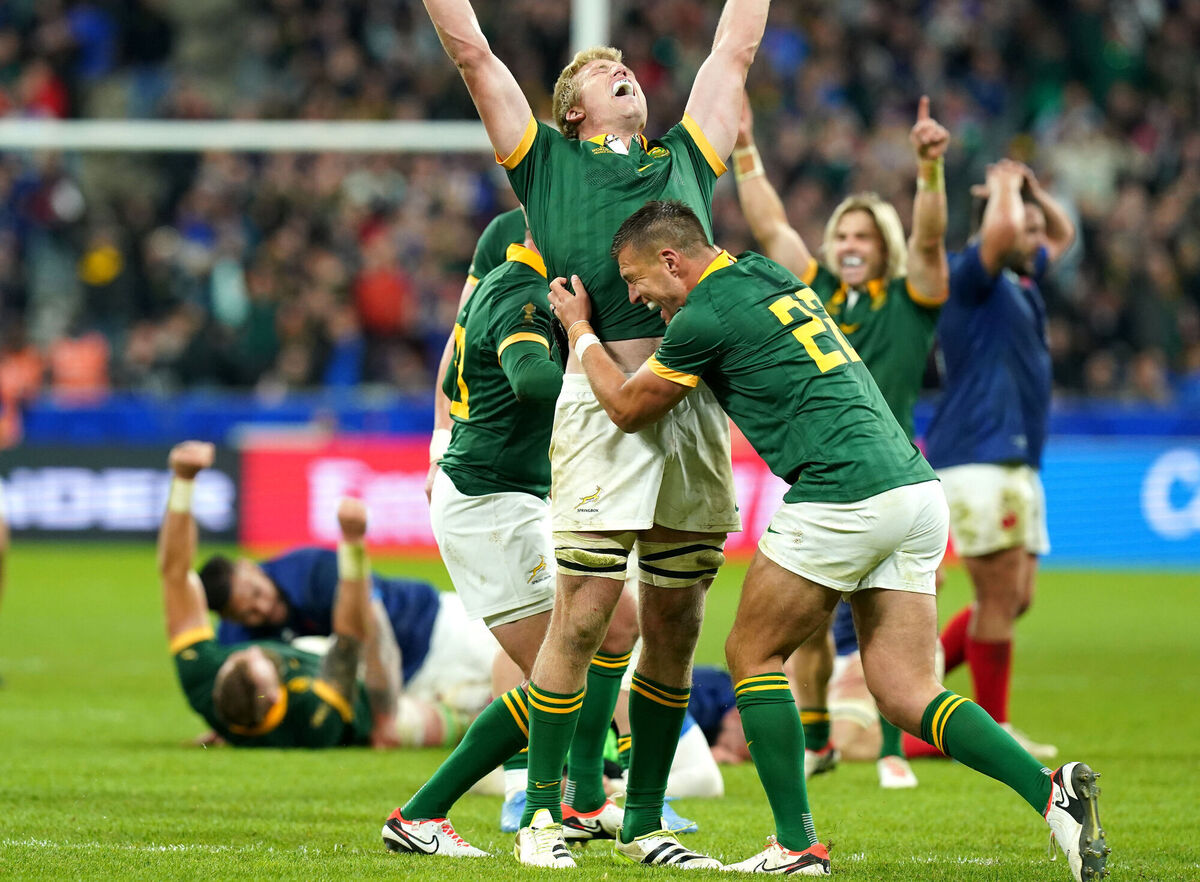
“We’re going to try to find something positive by saying that we have a lot of young players, a fine generation. But the reality is that we failed to get out of the quarter-finals of a home World Cup,” said Matthieu Jalibert after their one-point loss to South Africa.
“That’s going to be hard to accept.” Brutally hard.
The French broadcaster TF1 had teed up their quarter-final against the reigning champions as a “rendez-vous avec son histoire”. There was an expectation that this was their time, their destiny. This was supposed to be their World Cup in every way. The completion of a grand design.
It doesn’t have to be an end. Fabien Galthié has spoken about the ‘arrow of time’ throughout his tenure as head coach, the concept of time as a one-way street. There is no going back. So, while we can turn eggs into an omelette, we can’t turn an omelette into an egg.
It’s deep, scientific stuff at its heart, and it speaks to the work the French have done under Mickaël Campo, their union’s head of mental preparation, but it also brings to mind Eddie O’Sullivan’s old line about how you can’t unring a bell. What’s done is done, basically.
“It's difficult,” said Galthié. “We used ‘the arrow of time’ [analogy] to work and grow with the players according to a certain methodology. We've worked really well over the last four years with the staff, the players and the federation, and we've achieved something great.
“This arrow of time gave us a very clear vision. The French team will continue to play, move forward and develop. Only two players are retiring, Uini Atonio and Romain Taofifenua. As for the rest, what we've just experienced is part of writing the book for the French team.”
As with Ireland, France will need space to wash this one from their hair. None of these players, or the coaches, will ever get the chance to win a World Cup on French soil again but work through the raw hurt and there is hope. Plenty of it.
Andy Farrell has a major body of work to do in rebuilding a squad that can compete at the very top level again come Australia in 2027. Seventeen of his players are 30 or over and Ireland had the second-oldest squad among the world’s top ten here.
France are at the other end of that spectrum. Only eight of their players are into their fourth decade and only an Australian team that had been shorn of far too much experience by the combustible Eddie Jones boasted a lower average age than their 26.1.
All that can be traced back to Galthié's first squad, picked in January 2020, when he named 19 uncapped players for the approaching Six Nations. He omitted any number of big names: Maxime Médard, Yoann Huget and Camille Lopez among them.
And he did all that after the retirements post-Japan of Guilhem Guirado, Wesley Fofana, Louis Picamoles and Seébastien Vahaamahina. Bernard Le Roux was the only man aged 30 or over who was included in that initial gathering.
That created a foundation that will stand to them going forward.
“The France team will go on,” said centre Jonathan Danty. “We’ll be at the World Cup in four years' time.
"There are still some fine players to watch. For me, the next World Cup will be complicated. That's a discussion I'll have to have with the staff. I'm 31. If they want to work over a four-year period, maybe I won't be part of it.”
Ireland’s consistent failures at World Cups show again the limitations of four-year cycles and best-laid plans so maybe Danty has a few Test seasons left in him yet. But, of all the leading contenders, France have the best age profile.
Their total cap count of 780 entering this tournament was miles off the other main contenders and they continue to produce exceptional young talent. Their U20s, winners in 2018 and 2019, claimed the title earlier this year after a three-year gap caused by Covid.
And Galthie is going nowhere.
“I have a contract that runs until June 2028,” he smiled when asked if he intended standing down, “so no.”


CONNECT WITH US TODAY



Be the first to know the latest news and updates