Ireland’s Joe Schmidt reunion won’t be defined by the past
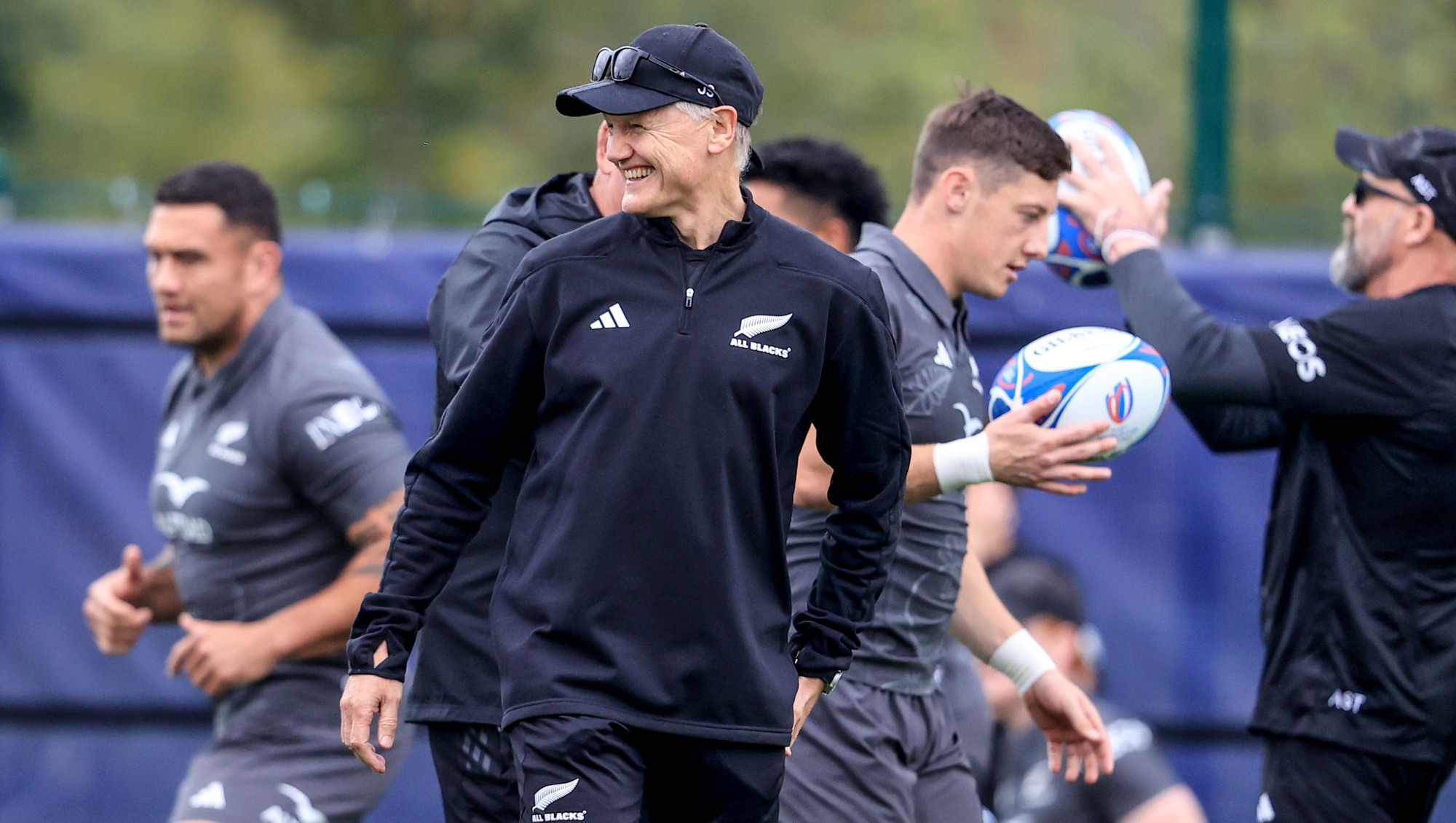
ABOUT SCHMIDT: New Zealand assistant coach Joe Schmidt at All Blacks training on Thursday. Picture: INPHO/Dan Sheridan
Meeting a former coach stokes all sorts of memories and sensations. No matter how close the couple once were or what they achieved together, the conclusion of any relationship ensures subsequent meetings are bound to be laced with awkwardness. How do you navigate that?
Former lovers often become complete strangers as a coping mechanism. Even still, avoidance isn’t eternal. Joe Schmidt’s union with Ireland felt like more than just a romance, it was a fruitful marriage. That bond broke fatally in Japan at the last World Cup. From those ashes rose Ireland’s rocket back to number one in the world and Schmidt’s return to a struggling homeland. They were always likely to cross paths again. Players, in every single sport, are destined to encounter such difficulties.
The first step is dealing with the flood of emotion that rains down during a reunion. Some bypass it entirely. Others embrace it. Ireland have endured messy divorces before. When Warren Gatland was invited to the hospitality suite at Twickenham for Ireland’s trip to England in 2004, he found himself surrounded by visiting committee men.
Connacht’s Don Crowley had assumed presidency of the IRFU. ‘Gatty,’ he said with arms open wide. Gatland couldn’t restrain himself: “F*** off.” He was still seething that Crowley didn’t even have the courtesy to call. That same season his Wasps took on Munster and captain Lawrence Dallaglio was unequivocal on their motivation. He told the group they needed to produce in the tie and repay Gatland’s faith in them. Avenge him.
The manner of Schmidt’s departure and its bitter parting song was always going to sting. During his book promotional tour, he repeatedly rejected the criticism that his environment was too controlled. At one point, he specifically referenced a comment by his former captain Rory Best and went on to reveal that the Ulster man had texted him to clarify he had spoken ‘inadvertently.’ For the guts of six years, detail was Schmidt’s selling point. He has a talent for capturing a squad and moulding them with his sense of mission. They had a formula and stuck to it. It made them. Could the same approach now break them?

"The tactics one is interesting,” says former Irish international Niall Ronan. He spent four seasons with Leinster before crossing the divide and logging over 100 appearances with Munster.
“When I was with Leinster, we had four different coaches in four years. Some of the calls change, but the fundamental power plays were there anyway. With Munster our set-piece was always similar because it was all player lead. There is a lot that you keep.
“But look at Ireland, how they play now compared to the end of Joe Schmidt’s time, it is a totally different attacking philosophy.
“When you think about the amount of analysis and data that exists right now, Joe Schmidt might know the players and some plays, but a lot of that is known by opposition teams already. There is so much information out there now that whether you worked with a team or not, you’ll probably have the same tactical breakdown of them anyway.”
Previously Schmidt built player profiles of opposition and presented them to the group. Tendencies, how they carry, where they are strong or vulnerable. New Zealand will likely have received a similar breakdown this week. Professional coaching is a cutthroat business. Everything is variable, even loyalty. An occupational hazard is deconstructing players you once helped to develop.
Galtand’s response to the Irish walls closing in was to cull half of the starting team. Young prospects were parachuted in, most notably at half-back where Munster duo Peter Stringer and Ronan O’Gara debuted.
Fast forward to 2004 and Gatland was basing an entire gameplan around O’Gara, as he revealed in his autobiography. The plan was simple: “Making his life a misery.” It never came to fruition.
“Unfortunately, he picked up a hamstring injury early in the game and was replaced by Jason Holland, a very different kind of operator.” Holland was superb and it took a last-gasp Trevor Leota try for Wasps to prevail. It wasn’t until the 2011 World Cup quarter-final that Gatland’s strategy for O’Gara was unveiled. To blunt his pinpoint kicking game, they doubled up at full-back with a wing coming in to share duties with Leigh Halfpenny. Some tried to target the Irish outhalf’s perceived defensive faults. Gatland knew he had to deal with his attacking power too.
How big a factor was familiarity in all of that? Not a major one anyway. At best a marginal gain. Gatland has proven once again at this World Cup that he appreciates how to create a culture and maximise their talents. The reality for Ronan is that Ireland don’t need to worry about what Joe Schmidt knows about their prior iterations, it is about what this gifted coach can do to interrupt this unprecedented version.
“Even when I left Leinster and Joe Schmidt came in a year later, you could see that they were way more organised. The level of detail in and around the breakdown. We recognised some of the calls around the line outs and you might try to react to it, but the call could be a dummy to another call as well. You just can’t bank on that stuff. We’d all do that against provincial teams. XYZ-2 instead of LMO-1 or whatever. Nothing spectacular. Mind games always come into it; Paul O’Connell was a good man for that.
“I think this is the best Ireland team ever. Just their attack shape, we dominate the ball with multiple options off nine and ten. There is so much width and creativity within that, they’ve licence to try things. When Joe Schmidt was there the environment and style was different. It’d be a good thing if Joe Schmidt was thinking about his Irish team. It is a different one he has to stop on Saturday.”
CONNECT WITH US TODAY



Be the first to know the latest news and updates