Donal Lenihan: Burning the Kiwis in the Cake Tin my 2022 highlight
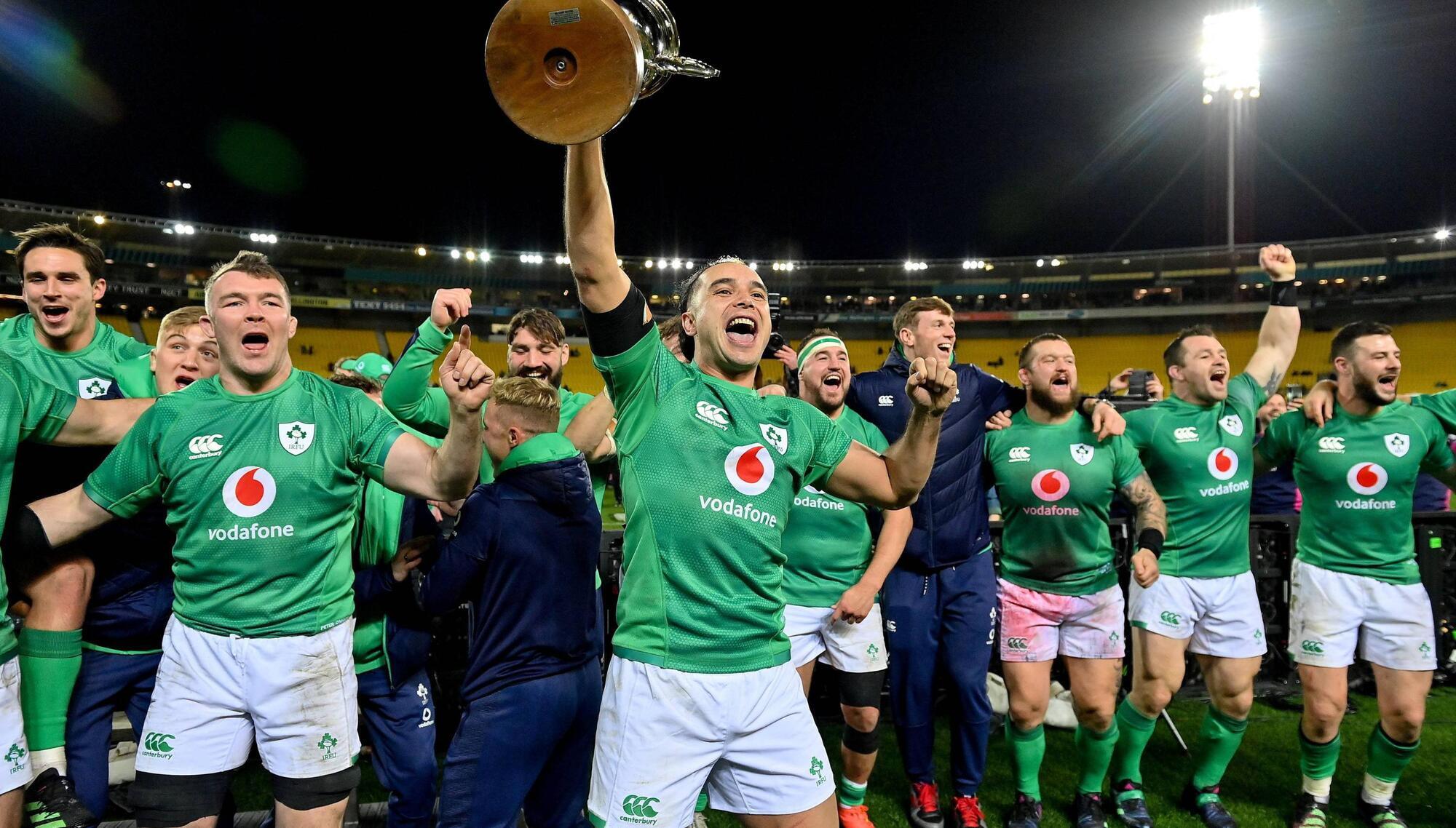
JOB DONE: Ireland players, from left, Joey Carbery, Peter O'Mahony, James Lowe, Rob Herring, Ryan Baird, Andrew Porter, Cian Healy and Robbie Henshaw celebrate with the cup after the Steinlager Series match between the New Zealand and Ireland at Sky Stadium in Wellington. Picture: Brendan Moran/Sportsfile
It may be another 10 months before we discover the true impact of a very special period in the history of Irish rugby, one I was privileged to witness up close, 11,575 miles from home, in far away New Zealand.
Regardless of what happens at the World Cup in France next year, those highly charged few days between the second test in Dunedin on July 9th and the decider a week later, across the Cook Straight in Wellington, not only provided my rugby highlight of 2022 but will stay with me forever.
Beating New Zealand on their patch for the first time, as Andy Farrell’s men did on a dramatic and highly eventful evening at the Forsyth Stadium, having recovered from a hugely disappointing defeat in the opening test, was seismic enough in it’s own right.
To repeat the dose seven days later in the famous Cake Tin was a feat of even greater proportions, given the whole of that rugby mad country had begun to take notice of the jolly green giants from Ireland. No longer were the tourists portrayed as the plucky, fighting Irish capable of making life difficult for the hosts before the inevitable capitulation. There was something far more steely about this belligerent crop of Irishmen that posed clear cause for concern.
When Ireland arrived in downtown Wellington against the backdrop of a potential rare home series defeat for the All Blacks, the locals began to countenance the prospect that this talented Irish squad might be good enough to deliver.
The host media were quick to point out, after the victory in the second test, that the touring squad was clearly made more competitive by the presence of a handful of Kiwis in Bundee Aki, James Lowe, Jamison Gibson-Park and Joey Carbery who, had they stayed around, might one day have worn the famous silver fern and just might be good enough to actually win again.
That unlikely prospect was fuelled further by the fact that a completely unknown and unheralded support cast of up and coming Irish squaddies managed to reverse the comprehensive 32-17 defeat in the tour opener in Hamilton against the revered Maori All Blacks, winning 24-30 at the second time of asking, in the same dockland arena in Wellington on the Tuesday night.
The locals were nervous. It was difficult to meet a Kiwi fan in the days building up to the third test not prepared to comfort themselves with the prospect that an Irish win might even have a silver lining. A defeat would surely lead to the departure of head coach Ian Foster who, it became abundantly clear over the course of our three-week sojourn down under, didn’t enjoy the support of the wider rugby public.
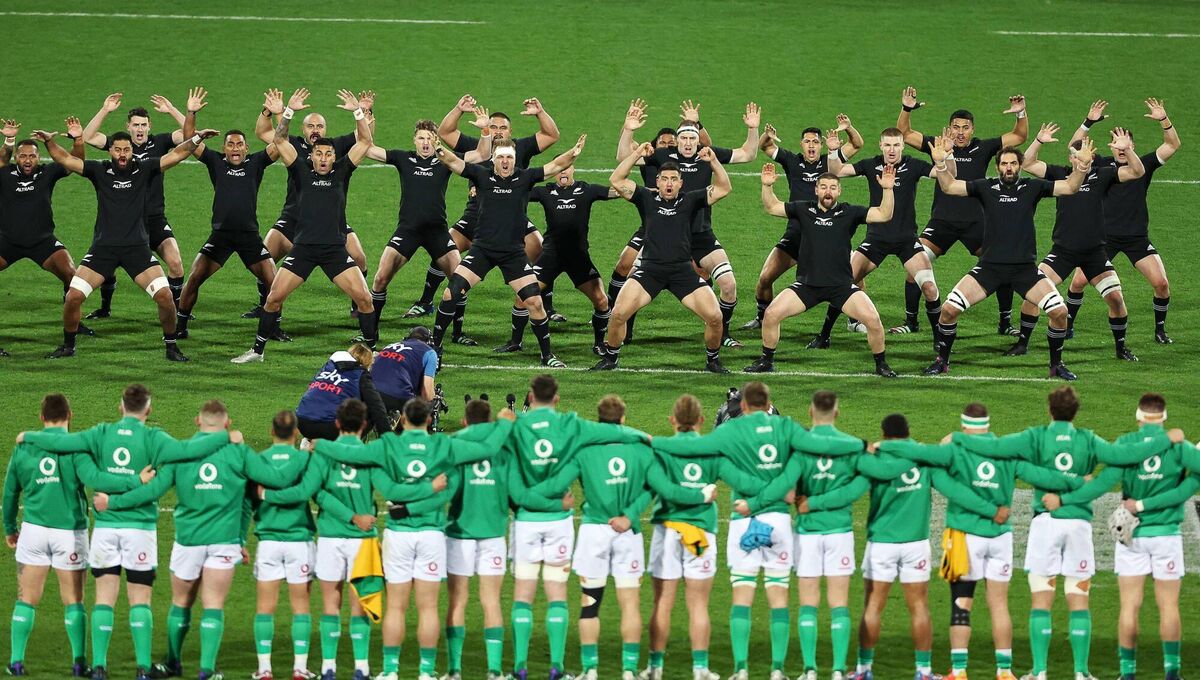
Much of that could be traced back to the fact that the people's favourite, the Crusaders serial winning Super Rugby head coach Scott Robinson, failed in his bid to succeed Steve Hansen after the 2019 World Cup. I’ve never seen New Zealand supporters hedge their bets like that.
They never contemplate defeat, see themselves as superior to every other rugby playing nation and, on the rare occasions when they are beaten, tend to look closely for reasons other than facing the fact that the All Blacks might just not be as good on a given day than their opponents, to explain the loss.
Such was the interest in the third test, the NZRU were forced into adding additional temporary seating to cater for the demand. The last time that happened was for the second test on the 2017 British and Irish Lions tour.
Perhaps influenced too much by history, I couldn’t escape the feeling that, with the “genie out of the bottle” in relation to just how competent this Irish team was, there was sure to be a massive backlash from an All Blacks squad clearly feeling the heat and under pressure from within.
The fact that veteran lock Sam Whitelock was restored to the second row after missing the defeat in Dunedin added further to the theory that the New Zealand forwards would be far more difficult to subdue this time out and that the level of physicality they would bring to this decisive contest would ratchet up another level. The fact that Joe Schmidt was to play an increased role within the New Zealand management team added further fuel for pessimism.
Perhaps we were duped by the showing of the last time Ireland contested a third test in New Zealand, on the 2012 tour, which appeared to be playing on a continual loop on their rugby channel. It was impossible to miss.
Every time you turned on the television, there stood familiar figures, extremely youthful versions of Johnny Sexton, Cian Healy, Conor Murray, Keith Earls and Peter O 'Mahony, standing behind the posts as Dan Carter struck conversion after conversion en-route to a 60-0 massacre. A week earlier on that tour, Ireland had come within a whisker of creating history in Christchurch before eventually losing 22-19 in controversial circumstances.
Perhaps those images only served to reinforce the message from that “famous five” cohort of 2012 survivors that the mistakes of the past would not be repeated again.
Any fears we may have harboured about a potential collapse from the tourists this time out were firmly put to bed after a clinical opening passage that yielded a try from the outstanding Josh Van Der Flier, three minutes into the game, in a first-half performance that ranks as the best this commentator has ever seen by an Irish team against such a highly ranked opponent.
Farrell’s men were absolutely superb in the opening 40 minutes, carrying a scarcely believable 19-point lead at 3-22 into the break. As sure as night follows day, we knew that New Zealand would come roaring back, which they did.
When Will Jordan ran the length of the field to score a try that reduced Ireland’s lead to three at 22-25 on 60 minutes, it was impossible not to fear the worst. If inspiration was needed to dig even deeper at that point, it was provided by Johnny Sexton who, despite having nowhere near Jordan’s pace, never gave up the chase, forcing the winger to touch down in the corner.
When Jordie Barrett missed the more difficult conversion, the defiance and refusal to yield an inch displayed by Ireland’s captain in the face of impossible odds, five days after celebrating his 37th birthday, stood as a metaphor for the 2022 tourists stationed behind the sticks as they stared the prospect of defeat in the eye.
This time the outcome would be different. The fact that the Irish forwards were capable of responding in kind, with replacement hooker Rob Herring delivering a try off a powerful maul within four minutes of Jordan’s lifeline, proved a further act of Irish defiance. This team were not for turning. They saw no reward in glorious defeat.
The fact they were made fight so hard, after being in a position of such dominance at half time, made the victory even more sweet in the end. On the final whistle, I stood in the commentary box, consumed by an intoxicating mix of pride, giddiness and disbelief.
The fact that history was made on the back of two defeats against the Maoris and a potentially more damaging 42-19 reversal against New Zealand in the series opener at Eden Park made what happened over the final eight days of the tour even more remarkable.
Ireland had joined a select few in South Africa, Australia, France and the Lions to enjoy a series win in New Zealand in over 120 years of combat. The sight of Peter O'Mahony, an unrelenting force throughout the series, being reduced to a blubbering mess on the sideline after the game, encapsulated the enormity of that emotionally charged evening.
A decade previously, in his first international season, O'Mahony discovered the harsh reality of just how ruthless the All Black machine can be. He was there with the Lions in 2017 and came within touching distance of greatness in a dramatic drawn series. More that most, he understood the significance of the moment.
In my opinion, this triumph stands alone as the greatest achievement in Irish rugby history. The only thing that can top it? Hopefully we get to experience that in France in 2023. Happy New Year to one and all.
CONNECT WITH US TODAY



Be the first to know the latest news and updates