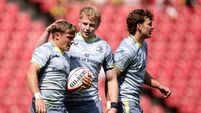
Spot on Irish tactics starved Les Bleus
FOR Ireland to start a match at Lansdowne Road as favourites against a team such as France and come through to win is a huge step forward, especially when the French had revenge on their minds after last season’s win by Ireland at the Stade de France.
For once, most of the pre-game predictions came true. The French did try to attack the Irish scrum and although it creaked on occasions the French were never able to gain the dominance they needed to use the scrum as a launching pad for their own attack.
Ireland played exactly the right sort of game. Apart from three or four quick turnovers in the opening minutes they kept control of the ball and played the majority of the game in the French half. Therefore any scrum was too far from the Irish line for the French to profit.
Tactically the Irish played an almost perfect match for at least the first hour - except perhaps for Keith Wood’s attempted dropped goal - in that they maintained possession and played in the French half. They didn’t kick away the ball they’d kicked away against Italy and what ball they did kick was able to keep the French under pressure.
One newspaper writer yesterday criticised the French for being boring and hardly firing a shot for the first 60 minutes. He failed to recognise that France existed on virtual crumbs of possession and what ball they did have was when they were on defence.
The Irish forwards dominated possession. In the first hour they stole six French lineouts and lost only one of their own through a not-straight throw.
It was a step up for all of the tight five compared to the match two weeks ago. Prop John Hayes was an outstanding driving force in the tight along with his propping partner Peter Clohessy.
Although Keith Wood does not look quite the dynamic individual player of previous seasons he has become much more of a team player and is therefore more effective. His try-saving tackle on Christophe Moni emphasised just how committed he was for the entire match.
Mick Galwey is your archetypal forward. You don’t see much of him but he’s there and performing his role well, making sure the ball is available.
His lineout partner Malcolm O’Kelly has all that, and more. He is an outstanding athlete. In lineouts he was responsible for the majority of ball won by Ireland on the French throw and he has the speed to support the ball carrier in any part of the field. It was a display that must see him as a good option on the hard rugby grounds of Australia.
One pre-game match-up I mentioned last week was the contest between David Wallace and Olivier Magne. It turned out to be very one-sided. It shows how even the best players need to have an attacking platform to work from and, without that, Magne basically sank without trace. He was almost invisible whereas Wallace, after a quiet first 30 minutes when he was possibly coming to terms with playing against a world-class opposition, was outstanding. In a day when at Twickenham the two real under-achievers in England’s demolition of Italy were Richard Hill and Neil Back, Wallace would have moved up the loose forward rankings for the Lions tour.
Whenever Ireland’s play became too static Alan Quinlan and Anthony Foley, along with Hayes, were able to get the team moving forward again.
Never in the history of France versus Ireland encounters have the French three-quarters been so comprehensively outplayed. Ronan O’Gara, Rob Henderson and Brian O’Driscoll dominated the centre of the field possible in no small way due to the speed of pass they were receiving from Peter Stringer.
The French had spent all week talking about their centres, on attack and defence, but the power of Henderson and the elusiveness and pace of O’Driscoll destroyed their plans. The contrasting qualities of these two players makes an ideal combination which is hard to defend and they look the most potent pairing in the championship.
If there was a small negative in the Irish performance, given the overall dominance of possession and the opportunities created by the centres, it was the lack of attacking ability shown by Girvan Dempsey. Against any team, but in particular England, Ireland will have to capitalise on any attacking opportunities created and the link between O’Driscoll and the two wings was missing.
Because of this both wings had a surprisingly quiet day on attack and while Denis Hickie defended well Tyrone Howe committed a basic blunder, coming far too far infield and allowing Philippe Bernat-Salles an outside gap and a sure try. It was a man-on-man defensive situation and any international wing will score given the latitude Howe allowed his opposite.
For their part, France showed an outstanding defensive line and although beaten occasionally in midfield they all, bar once, kept a well-organised cover defence. Ireland can expect more of the same in their next home game against England when the same degree of patience will be required to break down the defence. Whether Ireland took their foot off the gas or tiredness set in, a Six Nations game at Lansdowne Road wouldn’t be the same without a last 10 minutes of nervous tension but in the end it was an outstanding home victory. Warren Gatland and his coaching staff got it tactically and technically correct and deserve congratulations.
In the battle of the present and former Lions coaches it was honours even.
Tactically, Graham Henry had made changes to the Welsh lineout to combat the Scottish strength and that superior possession enabled Wales to dominate the scoring early on. On the other hand the Scots knew that they wanted to move the heavier Welsh forwards around but for the first 40 minutes Duncan Hodge forgot how to either kick or pass.
In the second half however, the faster loose forward trio of Budge Pountney, Martin Leslie and Jon Petrie gained control of the ball and Scotland came roaring back. Tom Smith, who plays his club rugby in Brive, did everything that his own French team-mates couldn’t do against Ireland and used pace and deception to score an outstanding winger’s try, let alone that of a loosehead prop. Both teams lacked the control exhibited by the Irish and the game looked a level down from that at Lansdowne Road.
England were at their arrogant worst for the first 30 minutes of their game against Italy when just being on the field and playing touch rugby against a team the quality of Italy was thought to be enough. Finally, down 17-20, England re assessed their opposition and tightened the game up enough to produce more control and more scoring chances.
England reminded me of the All Black sides of the last two years who, while comfortably winning matches against inferior teams, made far too many mistakes and looked vulnerable when put under pressure. I think we should all congratulate England, tell them how wonderful they are and wait with our fingers crossed for the next home game at Lansdowne Road.
CONNECT WITH US TODAY



Be the first to know the latest news and updates