VIDEO: Stuart Lancaster: I don’t think I’ll ever come to terms with it
It is now 50-50 whether Stuart Lancaster will remain in charge following the defeat to Australia.
That represents a significant improvement on his chances immediately after the game on Saturday night, when it appeared certain he would vacate his post.
But a combination of good-will and pragmatism — particularly when it comes to who could replace him — seem to have shifted the balance.
Lancaster is unsure of his intentions. He may resign, but he won’t think too deeply about that until after the game against Uruguay (the deadest of dead rubbers) on Saturday.
The RFU may sack him, but won’t make up their minds until after the tournament. Either way, it’s an awful mess.
“I don’t think I’ll ever come to terms with it, personally, because it was such a big thing,” admitted Lancaster yesterday. “As a coach, I’ve had some great moments coaching England and I’ve had some disappointing ones but this pales everything else into insignificance because of what the tournament means to everyone.
“In many ways it reeks of 2011, when Martin Johnson’s side self-destructed in New Zealand. One key difference was that behaviour has been exemplary this time, and that will count for more than it would otherwise.
Also, the players genuinely like and respect Lancaster. ‘There is no need to rip it up and start again,” said Tom Wood, and Lancaster will need words like that when his position is reviewed.
Among the many issues that have to be resolved are the six-year contracts Lancaster and his coaching staff of Andy Farrell, Graham Rowntree and Mike Catt were awarded just a year ago, while the position of Ian Ritchie – the RFU chief executive who awarded those contracts — would also come under scrutiny if Lancaster were to leave.
Not all of them will stay, that is for certain.
None of them had any answers at Twickenham on Saturday, either, and they could hardly say they were surprised. The ability of David Pocock and Michael Hooper at the breakdown was well documented, and they punished England time and again.
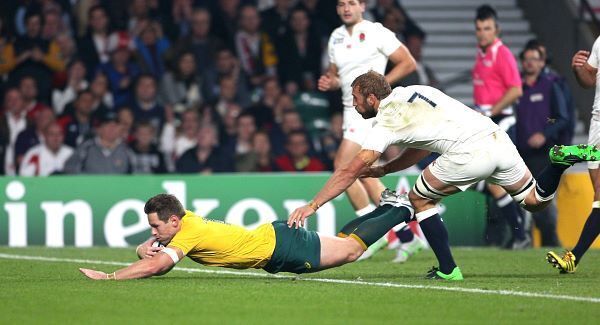
Their tally of six turnovers barely begin to demonstrate their superiority in that area, and allowed Bernard Foley to score his 28 points with astonishing ease.
“It was another opportunity for our back row to work together and it developed nicely throughout the game,” said Hooper, with classic understatement.
“We adjusted well, didn’t get penalised too much in that area. It was a good performance but we will have to review where it went wrong and where it didn’t go too well.”
Nothing England tried came off. They ended with George Ford on at centre, Jonathan Joseph shoved to the wing and Brad Barritt in his unfavoured outside-centre position.
It was a calamity of planning and foresight.
In a first half Australia dominated, England were fortunate to only be 17-3 behind, Foley scooting through for two exceptional tries.
England briefly rallied when Anthony Watson showed his class to shrug off two would-be tacklers and touch down. But the hope was extinguished when Farrell was sin-binned for a shoulder charge on Matt Giteau, who dusted himself off to score Australia’s third try in the final seconds.
“I’d like to say we were right in the fight to the end but we weren’t, we were desperately clutching at straws and trying to salvage something from a game that had gone,” said Wood.
In the end, Australia’s greater experience made the difference in the final 15 minutes — the time when England lost out to Wales the week before. “It’s obviously a nice thing to have,” said Hooper. “Matt Giteau is playing his third World Cup now.
“Swoop’s (Adam Ashley-Cooper) got 110 caps so it’s great to have those guys on the field but it’s more important at training to get the experience out of those guys to get the performance at the weekend of the week. That’s probably where it shows the most.”
Australia march on, and so do England — to Manchester and Uruguay. Expect more of their youngsters to be given a go. But then come the reviews, and judging by the words of RFU chief executive Ian Ritchie yesterday, they may be complicated and convoluted.
“I haven’t got a clue yet in terms of what we need to look at,” said Ritchie. “Sustainable success is what we’re trying to build towards. Clearly, that was not sustainable success.
“We hold reviews regularly on an internal basis, after every competition, and we had discussions before the event about what we’d like to do.
“What do we need to put in place to try and achieve that? We’re going to have a look at what it is we need to do.” So in short there are doubts over whether the head coach wants to stay, whether the RFU want to keep him, what the review they are about to enact will entail and what they are looking for. Ultimately, after just 15 days of competition, England seem well set for another four years of soul-searching.
Tries: Watson. Cons: Farrell. Pens: Farrell 2.
Tries: Foley 2, Giteau. Cons: Foley 3. Pens: Foley 4.
Brown, Watson, Joseph, Barritt, May, Farrell, B. Youngs, Marler, T. Youngs, Cole, Launchbury, Parling, Wood, Robshaw, Morgan.
Burgess for Barritt (65), Ford for May (41), Wigglesworth for B. Youngs (50), Vunipola for Marler (50), Webber for T. Youngs (61), Brookes for Cole (55), Kruis for Launchbury (70), Easter for Morgan (58).
Folau, Ashley-Cooper, Kuridrani, Giteau, Horne, Foley, Genia, Sio, Moore, Kepu, Douglas, Simmons, Fardy, Hooper, Pocock.
Toomua for Folau (66), Phipps for Genia (61), Slipper for Sio (58), Polota-Nau for Moore (65), Holmes for Kepu (58), Mumm for Simmons (66), McCalman for Fardy (76).
Romain Poite (France).
CONNECT WITH US TODAY



Be the first to know the latest news and updates