Ireland ready to rule the world, declares O’Connell
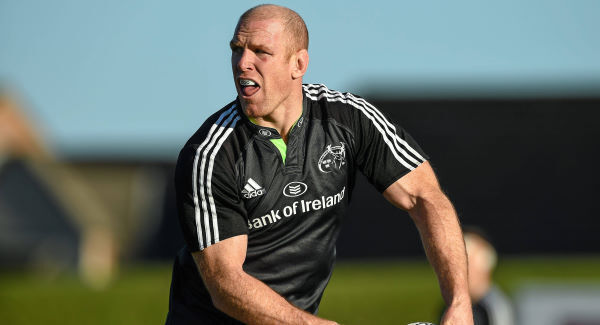
Ireland begin their Six Nations campaign against Italy in Rome on Saturday ranked third in the world, their highest position since 2006.
But O’Connell believes the side’s growing maturity under Schmidt is demonstrated by the fact they now recognise their ranking is “irrelevant”, with the squad’s self-belief instead coming from beating the likes of South Africa and Australia in the autumn. And the 35-year-old has set his sights on Ireland finally making an impact at the sharp end of a World Cup, having failed to progress past the quarter-finals in their seven previous attempts.
This year’s World Cup will be O’Connell’s fourth as he was a key part of the Irish sides that reached the quarter-finals in 2003 and 2011, as well as the team that humiliatingly exited the 2007 tournament at the pool stages.
Those exits are behind his opinion that his World Cup history has been “more disappointing than fulfilling” as teams containing the likes of Brian O’Driscoll, Keith Wood and himself have never made the semi-finals.
Yet with this year’s World Cup certain to be his last — O’Connell turns 36 during the tournament — he believes the time is right to leave a positive lasting memory.
“It may sound negative but I don’t think we’ve ever played to our potential at the World Cup,” said O’Connell.
“Even in 2011, when we played some great rugby and beat Australia, it ended painfully. The Wales game (the quarter-final defeat) was really disappointing.
“They were excellent but we played into their hands. It was the same in 2003 (when Ireland lost again in the quarters to France). We never played to the best of our ability.
“It has been more disappointing than fulfilling — and 2007 would probably be, God, a period in my career I’ll never forget or really be able to explain.
“We’re a lot more consistent now — and I don’t think we’ll be distracted by the bigger picture. Being number three in the world seven years ago was probably a big deal. This time around we’ve learnt it’s largely irrelevant.”
O’Connell, though, believes Ireland can go all the way if luck favours them. “For Ireland to win a World Cup, you need a load of things to go your way,” he says.
“You need luck with injuries because we don’t have the playing numbers of other countries. But Ireland certainly have a chance of winning the World Cup. You don’t go out and play unless you believe that.
“It’s an outside chance because you look at New Zealand and the way they can pull games out of the fire — or the way they can put teams away very quickly.
“If you give them any opportunity, they’ll take it. You look at South Africa and their size and strength — and then you look at Australia and the way they played against us for those 25 minutes before half-time (when recovering from 17-0 down to draw level before Ireland won 26-23). They’re incredible sides. But, when we get a few things right, and we have some luck, we can live with those teams.
“The way we’ve performed in the last 18 months makes me think that, at our best, we’d certainly have a chance against them. That sharpens our preparation because we know how good we have to be against them. We have to really perform to the best of our ability, whereas other countries probably have the luxury of not always being at their best and still winning.”
Key to a renewed sense of belief is the impact Schmidt has made in the 22 months since he replaced Declan Kidney as Ireland head coach.
Schmidt’s attention to detail is legendary, and even for a player as experienced as O’Connell, it took some time to get used to his methods.
“You’re asked to do a lot of very different things,” he told The Guardian. “There is a lot of detail in terms of the plays and how we execute them. So, initially, for your first few games, you’re thinking a lot on the pitch. And rugby is a game where you have to be physical and aggressive and it’s hard to do that if you’re thinking too much. But once these things become second nature, and you’re doing them subconsciously, you start executing them with more aggression, physicality and speed.
“Joe is a brilliant communicator and he’s very good at making complicated plays really easy to execute. It needs to be explained well and simply and you need a coach who can let you know that you need to do this — or else — without creating a negative vibe.”
O’Connell still dreams of lifting another major trophy, but the questions around his future will not go away. He may retire after the World Cup, but admits he may move into coaching.
“I honestly don’t know whether this will be my last Six Nations,” he said. “I haven’t made a decision either way yet. I have a few ideas but I’m not 100% clear (on what he will do after retirement). It’s a bit worrying — but it’s also quite exciting... If I had a choice I would train every day of the week, do video, do preparation. I love what I do and it’s important to find that same passion.
“I’m very interested in coaching and how we communicate. The best coaches seem to be very good communicators and they understand how people learn. So, yes, coaching is a possibility.”
But first, one last World Cup and one potential leap into history.
Paul O’Connell has admitted Munster are simply "not as good" as European Rugby Champions Cup conquerors Saracens but is adamant talk of a doomsday scenario for the province is wide of the mark. Munster failed to qualify for the knockout stages of Europe’s premier competition for just the second time in 17 seasons as they were smashed 33-10 in their must-win penultimate pool game in London.
O’Connell came in for particular criticism for his performance and the 35-year-old admits he failed to reach the standards he has set since making his Munster debut in 2001.
But he has dismissed talk the defeat marks the end of Munster’s European glory days.
“I think they’re a better side than us,” he said, when asked about the Saracens defeat in an interview with The Guardian. “We’re a young side and we have a long way to go and the gap was very big. Personally, it was a very poor game. I was frustrated with myself and it was a very disappointing day — luckily, they have been few and far between at Munster.
“I’m old enough now to know you can’t dwell on it. It is easier to put it behind you because I see it for what it is. Less experienced guys can get caught up in the doomsday scenario. I know we’ve got a great culture, a very good group of players, great coaches, and everyone is eager to be successful at Munster. We just need to learn from those experiences.”
CONNECT WITH US TODAY



Be the first to know the latest news and updates