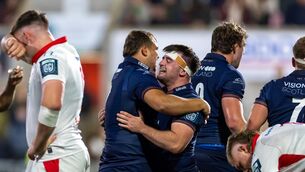
‘I’m a really selfish person. Rugby has made me like that
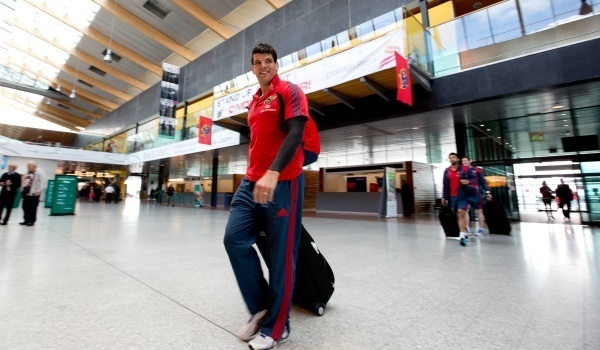
His Munster career goes back to the 90s, 244 games ago. But patronise Donncha O’Callaghan about being a great servant at your peril. He wants game time. Like tomorrow in Marseille. Munster’s lifer lock opens up on friends and family.

‘I’m a really selfish person. Rugby has made me like that

Tomorrow, David takes on Goliath. The big-spending continentals against an Irish province. Donncha O’Callaghan has been around long enough to remember a time when simply facing foreign opponents in famous jerseys could poke at Munster confidence.

“When we played Wasps in Lansdowne Road in the 2004 Heineken Cup, I remember being at a line-out late on and one of their fitness staff came over to Simon Shaw with a little orange drink, saying, ‘get that into you for the last ten minutes’.

“To a young fella there’s a sense of ‘oh, this guy has the magic juice’. Now it could have been Kia-Ora, or Mi-Wadi, but with time you learn. You realise it’s not about the magic bullet, it’s about the hydration, the nutrition, the sleep — the small details.

“It’s easier to look for the out, to look for the big 100 per center that will solve everything, but in doing that you can miss something that’ll give you 15 per cent — being properly hydrated, or being in bed at 9pm every night the week before game.

“Because everybody knows about those they can be the easiest things to drift away from in favour of looking for the new magic development.”

The lessons weren’t always scientific. O’Callaghan read in Neil Back’s book he’d have a protein shake on the cistern of the toilet, so when he went for a pee in the middle of the night, half-asleep, he just had to reach out and take it: “To me that’s a better tip than someone telling you, ‘hey, eat venison because it’s very lean meat’. That’s a real gain because it’s easy to do and it makes it easy for you.”

O’Callaghan has seen the collective culture change at Munster over his decade and half on duty.

“We’d hear of something and go back bitching to Deccie (Kidney) or (Alan) Gaffney, saying, ‘hey, we need this or that’, and that drives the whole thing if the entire group is reaching for more. It’s heaven when you get to a point where you sit down with the fitness advisors and say, ‘why are we doing this?’, and they tell you and they can stand over it.

“And that builds the trust when they can say, ‘look, do your strength block now and when you’re in the power block you’ll go through the roof in three weeks’. When that happens it reinforces the trust — and that works the other way, too, because you can go back to them and say, ‘look, X won’t work for me because when I get to this point I need to heavy squat or whatever to improve’, and they trust that you know your body and what’ll work for you. When you’ve been there for a while you won’t want to invest the time into a regime that isn’t going to benefit you.”

Another player would gripe about omission from Ireland’s Six Nations campaign. Typical of O’Callaghan, he unearthed a positive, a run of training with Munster he hadn’t had since 2008.

“In that training block I benched 155kg for three reps — I’ve been on the edge of 160, it’s a threshold that’s nearly half-mental for me now in terms of doing it, but that’s the case for all my scores whether those are squats, and it’s because I’ve had the time to put into personal, selfish training, if you like, instead of being in camp.

“That’s the drive. What has me in the gym is that I want to be there, and I know what gets you there is being perfect in everything you do — the rugby side, the strength side, all of it.”

The personal, selfish side he refers to has repercussions, of course. He’s conscious of what he’s asking his family to do.

“They pick up the slack when it comes to my drive — what was a personal sacrifice becomes a family sacrifice, and luckily for me they’ve bought into that. I love it that they back me for it — they know Dad’s dinner is different, and they can’t have snacks with Dad when he’s having a snack in the middle of the day, because they’d end up the size of a house.

“I’m grateful they row in with that. I’m sure the kids would love chicken nuggets and chips but they get sweet potatoes and chicken breast and broccoli, and they go along with that because they know what it means to me.

“And that drives me too, because they’re making sacrifices for me — Dad isn’t around between six and seven, crazy time for parents, because he’s having a rub. Granted, Dad could change the time to eight o’clock . . .

“I’m a really selfish person and rugby has made me that way. I don’t mean that in a bad way, it means I’ll do whatever I need to do to get the performance on Saturday. You could call it professionalism but it can definitely nudge into selfishness.”

Take a family trip to the swimming pool: “I said I had to get an hour of recovery in first, some swimming and stretching — and then I could splash around with the kids. It’s an unusual way to plot your day, I suppose. You end up saying, ‘yeah, let’s go out for breakfast — as long as it’s porridge and poached eggs’. There’s no resentment from the family on that, though.”

The fire still burns. A green jersey isn’t something he’s given up on.

“People have said to me, you’ve 94 caps, it’d be nice for you to get to triple figures. I’d just love to get to 95. It’s the same as when I was 19: I just wanted a cap. Now I’m 35 and all I want is a cap. What I’m thinking now is how I can empty myself for Munster and then see where that brings me. I don’t mean to be disrespectful to people who are being nice about being a great servant, but the hunger, if anything, is greater now because I’ve tasted success and I know what it takes.”

That cuts both ways. O’Callaghan knows what it takes to take a starting jersey, for instance.

“It’s a funny one because I’d like to think I’m approachable for fellas who’d want a hand, but you’d also be nearly disappointed if they asked. It’s a funny balance. The way I got the jersey, I burst myself to get it, and I’d want the next man in to do the same. And that’s a lovely place to leave it — that you’re done because the guy coming after you has done you. He can take it on because he put you the sword. Let’s have that. Le’s have that across every position, we’re battling each other for every jersey, and then you know the guys who wear the jersey go out on merit. They’ve earned it. I wouldn’t want to be judged on reputation, I’d feel like I should get more of a show, but if I’m not good enough for the jersey I’ve no problem with that.”

There’s a difference in personnel, of course, the last few months. One of his oldest comrades in arms has decamped to Paris.

“Well, Ronan’s way older, than me,” says O’Callaghan solemnly. “I’m friends with his younger brother, actually. Ronan’s still there as a friend, obviously, I wouldn’t have leaned on him that much lately but he’s still spotted the tough times. We’d think along the same lines and with the 241 Munster caps, he sent me a text to say congratulations — but the meat of that text was that he knew what I was really thinking.

“That’s something I’d be glad of rugby for, the friendships. I haven’t been on to ROG as much as I should, probably, and vice versa, but when I meet him you pick up the thread in two minutes. That was forged through being in horrible spots together. It’s there with Denis Leamy, loads of other guys. It’s a bond you have because you were nearly in a black hole together, and you had to rely on each other to get out of it.

“Dr Con (Murphy) said it to me once, ‘have you worked out sport yet?’ And that’s the fact there are more bad days than good and I’m thankful to Munster for that. It’s defined my personality, because I’ve taken on some of those values in my own life.

“The great thing about the environment is that you don’t have to be friends with everyone, but you do have to rely on them and to respect them. And there are guys in the set-up now, it’ll be the same for them in years to come. I nearly feel for some of the younger players because I think they feel they’re living in the shadows of past players, they’re relating the position to the players who were there for years.

“Little do they know those past players are their biggest supporters now: those former players are the ones who want the current guys to bring it to another level.”

Another man he soldiered with is near the end as well, but the big man is keen to share a little-known lowlight from Brian O’Driscoll’s career . . . “One thing people should know is the kick he missed in front of the posts in the U19 World Cup. That should be the biggest black mark against him, on the 22 in front of the posts . . .

“We were huddled around and when he came back we just laughed at him. He was the best player, and we were thinking, ‘how much slagging can we get out of this?’

“Seriously, Brian was an outstanding leader because he involved you. Not only did he appreciate you as a player, he appreciated your opinion. He listened. He also challenged you: he didn’t want the problems, he wanted to know how we’d fix them.

“Talent? He was the standard and everyone else had to get up to that standard. He always had time on the ball: in training with Ireland I had to defend against him and when you saw him coming for you, you’d be thinking, ‘everything’s going to be tested here, inside shoulder, outside shoulder, the whole lot’.

“He’s skilful at everything. Table tennis, anything. The significant thing for me was his pride in being Irish, getting horrible scores wiggling over from a metre to get vital tries. The big moment, he always found a way. Drico always had that bit of dog about him.

“But Cork grandparents, of course, what do you expect?”

Some of those former players are now pundits, of course. “Shaggy (Shane Horgan) and ROG have been brilliant. I think Irish people deserve to know more about the game, because it’s changed even in the last two years: tell people what’s going on. I love that watching GAA, to learn what’s happening and then say, ‘ah, that’s what they mean’.

“Rugby’s the same. For instance, Denis Leamy was on to me about the change in what we do at the breakdown.

“That’s evolving by the minute, never mind the season. The days of skin and hair and blowing people out of it are gone because every team has targets at the breakdown — there’s the tackle reloader, the guy in on the poach, and the different skills you need to get rid of them.

Leamy spotted we’re looking at a different way to attack the breakdown, and that’s the kind of thing the two lads have been informing people about sport as pundits.”

Pause.

“And informing viewers about what not to wear by providing such bad examples themselves, which is good.”

More in this section

Sport

Newsletter

Sign up to our daily sports bulletin, delivered straight to your inbox at 5pm. Subscribers also receive an exclusive email from our sports desk editors every Friday evening looking forward to the weekend's sporting action.

Cookie Policy Privacy Policy Brand Safety FAQ Help Contact Us Terms and Conditions

© Examiner Echo Group Limited