Referee supreme Rolland officially an Ireland great
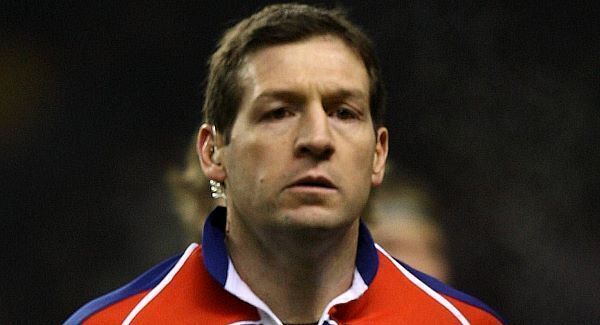
The well-known referee had handled his last game in Cork.
One of the country’s most successful officials is stepping down to start a new business, but he’ll miss the whistle.
“I will, but I’m lucky enough to be getting out on my own terms. That means I’m ready for it.
“Work is a first priority but I also have four young kids, and I was away for 26 weekends last year. Having had last summer with them, it hit home that I wanted to spend more time with them.
“In fairness to the IRB, they’ve been good to me, so it was only fair to tell them two years out from the next World Cup that I wouldn’t be involved, rather than at the last minute.”
It’s a fair sacrifice: he handled the decider seven years ago, after all. Would that have been a pipe dream when he began?
“I’m an ambitious individual, and I’m good at setting goals, but I’m also realistic, and I wouldn’t set unrealistic goals.
“When I started I was enjoying it and felt I could go reasonably well. I sat down with Owen Doyle (IRFU Director of Referees) after my first year, in 1998, and analysed how I’d done and worked out what I wanted.
“The aim was to make the panel for the 2003 World Cup and I achieved that.
“Afterwards I felt ‘what can I work on?’ because I felt if I improved a few things, I’d be in the shake-up for the 2007 final.”
What were those ‘few things’ which had to be improved?
“Early on, I probably had too much empathy for the game and left too much go — continuity for the sake of continuity.
“You soon realise, though, you have to be able to give a structure to the game, because players and coaches want consistency and structure. At the start, I’d let things go but sometimes when you do that — as I learned — it can develop into something more and could possibly get away from you. I had to balance between officiating as a player and being a referee.”
So letting it flow, as the cliche has it, can be a mistake.
“You can only officiate what the players give you,” says Rolland. “There are different skill levels, obviously, and conditions, pitches, everything plays a part, but if you have two positive teams, they’ll dictate the outcome, rather than the officials. If you start letting things go, then teams will say, ‘well, he let that go so I can do this’, the other team thinks the same, and there’s the potential for things to get away from you.”
Rolland says proper preparation inoculates a referee from being overwhelmed by an occasion.
“There are two ways to prepare for a game and I’d use both: on one hand you take a quiet few minutes to run through potential flashpoints — a scrum five metres out, the crowd reaction, and so on.
“You can also run through those scenarios when you’re on 20 km/h on the treadmill and sucking for air — running through those situations in your head then, too.
“Then, when it’s a two-point game in a full stadium, the captain’s in your ear at an attacking scrum-five, the crowd’s roaring... that’s pressure, but if you’ve prepared for it, then it’s a case of ‘let’s get on with it’.”
He acknowledges mistakes are made. You just don’t dwell on it, and you certainly don’t overcompensate as a result.
“It happens. Every now and again you’ll think, ‘I got that wrong,’ but you can’t change it. You have to park it.
“Sometimes a player will say, ‘should x not have happened there?’ and I’d say, ‘yes, can’t change it now, apologies’ and move on. The trust of the players is important there, because if they think you’ll try to correct that later, you’re goosed. Hands up and acknowledge it — but move on.”
There are moments that stay with him. Some of the Toulouse handling in the 2003 Heineken Cup final. The atmosphere in the Stade de France for New Zealand-France in 2008. Working with the likes of Lawrence Dallaglio and Martin Johnson, Richie McCaw, John Smit, Augustin Pichot.
Wit? “I sin-binned a guy once who came back on and muttered, ‘thanks, I needed that’.”
About the only cloud was Welsh hysteria when he dismissed Sam Warburton at the 2011 World Cup.
“We don’t referee on emotion, we referee on fact and that one was a simple decision to make. Was I surprised by the reaction in Wales? Taking the emotion out of it, most people in Wales have moved on, but I also know there are people there who’ll never forgive me for it. That’s life, it’s head in the sand stuff to pretend otherwise.”
The new business involves consultancy work both in rugby and in business (“The website will be alainrolland.com when it gets up and running”).
A final question: was it hard to get up for an AIL game having refereed a World Cup final?
“No, not at all. I thoroughly enjoy games like that.
“I remember playing AIL and it always made me more comfortable when an international referee did one of our games, you’d expect to get the best out of them.
“International refs don’t think ‘I’m better than this’ because players expect more than that. For that reason I always enjoy those games, I remember when I got my first one, and how much I enjoyed that. You can’t forget where you came from.”