The day Ireland really felt Sean O’Brien’s absence
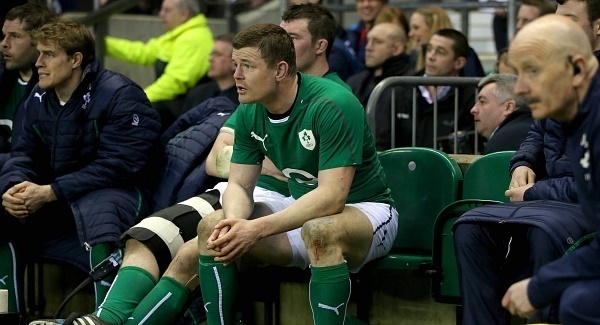
Yet, from the moment Ireland took to the field, things just didn’t look right. The confidence, fluidity and clarity that defined the comprehensive win over the Welsh two weeks earlier appeared somewhat diluted. Apart from an inspired period immediately after the break, Ireland found it difficult to make inroads against a very well-drilled English side in what was an absorbing Six Nations contest from start to finish.
While the players will find it difficult to focus on the positives in the immediate aftermath of this defeat, the one-score loss keeps Ireland firmly in the hunt for this years championship, now sure go down to the final day of action.
The fact that England travel to Rome that day may offer them an advantage while they still have a Triple Crown to play for against Wales in London in the next round. At this stage, however, with a Grand Slam no longer on the table, Ireland’s points differential of +42 places them in a very commanding position.
There is no question that coming in to Saturday’s game, Ireland had nothing but a Grand Slam in their sights. The thing that will hurt the players most is that they lost a game in fortress Twickenham by a three point margin without playing anywhere near their best. For that huge credit must go to England. With Italy next up in Dublin and France in a shambolic state if the evidence of Friday night is anything to go by, Ireland may have left that treasured prize behind them.
The over-riding factor that ultimately decided this game was power. As always England had that in spades but the thing that differentiates this England forward unit from that of their predecessors is the athleticism of Courtney Lawes and Joe Launchbury in the second-row.
They were outstanding on a day when the absence of Sean O’Brien really came home to roost. Against the biggest teams, you need your most powerful players.
When the game was still there to be won in the final ten minutes, Ireland tried everything to breach an English defence that refused to buckle. Their line speed was at a different level to anything faced by Ireland in the championship to date and even when it was breached out wide, Launchbury and Lawes delivered crucial cover tackles on Dave Kearney and Fergus McFadden to kill promising attacks.
Ireland needed something different to throw at England at that stage and the X factor that Simon Zebo brings to the mix may have proved invaluable off the bench. His ability to beat defenders in tight spaces was exactly what was required in that manic period that defined the closing stage.
In some respects Ireland were guilty of double-bluffing themselves when it came to exploiting the dominance of their much famed maul. Sensing England would have focused much of their attention in the period building up to the game in keeping numbers on the deck to repel the onslaught, Ireland shifted the point of attack away from the maul in the hope that space would be available with the England back row on red alert close in.
It almost yielded a spectacular try after only 15 minutes when a pre-rehearsed move designed specifically to exploit that scenario — with Chris Henry peeling off early from the maul and a series of dummy runners keeping England defenders fixed close in — enabled Johnny Sexton to put a cross kick into space out wide for Andrew Trimble. It almost worked but Rob Kearney just failed to hold a difficult pass from the Ulster man. That said England were more than happy not to see Ireland launch their most potent weapon at any stage in the opening half.
In fact it was four minutes into the second-half before Ireland decided it was time to go route one and that maul, launched from just outside their own 22, yielded a massive territorial gain and a penalty. Of even greater importance it sprung the Irish pack into life to such a degree they were becoming the dominant force in the scrum also.
In fact Ireland appeared a team transformed in that crucial period after the break when Rob Kearney’s try straight from the Leinster playbook within a minute of the restart contributed to turning a three-point deficit into a seven point lead. Given England had left a few scores of their own behind in the opening half, that was a big blow for them to absorb.
The surprise for me was that this young and inexperienced English side were allowed the scope to work their way back into the game and got their rewards with a spectacular try from Danny Care. Coming into this contest, I felt if Ireland could curtail the influence of Care and Billy Vunipola, they would win the game. When the No 8 was forced off after 35 minutes of action, you felt that in a contest as tight as this, the tide might just turn Ireland’s way.
That never materialised due primarily to the excellence of Care, a livewire throughout, and the magnificence of Mike Browne from full back. He proved a serious thorn all through with his probing runs from deep creating havoc for the Irish defence. In addition Vunipola’s replacement Ben Morgan continually breached the gain line and Ireland spent far too much time, playing too much rugby, in their own half.
Ireland’s failure to capitalise on that excellent period after the break will worry Joe Schmidt as will their poor discipline in coughing up some silly penalties at crucial times — even if their penalty count was still very respectable with just nine conceded. It was telling that most of those were conceded in or around the breakdown area where England managed to exert maximum pressure all day. In addition, despite conceding eleven penalties of their own, England restricted Sexton to a single penalty shot at goal all afternoon.
Unfortunately Ireland’s kicking game, such an outstanding feature against Wales, deserted them with Sexton looking particularly off-colour after taking a few heavy knocks. In the circumstances, the failure to spring Paddy Jackson, a 79th minute replacement for Brian O’Driscoll, was hardly a ringing endorsement for what he brings to the table.
Ireland must quickly park this disappointment and focus on the tangible rewards still on offer. It may be no harm to freshen things up against Italy with some of the younger brigade getting a run. Marty Moore looks ready to start an international for the first time while Luke Marshall, Luke Fitzgerald and Zebo might offer an additional spark in attack before the campaign reaches a crescendo in Paris. Disappointment yes, but there is still so much to play for.
CONNECT WITH US TODAY



Be the first to know the latest news and updates