Seven-try demolition sets up Ireland for Six Nations assault
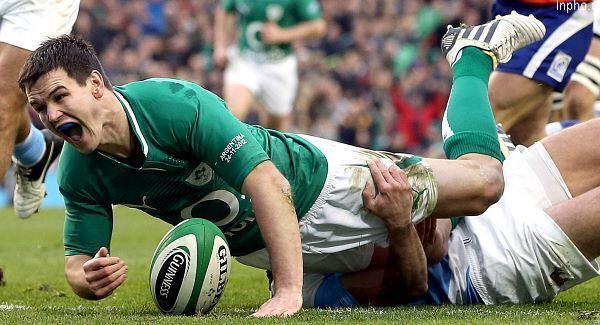
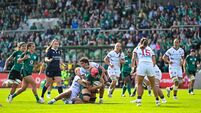
Watching Ireland play Argentina off the park on Saturday almost required a reality check. Was this the same Ireland that committed hari-kari against the All Blacks just last summer?
And was it really just two weeks ago that Ireland couldn’t buy a ticket over the halfway line against South Africa, let alone a try? This wonderfully positive, intelligently crafted and superbly executed seven-try victory against a strong but fatigued Pumas side made light of the angst surrounding Ireland since their World Cup quarter-final exit to Wales 13 months ago and a joke of pre-match permutations regarding a precarious world ranking.
Ireland played with brains, brawn and verve to unsettle Argentina and deny them the outlets they thrived on to such great acclaim in their Rugby Championship debut and victory over Wales this month.
Just one offload in 80 minutes and no threat whatsoever from the boot in open play is a credit to the Irish effort, led by the standout forward display from man of the match Donnacha Ryan and augmented by an inventive attacking display orchestrated by Conor Murray and Jonny Sexton, playing by far their best game as a half-back partnership since they were paired at the 2011 World Cup. Individually, too, Murray has not played better in an Ireland jersey while Sexton gave a virtuoso performance, underscored by two tries, on par, for Ireland at least, with his one-man demolition of England’s Grand Slam dreams in 2011.
The pair were at their instinctive best, and their outside backs matched them with tries for exciting debutant Craig Gilroy, Tommy Bowe (2) and Simon Zebo, the only forward’s score coming from Richardt Strauss. Kidney, then, can allow himself the satisfaction of sticking with a pairing that had not been gelling up to this point.
No wonder Argentina were frustrated, with the old bad blood returning in the 64th minute when Max Bustos threw the ball at Cian Healy’s head. The same ruck could also have repercussions for the Pumas after Ireland’s on-pitch protests to match referee Jaco Peyper that an Argentine hand had made contact with the eyes of Peter O’Mahony, something independent citing commissioner Yann Ledore will consider in the coming hours.
It is the coming weeks that will concern Kidney though, as the visit to Cardiff looms on February 2 for the 2013 Six Nations opener. With a second-band seeding secured for next week’s World Cup 2015 pool draw, Kidney must use the time to ensure his team get off to a fast start in the spring.
There were wobbles against Argentina – the kick-off went out on the full, penalties were still too easily conceded and two late tries were a blot on the scoreline, but that would be nit-picking on a day of seven tries scored.
On a deeper level, Ireland have too often been too slow out of the gate during international windows before eventually rumbling into something like championship form and this autumn was no exception as the opening performance against South Africa was blighted with inconsistency. Kidney will want to see his players hit the ground running in Wales and maintain it through the season.
Losing leaders like Brian O’Driscoll, Paul O’Connell and Rory Best and stars like Stephen Ferris, Rob Kearney and Sean O’Brien this autumn only added to the churn of players Kidney has to manage and he counted 17 players in camp this month that had not been at the World Cup — a “monumental turnover”. Time to work with them is precious and Kidney will grab as much as he can with his new squad.
“In the ideal world, you’d have a month leading into it. I don’t think anyone is going to be withdrawing anyone from Heineken Cup 5 and 6,” he said.
“That’s what would give us a month and that’s the trick of that first match, to be detailed enough to try to get the better of the opposition... intricate enough.”
Kidney will have hopefully welcomed back his fit-again stars by then. He is after all, in a business that demands Six Nations success and those imperatives will deter him from further experimentation.
“You cannot do that really, the financial model of the whole thing is the Six Nations. That is what the pressure comes from, that is what makes the money, so we have to all time trying to get the balance.”
Experimentation will come, but look for it either side of the championship, when the Wolfhounds play England Saxons in Galway on January 25 and on next June’s tour to North America, “So you are trying to get the balance between the younger players coming through with the Saxons game, the tour to America knowing that you have to front up against Wales.”
At least Kidney had a smile on his face on Saturday evening, albeit a wry one when asked if he had the luxury of long-term planning.
“No I don’t,” replied the soon to be out of contract coach. “I don’t at the moment anyway.”
IRELAND: S Zebo; T Bowe (F McFadden, 74), K Earls, G D’Arcy, C Gilroy; J Sexton (R O’Gara, 72), C Murray (E Reddan, 72); C Healy (D Kilcoyne, 74), R Strauss (S Cronin, 74), M Ross (M Bent, 68); D Ryan, M McCarthy (D O’Callaghan, 63); P O’Mahony (I Henderson, 72), C Henry, J Heaslip (capt).
ARGENTINA: J M Hernandez; G Camacho, M Bosch, S Fernandez, J Imhoff (M Montero, 54); F Sanchez (G Tiesi, 22-26 & 61), M Landajo (N Vergallo, 69); M Ayerza (N Lobo, 69), E Guinazu (A Creevy, 60), Max Bustos; M Carizza, J A Farias Cabello; J M Fernandez Lobbe (capt), J M Leguizamon (T Leonardi, 54), L Senatore (F Gomez Kodela, 68).
Yellow card: Bustos (64-74) Replacement not used: T Vallejos Referee: Jaco Peyper (SA).