The ManniX factor
Yet the All Blacks fly-half who found the most famous jersey in the game too burdensome to place on his shoulders, the transplanted Kiwi who forged a successful playing career in England and then another as a coach in France, had not bargained on a new life of surprises in Ireland. He had not reckoned on Munster, nor the men who represent it on a rugby field.
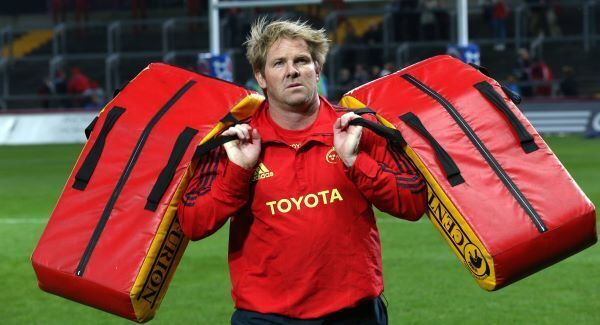
Mannix has been the province’s backs coach less than three months, brought in as the wing man (excuse the pun) for new head coach and fellow New Zealander Rob Penney. Joining Anthony Foley, the forwards coach, and Penney, the Wellingtonian is part of a new broom sweeping through the Munster set-up and Mannix has found the receptive attitude of the squad in wanting to adopt the expansive, instinctive style of play they are striving to introduce something of a revelation.
“I found a group of players that I’ve never come across, really, in professional rugby, in terms of their enthusiasm, in terms of their discipline; their hunger for it. I thought, ‘this is just unbelievable’,” Mannix said, of working with the Munster squad.
“Everything was 100mph, they are very committed into everything they do and that hasn’t changed. So that there, straight away, you’ve got the ingredients to work with and you can just worry about execution and putting in place simple structures that we’d envisaged putting into place.
“So it was wonderful to discover that, because from a coaching viewpoint, you don’t want to have to be dealing with those intangibles. They should be a given for a rugby player and to see it in such abundance here, that willingness to put everything into everything, be it training or games, is wonderful.
“This is a group of guys who are extremely disciplined, extremely studious in what they do and they do it very well. They’re a knowledgeable group and that’s all helped in our ability to move things along at a reasonable pace, it’s got to be said, because it’s a philosophical shift for Munster, possibly, with our style of play and the players have embraced it.
“It’s all very well, a new coaching staff coming in and saying this, that and everything else, but it’s a case of whether the players really embrace what you’re trying to do and I have to say the evidence is we’re on the same page at the moment.”
It is abundantly clear that the backs coach has done some buying in of his own, describing his decision to join Penney at Munster as “getting the opportunity to come to this huge European powerhouse was something you didn’t even need to think about, it was a given.
“Also, without a doubt, knowing that Rob was coming in. That had a huge bearing. For me, it was an opportunity to coach with and learn from one of the best coaches in the game — he’s proven that in the New Zealand provincial game.”
What Munster are now trying to achieve is rooted in New Zealand rugby and the approach to it that Mannix credits Penney with helping to foster.
“Probably for me, where New Zealand’s always been ahead is that, technically, the players are just better. Simple as that,” he said. “It’s not a case of being bigger, stronger, faster. I think all the players across the board today in world rugby would churn out the same Test results. But when a team is technically better from one through 15 and can make good decisions under pressure, that gives them the edge.
“Rob’s been a strong part of that growth in New Zealand rugby for this decision-making, responsibility culture that now exists within New Zealand.”
How quickly that cultural osmosis has taken hold in his adopted province will soon be put to the test with the opening Heineken Cup pool game a week away in Paris, when Munster take on Mannix’s old club, Racing Metro at Stade de France.
As much as he loves Paris, the return trip represents a difficult journey not just for Munster’s aspirations of a return to European glory but for Mannix’s strength of character. Let go by Racing only last December after five years with the club, he declines to discuss his departure but it is clear from sources other than him that Mannix was a victim of internal strife between the players, director of rugby Pierre Berbizier and club owner and president Jacky Lorenzetti that saw cult hero Sebastien Chabal depart soon after and contributed to the exits this summer of French lock Lionel Nallet and South African Francois Steyn.
It is also clear that Mannix was held in high regard by the players he left behind; players who unfurled a banner the week after his exile proclaiming: “There’s only one Simon Mannix.”
Describing his five seasons at Racing as “an incredible adventure with great people, players with an incredible amount of talent,” he recalled: “It was stepping into something that was big in terms of the investment that was made in the club by the president. I started at that club as an interpreter. They had Philippe Benetton and Didier Camberbero, the two former French internationals and they couldn’t speak much English and they had recruited a lot of foreigners. So I spent the summer helping them out on the field, explaining things and six months later I ended up as backs coach.
“Then the following season the president invested heavily in the club, post-World Cup 2007. Berbizier came in then and a big recruitment drive. It was a massive change, we just missed promotion to Top 14 that year but the next year we went up.”
So is he looking forward to going back?
“It’s a tough one, personally, but this is not about personal stuff,” Mannix replies. “It’s going to be tough, just because of the players and quite a few members of the staff and a lot of the administration people who I’ve very good relationships with. It’s going to be an incredibly tough test for us first up, and that’s looking at it globally and from a personal aspect of it. I suppose some might say it’s an ideal one, you get to go back to an employer who let you go and you get to try and prove a point but it’s not about trying to prove a point on my part. There’s one thing that matters now and that’s that we get the result we deserve. But it’s going to be incredibly tough.
“It’s a difficult, difficult group but I don’t think Munster’d want it any other way. That’s the sort of challenge they relish.”
Mannix says it with the certainty of someone who has quickly sized up his new personnel, rookie and veteran alike.
“I see the older, established players here and Munster means something to them. I get the impression that the Munster jersey means as much to guys as I see with an All Black jersey. To listen to a guy like Ronan (O’Gara), to watch a guy like Donncha O’Callaghan, it’s pretty amazing really with their attitude to the whole thing.
“They’ve set the standards for years and now it’s up to the new generation down to youngsters like JJ Hanrahan and the others coming through to carry it on. That desire for Munster to be successful is pretty special.
“So when you’ve got that and you’ve got the drivers of that culture within your team you’re onto a recipe to do good things together. So we’ve got the ingredients here, we’ve just got to make sure we get it right and that’s the challenge in front of us, both coaches and players.”
As for the likes of young backs like Luke O’Dea and the aforementioned Hanrahan, Mannix returns to decision-making, responsibility culture of his homeland. “It’s a question of how far do they want to go. There are tremendous talents there and these kids, and I know they do, they’ve got to continue taking the lead off our older players in terms of what’s expected of the Munster Man. And those things are earned, it’s not a given.
“You don’t put on the shirt and just become a Munster rugby player. There’s stuff that’s got to be worked at. These are young men growing up in this environment and there’s a lot of distractions but if the education is right around them from peers, they can’t help but progress.
“I’m really liking what I’m seeing. We’ve got a long way to go but there’s the talent here and they’ll decide where they want to take it. We as a coaching staff will be along for the ride.”