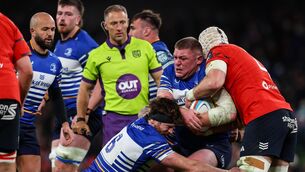
‘Thank God I’m playing with him, not against him’
“I remember the talk about a young fella down around Munster who was inexperienced but a mountain of a man...” says Corrigan.
Byrne chimes in: “Like most people I’d heard of this lad who wasn’t long playing rugby, and it was a case of who is he and so on. Then, when you saw him, it was mother of Jaysus, who is this? People don’t get it because on the telly he doesn’t look as big, but he’s enormous, and one of the strongest men I’ve ever met. He certainly made an impression.”
Hayes picks up his 100th Irish cap today against England and his former international teammates are warm in their praise for the Bruff man.
“For me as a hooker I ran the line-outs for Ireland and he was the best line-out operator I ever came across,” says Byrne. “You can talk about second rows and the thrower, but Hayes’ lifting was one of the main reasons Ireland had and have a good line-out.
“He actually messes up your throwing – I’d be throwing to Mal O’Kelly with Ireland, and then I’d go back to Leinster and I’d miss Mal because he’d be a foot lower. I’d be wondering ‘what the hell is going on here’.
“His lifting technique is immaculate. At one stage we brought in single-lifting, which meant he was lifting guys who were a minimum seventeen stone on his own.”
Frankie Sheahan, who soldiered with Hayes at Munster, concurs. “His lifting was extraordinary – it’s hard to describe, but he’d lift a player and then there seemed to be another burst, as if they went up, then up again. Sometimes you’d throw to where you’d expect the top of the jumper’s hands to be but you’d end up hitting his chest, John had lifted them so high.”
Hayes’ diligence extends to homework off the field. “Often you’d see him in a line-out and he’ll pull the second row to the right place, because the second row is in the wrong spot,” says Byrne. “Nobody resists – they’d go with him because they’d know he’s right. He’s never questioned on that.
“He has very good discipline and the fact that he studies the line-out calls so carefully is something people wouldn’t be aware of, but he never makes a mistake there. People sometimes don’t expect props to be as disciplined or as intelligent as other players, but John is very sharp in that regard.”
Hayes has been criticised for his scrummaging, but his colleagues put that in context.
“100 caps doesn’t happen by accident,” says Byrne. “As for the scrummaging, if what people perceive as a weakness was a real weakness he wouldn’t have lasted that long. He offers a lot more. He’s a couple of inches taller than he needs to be as a tight- head, but he battles on and he gets better as the game wears on. He’s very fit, there’s not a pick on him, which is outstanding given his size.”
“Tight-head prop is the toughest position on the pitch, no doubt about it,” says Corrigan. “Loose-head is tough enough but tight-head is twice as hard. I had to fill in for John a couple of times at tight-head. We toured Tonga and Samoa one time and he wasn’t there, so I had to play tight-head, and I didn’t thank him for it, I can tell you.
“John would tell you himself he was trying to learn this position in the early days, but he was trying to learn it against the best players of the world. Whatever chance you’d have of finding your way against club players, at provincial or international levels you’re really thrown in at the deep end.”
“At times it was fair enough, it wasn’t the best part of his game,” says Sheahan of the criticism. “But the other side is that if you give a dog a bad name it follows him. Converting to a front row as he did, he got mangled at times starting out. He was taken off in the first half of a game against Perpignan for his own safety, for instance.
“You’d say that in life and in rugby you have to learn from your mistakes, but that’s easier said than done. John learned from every single match he played. He improved a small bit after each game and he’s still improving.”
“He got a lot of stick in the early days,” adds Corrigan. “’The scrum is getting screwed and it’s John’s fault’. And it certainly wasn’t true that it was all his fault, but it shows he was a tough character that he was able to withstand that kind of criticism.
“He’s a gentleman, you wouldn’t meet finer off the pitch, but if he’s pissed off on the pitch he’s quick enough to react. Things change when fellas go on the pitch and he’s certainly as tough as anyone else out there.”
“He’s a nice guy,” says Sheahan. “I guess when he got his chance he’d come from the amateur days so he probably appreciated the chance to play professionally. And he treated it accordingly – you could count on one hand the number of times he’s had a few drinks, for example.”
CORRIGAN sees no reason why Hayes can’t play in next year’s World Cup.
“He’s expressed an interest himself in going to the World Cup. If he’s managed properly I see no reason why he wouldn’t make it. The World Cup itself isn’t that many games – it’s the build-up and the games he plays before it for Munster and Ireland.
“The tournament wouldn’t be a problem – even if you got to the final you’d only have seven games, and it mightn’t even be necessary for him to play all the pool games if you have weaker teams in there.
“For me the World Cup wouldn’t be an issue if he wants it.”
Frankie Sheahan puts it simply: “You walk out of a dressing-room with John Hayes, he’s probably the biggest of the thirty players on the field.
“And there’s something to that – no matter how professional the game gets, when you look at him, you’re thinking ‘thank God I’m playing with this guy, not against him’.”

CONNECT WITH US TODAY



Be the first to know the latest news and updates