No sign of new world order
While excuses will be made about player unavailability and the inevitable fatigue that accompanies the end of a long season, it is hard to hide from the facts. In the eight tests played between the home countries and New Zealand, South Africa, Australia and Argentina, not one victory was recorded by a northern hemisphere side.
On Saturday, Ireland and France (who face South Africa) have one last opportunity to strike a blow for Europe.
Despite losing both tests to Argentina, Wales — given they were forced to travel without 16 first-choice players — will be pleased with the amount of young talent they exposed to international rugby. In this respect, the Ospreys trio of forwards Ian Evans and Aled Wyn Jones, along with new out half James Hook, look exciting talents for the future.
Scotland also displayed encouraging signs of improvement in their test against the Springboks and with two tries disallowed in tight calls deserved better than defeat by a 14-point margin.
It has been a particularly bad two weeks for English rugby with their senior side humiliated in both tests against Australia and their ‘A’ side beaten by both Scotland and Ireland in the Churchill Cup in Canada.
For Ireland, the two-test series against New Zealand offered many positives, despite the failure to record that elusive first test victory over the All Blacks. Without question, Eddie O’Sullivan now has a side capable of competing with the very best on the international stage. However, despite the closeness of the two test encounters, when the serious questions were asked of New Zealand, they were able to respond. With at least six quality test performers waiting in the wings, one suspects that Graham Henry’s men will still be the dominant force in the forthcoming Tri-Nations series.
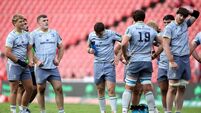
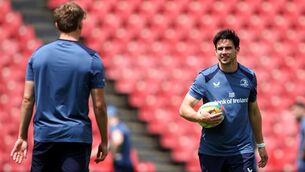
On Saturday in Perth, the Irish players must dig deep for one last titanic battle before the season draws to a welcome close. Australia hit a record low last season, when eight defeats in nine tests cost both Eddie Jones and Alan Gaffney their jobs. Their only victory in that period was against Ireland last November.
New coach John Connolly is a student of the old school and respects the importance of the set piece. Motivated by a lack of quality props, Eddie Jones had campaigned shamelessly in recent years for a de-powering of the scrum. It was somewhat ironic therefore that as a result of injuries to both Graham Rowntree and Julian White lastSaturday, England were forced into uncontested scrums for the entiresecond half.
Ireland now face a superior Australian team to the one that defeated them in the autumn. The most experienced half back partnership in world rugby in George Gregan and Steve Larkham has been reunited once again and they are extracting the maximum from a quality back division. If anything, the Wallabies pose a greater threat behind the scrum than Ireland faced against New Zealand over the past fortnight.
For the test series against England, Connolly set about rectifying the well-documented frailties up front by selecting one of the biggest forward units ever to represent Australia. New tight head Rodney ‘Rodzilla’ Blake, at 21 stone, made a try-scoring debut against the English but has been ruled out of Saturday’s test due to injury. Given the pressure that Marcus Horan, Jerry Flannery and John Hayes faced against New Zealand, they won’t be sorry to see the back of him.
Connolly has also strengthened the lineout by including four jumpers in Daniel Vickerman, Nathan Sharpe, Rocky Elsom and Mark Chisholm against England. No doubt, he will continue with this strategy to help negate the quality of the Irish lineout. The Wallabies were less than assured in this area against England, primarily due to the wayward throwing of hooker Adam Frier. It was no surprise when he was withdrawn at half-time last weekend. His absence next Saturday, due to injury, will only aid the home lineout. His potential replacement, the experienced Jeremy Paul, will ensure that the Australians are more competent in this area.
Eddie O Sullivan restricts change to a minimum with the introduction of Girvan Dempsey for Geordan Murphy. This represents his only selection alteration on the tour and is a surprise. Once again he has spurned the opportunity to introduce new faces in favour of the tried and trusted. The only concession on the bench sees the introduction of Jeremy Staunton but he is unlikely to receive any meaningful game time.
The difficulty for Ireland at this stage is to remain fully focused on the task at hand on the final day on tour. Minds inevitably wander to thoughts of well-earned holidays and a break from rugby after ten months of continuous confrontation. Saturday’s encounter presents the tourists with another opportunity to finish the season on a high.
Connolly is well aware this Irish team will be far less accommodating than England were in recent weeks. The Irish forwards, in particular, have been outstanding and need to rise to the occasion once more in order to deny Gregan and company the opportunity to attack.
While Ireland operated mostly in defensive mode in Auckland, the backs showed in the first test in Hamilton that they are capable of scoring tries against all opposition. After all the highs that the season offered both on the provincial an international fronts, victory on Saturday would provide a fitting finale.
Somehow I think it may prove a bridge too far.
CONNECT WITH US TODAY



Be the first to know the latest news and updates