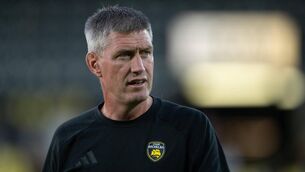
Williams on a Munster transition mission
The JRU and the assistant Munster coach aren’t exactly on the best of terms and the Australian admits he had all but promised the JRU that he would be accepting their offer to go and play there once he was out of contract with Munster at the end of last season when, out of the blue, the chance to stay put came his way.
In a nutshell, Munster fancied him as assistant to Declan Kidney. Jim weighed up the pros and cons and opted to remain with the side which he had graced so magnificently since first arriving in Ireland in 2001.
The Japanese weren’t best pleased but Williams felt he had to do what was best for himself and his family, and that’s why he has played a big part in preparing the Munster side for tonight’s all-important Heineken Cup clash with Castres at the Stade Pierre-Antoine.
‘Seamus’, as he became known to teammates and the public alike, is taking it year by year for now, aware that the success or otherwise of the team will have a bearing on his future. If he’s half as successful as a coach as he was as a player, most will be happy.
He played eight of the nine Heineken Cup matches that first year when Munster reached the final, only to lose controversially to Leicester. He was an automatic choice for the next three years and had 30 appearances in Europe behind him when he called it a day at the end of last season.
“I was all set to go to Japan in April when the Munster job came up,” he recalls.
“At this level and knowing this group of players and the set-up, it was obviously far more attractive to stay here and coach one of the most high-profile teams in Europe. That can only enhance your reputation as a coach.
“It was very late when it happened and I don’t think I’d be too welcome in Japan at the moment. My wife Megan and the kids (Kieran, two-and-a-half, and Ryan, 14 months) were a huge consideration. It was a choice between moving to Japan, which obviously isn’t English-speaking, and the opportunity to stay in Ballincollig and coach Munster, and I knew what I had to do.”
Williams may have celebrated his 38th birthday last month but he still looks so awesomely fit and big - 6’4” and 16 stone - that you suspect he has to miss the playing side of the game. He ponders the suggestion and states: “I haven’t had time to think about it.
“You worry about yourself when you play, when you coach there are 40 players to worry about and that keeps you well occupied. Yeah, when you stand on the touchline and things aren’t going well, you still think you could improve matters but that’s probably the same with every player winding up.
“But I’m enjoying the transition. It’s not just on the paddock that the decision-making goes on because there are vital aspects off the paddock as well: how to train them properly for that week, how to get them prepared, make sure you’re doing the individual stuff with the guys. I really enjoy working one on one with them, getting their attitude right and hopefully bringing that into the team.”
Williams accepts that continuity - or rather the lack of it - is one of the areas where Munster must work hardest (“it’s been inconsistent so far”) and sees this as a particular challenge.
He believes that people need to decide what they should do before going into contact, and that a lot of time Munster players aren’t doing that. As a result they aren’t getting quick ball.
“It’s always been a problem with Munster,” he says.
“Getting the continuity going at a consistent level is a huge challenge. We had bits and pieces of it against Edinburgh and any team doing that will end up scoring tries or getting points down at that end.
“As teams improve, you’ve got to improve as well. Guys are getting physically bigger, sevens are getting massive and Castres are an example.
“Taking the ball into contact and getting over the advantage line and getting the ball back quickly is all-important - simple things which a lot of teams at every level tend to forget about. It’s a basic skill.”
He has memories, most of them happy, of going to France, to some not too hospitable spots like Castres, Bourgoin, Toulouse, Perpignan and so on, but recalls the 2002 win over Stade Francais in the quarter-final in Paris as the biggest of all.
He points out that “not many teams have success in France”.
“It’s a difficult place to go, especially with a team like Castres. This is the fourth time we’ve played them there. They have a high turnover of players coming and going, so you’re never playing against the same group of guys. It’s incredible the way players like Kees Meeuws, Carl Hoeft, Brad Fleming and so on come on the scene.
“The numbers they can call on is fantastic. Every time we come down here, it’s basically a different team we’re playing against. It will be interesting and it will be tough.
“We’ve just got to grind out the win and if we do that, I think we’ll be happy.”
CONNECT WITH US TODAY



Be the first to know the latest news and updates