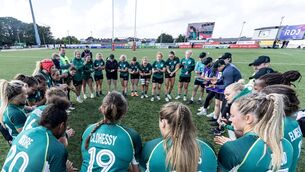
Irish must stifle Welsh free spirit
While the consequences of defeat would not be as severe, one can’t escape the fact that Ireland’s Six Nations campaign will hang on the outcome.
From the Welsh perspective, Steve Hansen will see this as a true measure of the progress his side has made over the past six months. The pressure was on them in their home tie against Scotland last weekend. Given the hype surrounding their two outstanding performances against New Zealand and England in the World Cup, the Welsh had to reproduce form and more importantly had to win. In both cases they delivered.
The transformation that has come over this Welsh team in recent months is remarkable.
Only last August, they arrived in Lansdowne Road for a warm up game against Ireland and looked woeful. Yet within two months, they outscored England by three tries to one in a memorable World Cup quarter-final and also played some scintillating rugby against New Zealand.
To their credit, they continued with their expansive approach right from the kick-off last Saturday. The win and the manner in which it was achieved, will lift Welsh spirits immeasurably for their trip to Dublin. However, they are unlikely to be given the freedom of the park they enjoyed against Scotland in the opening 40 minutes of tomorrow’s encounter.
From a purist perspective, the approach of the Welsh backs in their last four internationals has been breathtaking to watch. Their first instinct is to run and in the back three of Gareth Thomas, Rees and Shane Williams, they have pace to burn.
In many respects, Hansen has compromised his selection in order to accommodate his most talented players in the side. Thomas, with over eighty caps, has very limited experience at full back. I am sure that Ireland will look to expose his lack of positional sense at an early stage.
Of even more encouragement to the Welsh, rugby league convert Iestyn Harris has finally found his feet in the union game. Hailed as the saviour two years ago when he initially made the switch, he has now settled well at inside centre. The Welsh erred initially when throwing him onto the international stage at out-half. Given the pivotal nature of the position it proved too big an ask.
He has now regained his confidence after a difficult start and is having a very positive influence on the team as a whole. It will be interesting to see how he copes with the threat of Brian O’Driscoll tomorrow. The potency of the Welsh back line depends, as always, on the performance of their front five. Against Scotland, they were competent at best. The return from injury of Robin McBride at hooker and Robert Sidoli in the second row will strengthen this area considerably.
Sidoli has impressed me greatly since his arrival on the international scene last season. The inclusion of Jonathan Thomas in the back row for the injured
Colin Charvis will not weaken the side. In the World Cup, Thomas emerged from nowhere to star against the All Blacks and England. The Welsh see him as a future Lion.
The captaincy reverts to Martin Williams who has been in outstanding form of late. His poaching skills and support running is ideally suited to the patterns of play favoured by the Welsh at present.
Despite the defeat in Paris, the Ireland management has predictably kept change to a minimum. It was only a matter of time before Donnacha O’Callaghan would start in an Irish jersey and somewhat surprising that it has taken twelve months given that he won his first cap against the same opposition in last year’s championship.
Ironically, Malcolm O’Kelly played well last Saturday with a noticeable increase in his work rate. The surprise element in this selection revolves around the centre partnership of O’Driscoll and Gordon D’Arcy. O’Driscoll has played at inside centre before, two years ago, against New Zealand.
The biggest change required in respect of tomorrow’s clash will not be in personnel but in approach. Against the French, Ireland decided on a very limited game plan and played a game of containment. With O’Driscoll now restored to the side, they will seek to keep the ball in hand in attack.
In this respect, one suspects that the numbers on the Irish jerseys will bear little resemblance to their field position. One can expect to see Shane Horgan being used to take the ball up from set piece with O’Driscoll and D’arcy making an impact from broken field positions.
For Ireland to win this game, it is vital for the forwards to dominate possession. In the corresponding game in Cardiff last season, the Irish scrum was in all kinds of trouble. With that in mind, Steve Hansen has recalled Iestyn Thomas at loose head.
While he created difficulties for John Hayes, the angles of his scrummaging were questionable to say the least. I’m sure Eddie O’Sullivan will have a quiet word with French referee Joel Judge in the build up to this game. Ireland will have to be more positive in attack, yet cannot afford to get sucked into a loose Barbarians type game. To do so would play right into the Welsh hands.
As a collective unit, the Irish defence will require significant improvement from last weekend. On that occasion, communication broke down and too many first up tackles were missed. Given that the O’Driscoll/D’Arcy axis has not played together before, it is vital that this area has been addressed during the week.
For the Welsh, one feels that the element of surprise has now gone. Their bold sense of adventure was almost forged from desperation in the World Cup. Last weekend, their free spirit was rewarded in many respects due to naive defending from the Scots.
Ireland will not be as accommodating. Overall, I feel that the Irish pack and their lineout in particular hold too many aces. For entertainment value, this game could be a classic. In Cardiff last year, a late O’Gara drop goal was all that separated the two sides. It could be that close again tomorrow, but I expect Ireland to emerge triumphant.