Irish escape to victory as underdogs bare their teeth
With world champions England losing in Cardiff, and reigning champions France put to the pin of their collar by Scotland, Ireland kicked off in Rome yesterday forewarned that the gap between the northern hemisphere haves and have-nots is closing.
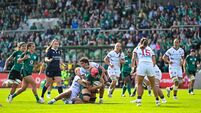
That said, nobody expected Ireland would struggle so desperately to record yesterday’s victory. The game finished with a try to Italy as Ireland’s inspirational captain Brian O’Driscoll was carried from the field injured. Such was the ferocity of the Italian challenge that without O’Driscoll’s brilliance, the Italians could have recorded a first Six Nations victory over Ireland.
Indeed, fortune favoured the visitors when Italian winger Ludivico Nitoglia lost control of the ball while grounding for a try with ten minutes to go. Had Italy regained the lead at that stage, anything could have happened. Under the circumstances, Ireland will be happy to leave Rome with a victory. With both O’Driscoll and Gordon D’Arcy doubtful for Murrayfield with hamstring injuries, it will be an anxious week for Eddie O’Sullivan.
From the kick off, Italy succeeded in putting Ireland under all kinds of pressure. Their forward unit threw down the gauntlet in the set piece and dominated the early exchanges to such a degree that the Irish three-quarters were starved of opportunity.
It also didn’t help that Ronan O’Gara was having a nightmare day with his kicking out of hand. Prior to the game he had expressed concerns over the Mitre ball which is used exclusively in Italy. It was evident from an early stage he had no confidence in his ability to control its flight.
Over the past 18 months, injuries to key players has deprived Ireland of the opportunity of fielding the “magnificent seven” back line that started in Rome. Ironic, then, that due to a lack of quality ball, it took 21 minutes before they were involved in a meaningful attack. That resulted in the opening try for Geordan Murphy, but with D’Arcy pulling a hamstring in the build-up, Ireland’s potent attacking division lasted a mere 25 minutes.
Ireland were extremely fortunate that Italy’s territorial dominance was not translated into points, due to the poor place-kicking of Luciano Orquera. In all, he missed three kickable penalties and a drop goal. Given Roland De Marigny’s subsequent success with the boot, Ireland were lucky he was not presented with the earlier opportunities. Due to the magnificence of Italy’s back row, Ireland’s attacking opportunities were limited throughout the game. In this respect, nobody did better than Mauro Bergamasco, restored to his best position at No 7. With his front five under pressure, Denis Leamy found it difficult to compete with the Stade Francais flyer.
However, Italy had very little to offer behind the scrum. While they did manage to put the ball through the hands on a number of occasions, they were too lateral and Ireland’s defensive line was never threatened.
With so little time to prepare for the Scotland game, Eddie O’Sullivan will be concerned with the vulnerability of his forward unit. Outside of the set piece yesterday, they also seemed strangely one paced in broken play.
Meanwhile, in Cardiff on Saturday, Wales finally secured the scalp they have been craving the past few seasons. When it mattered most, new Welsh superstar Gavin Henson showed just why they have been making such a fuss about him in the valleys.
When you play in silver boots, you must perform. Not unlike Brian O’Driscoll, Henson displayed a willingness to mix the unglamorous grunt with moments of magic. His opening tackle of England teenage debutant Matthew Tait set the tone for his team.
Remarkably, just 15 months after their World Cup triumph, only five of that victorious England team started this game. Yet Wales almost conspired to lose a game in which they were clearly the better side. At vital stages in the opening half, with clear overlaps out wide, they were guilty of kicking away possession.
The biggest question mark facing Wales coming into this game was the quality of their front five. At half time Mike Ruddock would have been extremely pleased with the manner in which his set piece performed. Throughout the opening period, Wales played with confidence and looked extremely efficient, but, as the game progressed, Wales were again blighted by a lack of self-belief. Why they abandoned their running game to engage in aerial ping-pong with England almost beggared belief and could have cost them the match. With Stephen Jones missing four kicks at goal, it almost did.
With five minutes to go in Paris, the biggest championship upset in years was on the cards as a result of a brave opening performance by Scotland. Bernard Laporte’s failure to select either Elissalde or Yachvili at scrum-half was further compounded by the omission of Michalak at out-half.
Scotland, with their backs to the wall, came out fighting. Apart from the scrum, where tight head Gavin Kerr had a torrid afternoon against Sylvain Marconnet, they competed admirably. The lineout was as productive as ever and despite injuries to their recognised back row, outplayed the French in this vital sector. Nobody did better than the hard-hitting Jason White.
Scotland will be disappointed that their own error presented France with the match-winning try. They will also rue strange decisions from the officials. However, they will take a lot from this game and look forward to Murrayfield next Saturday with renewed confidence.