So why is Thomond so special?
Everybody wants to talk about last Saturday. It seems that for the lucky 13,000 souls that filled the compact arena, countless thousands watched on television or listened to the radio.
The fact that Sale top the English domestic league has contributed even further to the feelgood factor of the red army. Prior to kick off, I spoke to many of the travelling English journalists including my former Lions colleague Paul Ackford.

You can sense from their rare visits that they never really know what to make of the place. Ackford himself played in a very competent London Counties side against Munster back in 1988 in front of at least 500 supporters. How times have changed.
Accepting that the game as we know it changed utterly with professionalism, the transformation in terms of support and general interest for the provinces is astonishing.
While Thomond Park has already cemented its place in the history books, the thing that makes the “Munster package” so special is the people who follow the team.
Nowhere is this more in evidence than when you travel on away fixtures. The knowledge, passion, belief and commitment shown by these people is reciprocated in bucket loads by the players.
For the home matches, the majority of the crowd occupies the same vantage point, game after game, fearful that any change in the match day routine could somehow influence the result. Humour is also very much to the fore.
The silence for the kickers is observed with such reverence that even when the inflatable mascot (soon to be named) goes through his Jonny Wilkinson kicking routine 15 minutes before kick off, the call for hush envelops the stadium.
The simplicity of the pre-match entertainment underlines Thomond’s uniqueness. In contrast to many foreign venues, bolstered by pom-pom dancing girls, smoking parachutists and remote controlled model cars, Munster’s finest respond with gusto to the promptings of a solo singer.
Of course it helps when, in the case of last Saturday, one of Cork’s finest, Cara O’Sullivan, was at the microphone.
Her rendition of “Stand Up and Fight” elicited the perfect response from the terraces as the teams took to the field. The sight of the piano player rattling the ivories on the touchline resembled something from a Monty Python movie. But it works for us.
One of the most satisfying aspects of Munster’s march through Pool 1 was the emergence of new young talent on the European stage. Over the years, on days of triumph, we have become accustomed to images of the clenched fist of Mick Galway, the bear hug of Paul O’Connell or the smiling face of Ronan O’Gara.
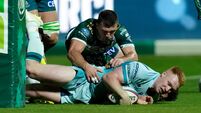
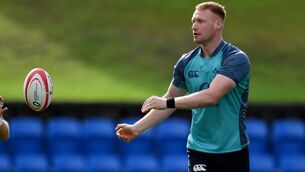
Last Monday, this newspaper captured new heroes with Barry Murphy’s magnificent solo try adorning the front page and Ian Dowling being carried shoulder high from the pitch on the sports pages. While the personnel may change the commitment has remained constant.
On the field, Sale were left reeling and couldn’t cope with the intensity of the Munster challenge. It will be interesting to observe over the next few months how they cope with this setback. All season, they’ve been eulogised in England and particularly by Sky Sports pundits for the quality in their side.
When Gloucester arrived three years ago they also topped the Premiership. Such were the psychological scars from the Munster defeat that their confidence was shattered for months.
Munster has now provided a blue print for the rest of the Guinness Premiership on how to tackle Philippe Saint-Andre’s side.
Recent talk from Edgeley Park wasn’t confined to qualifying for the knock out phase of the Heineken Cup but on winning the trophy outright.
Saturday’s defeat has made that task all the more difficult consigning them to an away encounter with Biarritz in San Sebastian.
When the Heineken Cup resumes on the first weekend in April it will almost seem like a new season for the players of Munster and Leinster. With the majority of both squads involved with Ireland at either A or full international level for the Six Nations, Declan Kidney and Michael Cheika face a frustrating period.
With the Celtic League now used as the barometer for deciding seeding in the Heineken Cup, it has been decided that no fixtures will take place during international weekends, as had been the case in recent seasons.
Therefore Munster have only four fixtures in the ten weeks from now to their quarter final with Perpignan. The majority of the international squad will remain unavailable to the provinces until the weekend before the knockout stages.
Leinster’s preparation is further complicated by the fact that their free weekend in the Celtic league falls the weekend before the Toulouse clash. They will be forced to arrange some kind of meaningless friendly.
Yesterday’s semi-final draw has thrown up the possibility of a clash between our two finest in Lansdowne Road.
What an occasion that would be. Over the years lady luck has seldom smiled on Munster when the semi-final draw was made. Of the five semis Munster have contested, four have taken place on French soil. The only exception was the epic encounter with Wasps in Dublin in 2004.
If anyone has the material to trouble Toulouse, Leinster has. The way the Frenchmen play would suit them. Should they fail however and Munster beat Perpignan, it’s back to familiar territory for Munster’s travelling army.
The real winner from that scenario? Trevor Brennan’s bar.