Blue blood racer
HE won't know it of course, but when Innox goes into the fray at the Cheltenham Festival next Tuesday, the eight-year-old gelding will reawaken the curious and swashbuckling sporting history of a Spanish aristocratic family.
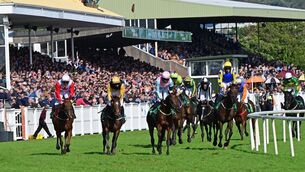
The Francois Doumen-trained horse is the sole French challenger going to post in Tuesday afternoon's Kim Muir Amateur Riders Steeplechase, introduced to the National Hunt Festival in 1946 in honour of a young cavalry officer who lost his life in the early years of the Second World War.
And given the background of his owner and her late brother there is no more apt a race for Innox to be entered in.
Innox's owner is the Marquesa de Moratalla, a Spanish noblewoman whose pure red racing silks are renowned in her adopted home country of France and which were carried aboard The Fellow to Gold Cup victory in 1994.
The 'Voice of Racing', Peter O'Sullevan is an old friend and long-time racing advisor to the Marquesa, and the pair were introduced by her brother, the 17th Marquis de Portago.
Their mother was Olga Leighton, an Irishwoman, former nurse and widow of a wealthy Biarritz-based financier. She married again, to the 16th Marquis de Portago, and Olga bore the nobleman two children.
Alfonso Cabeza de Vaca y Leighton, 17th Marquis de Portago was born in London in 1928, but grew up in France, living in the chic seaside resort of Biarritz while his father fought alongside General Franco in the Spanish Civil War on the other side of the Pyrenees Mountains.
With such a blue-blooded background, money was never in short supply. In fact, 'Fon' as he was known to his intimates, readily accepted the accustomed playboy lifestyle and glamour of a young cosmopolitan aristocrat.
He was also a tremendous all-round sportsman, excelling at fencing, polo, riding and even flying as a youth when he was still a teenager he won a $500 bet by flying an airplane under a bridge.
He went on to represent Spain in Davis Cup tennis, became bobsleigh champion on the Cresta Run and made the Spanish Olympic team which finished fourth in the two-man event at the 1956 Winter Games in Cortina.
On horseback, in the late 1940's, Fon became the leading amateur rider in France, both on the Flat and over jumps, taking the latter of those titles by riding a winner over hurdles despite a broken collar-bone.
In 1950, Portago went to Prestbury Park and rode in the Cheltenham Gold Cup, riding Garde Toi to third as Cottage Rake completed his hat-trick of consecutive victories in the meeting's blue riband race.
Fon rode Grande Toi again that year, in the Aintree Grand National won by Freebooter, the second of two rides in the race, much tougher in those less- forgiving days when the fences had all the feel of brick walls.
But when Fon returned to Aintree it was on four wheels rather than four legs.
Under the ownership of Ms Miriam Topham, the fabled Liverpool course also became a venue for the British Grand Prix during the 1950's.
It is a fact which horse-racing aristocrat Lord John Oaksey believes made Fon the only man to ride in a steeplechase around Aintree and drive a Grand Prix car on its track.
Fon was the embodiment of the rich, extravagant and fun-loving playboy driver, fearless behind the wheel and carefree too, as pictures of him testify, sitting in the cockpit of his Ferrari, casually drawing on a cigarette from the side of his mouth as a mechanic fills up its fuel tank right behind him.
His motor racing career began in 1953 when he crossed the Atlantic Ocean to attend the New York Motor Show.
It was there he met Ferrari's importer for the United States, Luigi Chinetti, who was a former winner of the Le Mans 24 Hours.
Signor Chinetti took a shine to de Portago and asked the Spaniard if he would like to be his co-driver on the Carerra Panamericana through Mexico.
Unsurprisingly, de Portago offered little resistance to the idea.
The opportunity sparked his love affair with motor-racing and before long he had purchased a Ferrari sportscar and was making his racing debut in the Buenos Aires 1000 in 1954.
Partnered by Harry Schell, the pair finished second.
De Portago then switched to a Maserati sportscar and raced with some success in Europe for the rest of that year.
From sportscars, Fon turned his attentions to Formula One and for the 1955 season bought an F1 car from the great Enzo Ferrari.
The partnership between man and car was short-lived, however. De Portago wrecked and completely destroyed the Ferrari in that year's International Trophy race at Silverstone, and badly broke his leg in the accident.
But he recovered in time to finish the year on a winning note back in sportscar racing and his success once again saw him lured back to the Prancing Horse and Formula One.
For 1956, the Marquis was hired as the fifth Ferrari factory driver alongside the legendary Juan-Manuel Fangio, Peter Collins, Musso and Eugenio Castellotti.
His best finish was a shared second behind Fangio at the British GP at Silverstone alongside Collins and the following year saw him open the season with a fifth-placed finish in Argentina in January 1957.
From there he went back to Europe to prepare for the streets of Monaco, but a week before the grand prix de Portago accepted an offer to drive in Italy's classic road race, the Mille Miglia The Thousand Miles from Brescia to Rome and back.
IN typical, carefree fashion, Fon had volunteered for the race as a favour to Enzo Ferrari when another of his drivers had taken ill. So with no proper race preparation or course reconnaissance, the 29-year-old playboy took off on another adventure.
It was to be his last.
As Fon careered through the village of Guidizzolo in the closing stages of the Mille Miglia, his car suffered a tyre blowout.
De Portago, his co-driver Edmund Nelson and 10 spectators five of them children were killed, 20 more people were injured.
Enzo Ferrari and the Englebert tyre company spent four years fighting manslaughter charges as a result of the crash, which also put paid to the Mille Miglia race itself.
Sport had lost one of its most remarkable and versatile competitors.
He was one of the last great sporting gentlemen, a man never afraid to take on a challenge, be it the brick walls of Aintree's steeplechase fences, the ice of the Cresta Run or, ultimately, the treacherous mountain roads of Sicily.
And Alfonso Cabeza de Vaca y Leighton, 17th Marquis de Portago, Fon, would have loved the Kim Muir Steeplechase.