Colin Sheridan: Ciara Mageean was a stranger who felt like a friend to everyone

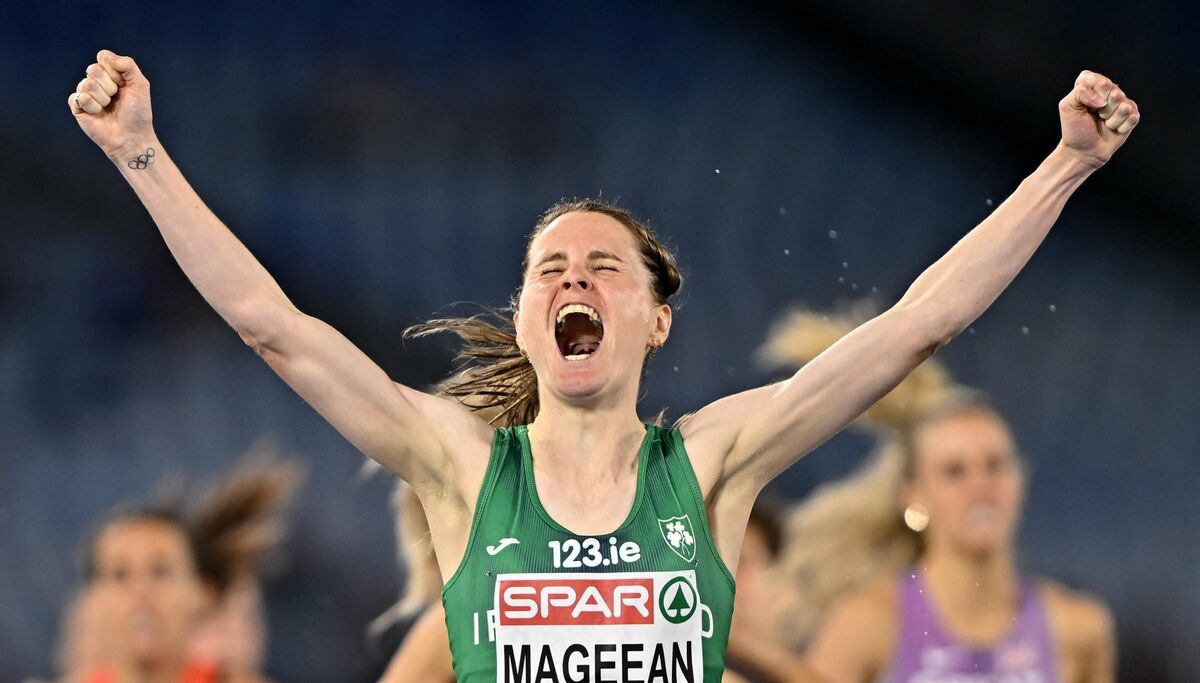
Ciara Mageean never hid what her triumphs cost. That made her 2024 European Championships gold medal win feel especially intimate. Pic: Tyler Miller/Sportsfile

Only the good die young. What a cruel, nonsensical, useless thing to say. As though goodness were a condition with a prognosis. As though there were consolation in finding a phrase that fits a death which should never have happened.
Ciara Mageean was 34. There is nothing in those five words that the next eight hundred can put right. We will reach for the gold medal. Of course we will. Rome, only two years ago.
The European title she had pursued through years of injury, disappointment and the particular loneliness of knowing what you might be capable of while your body keeps refusing you the chance to prove it. She got there. We watched her get there. We screamed at the television and knocked over coffee tables.
And because she had never hidden what it cost, because she allowed us to see the wanting and the hurt as readily as the joy, her victory felt unusually intimate. Here was someone we were desperately happy for. A stranger who felt like a friend.
Now we will watch it again. We will search her face for something we missed, although there is nothing to find that will make this bearable. Thank God she had that night, we will say. And thank God she did.
But I find myself resisting the impulse to make the medal the thing that completes her story. To arrange the years so that the gold arrives just in time, a final vindication, before the terrible reckoning. She did not need vindicating. Her life was already worthwhile. She had already given people reasons to love her that had nothing to do with how quickly she could run.
Last year, post diagnosis, a friend went to a book signing and asked Ciara how she faced each day of cancer treatment. It is an enormous question to put to someone so young. How do you get up and submit yourself to another day of trying to stay alive? How do you carry the fear without letting it take possession of every room you enter?
Ciara answered by talking about the children she never knew, but could see: the children whose futures were being erased on television. Children caught up in the worst the world had to offer by quirk of circumstance. Compared to them, Ciara said she felt she had little to complain about.
Imagine that. A young woman undergoing cancer treatment, almost certain she wouldn’t see 40, was asked about her own suffering, and her thoughts went to children whose suffering she could not stop.
Boy, was she entitled to complain. She was entitled to rage, to be frightened, to spend every available ounce of love and attention on herself and the people closest to her. Nobody could have asked anything else of her. Yet she was still looking outwards.
I would not turn her answer into an instruction for other people who are ill. Nobody owes us perspective from a chemotherapy chair. Nobody has to earn our sympathy by demonstrating that somebody else has it worse. What she said tells us something about Ciara. Even with so much to carry, she was thinking about people she would never meet. Their lives mattered to her. Their lost futures mattered to a woman trying to hold on to her own.
There are things you learn about a person that change the way you remember everything else. For me, that is one of them.
Another is Jerry Kiernan. Remember how she spoke about him after he died. The tears. The warmth. The terrible difficulty of putting into sentences what someone has meant to you when suddenly they are gone. We knew he had coached her. Listening to her, we understood how inadequate a description that was. She let us see the scale of her loss, the space he had occupied in her life.
So many people will recognise something of themselves in those tears now. People who knew her, people who ran beside her, people who had only ever watched her through a screen and nevertheless felt they knew something essential about her.
We should be careful here. A country’s sadness cannot measure what her husband, her family and her friends are enduring. They have lost the person whose voice they expected to hear, whose company they had plans for. We have no claim on the centre of that grief.
But we can say that she reached us. Her kindness reached us. Her delight reached us. Her capacity to feel things so openly, to care so plainly, reached us.
Thirty-four is no age at which to start speaking of a life as complete. There should have been decades: ordinary days walking the fields above Portaferry with her dogs, uneventful evenings, plans made casually because there was no reason to imagine they would not happen. She deserved time in which nothing exceptional was required of her. Time to be happy. Time to grow old with the people she loved.
The gold will endure. So will the records. But when I think of Ciara Mageean, I will think of that answer at the book signing. Her own future, threatened and cruelly uncertain, and she was grieving for someone else’s.
Only the good die young. The words explain nothing, yet capture everything.
How could a heart that held so much be allowed so little time?
Irish rugby likes developing coaches. Sometimes it prefers them to do the developing somewhere else. Noel McNamara went to Durban, then Bordeaux, and acquired the kind of pedigree that makes people back home wonder why nobody thought of him sooner.
If reports of his impending appointment at Leinster prove correct, the Clare man will return through the front door carrying a particularly useful reference: he helped design the Bordeaux attack that dismantled his prospective employers in May. An unusual interview technique. Effective, though.
Munster must be watching with interest. McNamara has previously been linked with them. How seriously he was courted remains unclear, but surely somebody was making the call. A man from O’Callaghan’s Mills, an Ireland Under-20 Grand Slam coach, now helping make Bordeaux one of Europe’s most exhilarating teams? You would hope the number was saved.
At Munster, he might have arrived as a coup. A homecoming worth celebrating. Someone whose ideas could be given room to take root. At Leinster, the welcome will come with an inspection date. McNamara knows the nursery, having run the academy. He knows the players. He once taught Dan Sheehan maths. He will understand that the arithmetic at Leinster is brutally simple: resources plus internationals must equal European Cups. The working out gets limited credit.
His achievements deserve better than any suggestion of a consolation appointment because a more glamorous name proved unavailable. This is an exciting coach with an imagination, returning with knowledge he could only acquire by leaving. Still, there is a difference between being welcomed as the answer and being asked immediately to supply one.
At Munster, time might have been his friend. At Leinster, it will be his enemy. With no move before next season, McNamara could face Leinster in another European final before joining them. One last chance to break the thing he’ll be hired to fix -
If grief has five stages, Mayo are entitled to discover how many joy has. After 75 years waiting for Sam, four months celebrating seems almost restrained. That everyone has survived, to date, merits its own award. Friday’s All-Stars should provide a bookend. Andy Moran deserves enormous credit for resisting the headmaster’s whistle, allowing his players to enjoy the happiness they gave everyone else. Quietly, though, November must come as a relief. Perhaps a gentler phase beckons: fewer homecomings, earlier nights, the occasional vegetable. They have mastered disbelief and delirium. Next comes learning that happiness can survive the odd evening at home.
Paddy McAteer could have spent Saturday on a mucky pitch at home, with winter training looming like a black crow. Instead, the Mullaghbawn man was launching a 60-yard field goal through the Indiana night, forcing overtime against Minnesota and helping his team to victory. Some kick. Some way to spend your youth. There is something life-affirming about seeing a young Irishman take a chance on a different path and find himself in a moment like that: teammates swarming him, a stadium roaring, a memory made forever. Whatever comes next, he will always have that kick. What a wonderful adventure.

CONNECT WITH US TODAY



Be the first to know the latest news and updates