Why 'glamorous' overseas options are not always the best choice for Irish athletes
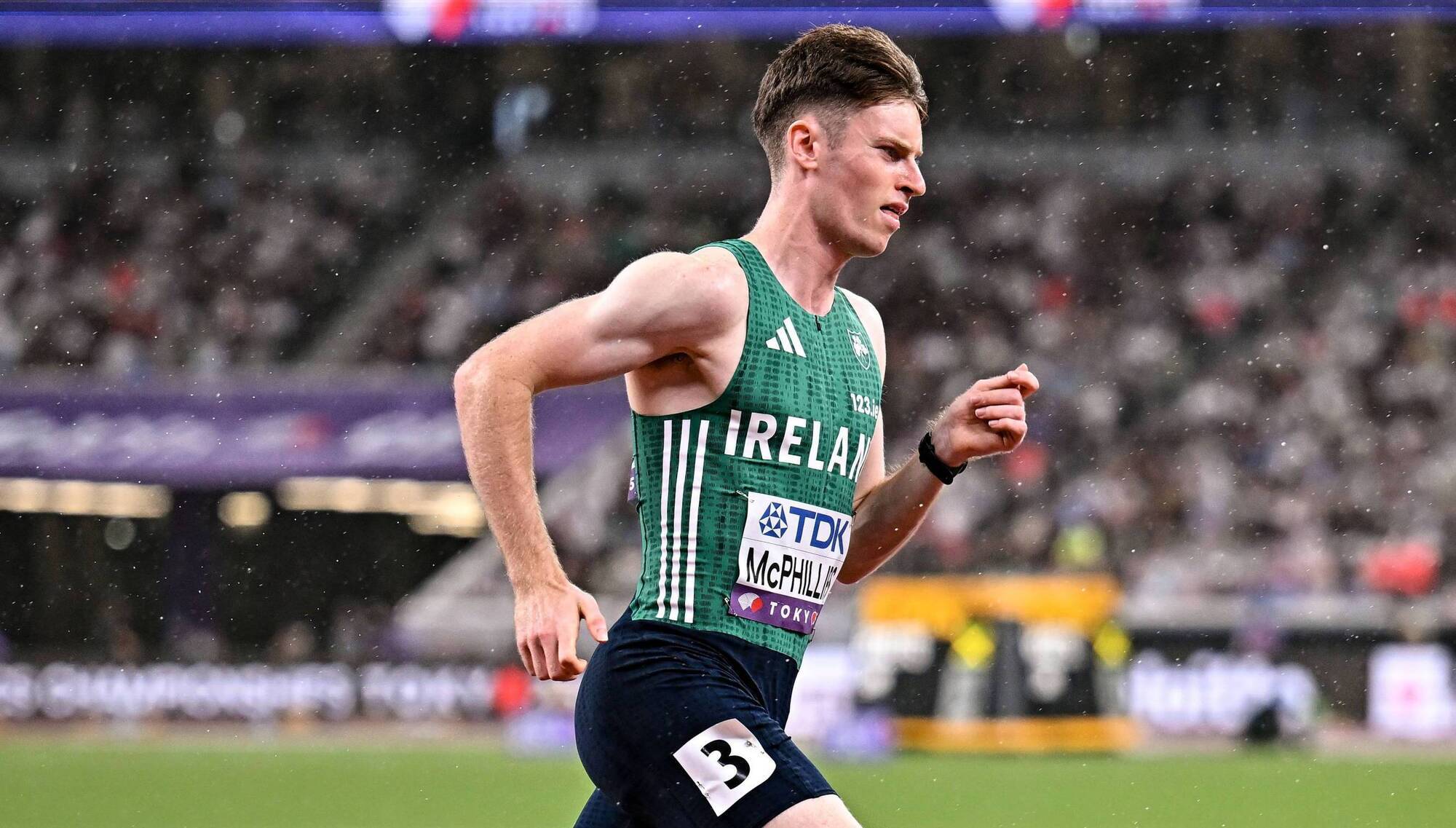
Cian McPhillips is one of the Irish athletes taking advantage of the support system available at home. Pic: Sam Barnes/Sportsfile
Athletics Ireland High Performance Director Paul McNamara believes the home-based supports available to this country’s track and field elite are the “best in the world”.
Following the country’s most successful ever European Championships, McNamara said both Athletics Ireland and the Sport Ireland Institute need to be louder and more assertive in selling to Irish athletes the “world-class environment” available on their doorstep.

Such are the industry-leading S&C, physio, biomechanics, physiology, and psychology services provided by the Sport Ireland Institute, McNamara’s view is that far away pastures aren’t always greener. More “glamorous” environments may certainly be available elsewhere, but for “backup and medical wraparound” support, Ireland is a global leader.
Rhasidat Adeleke, who trains out of Texas, based herself back home in Dublin from the middle of last month.
Read More
From a 23.07 200m clocking in Lucerne on July 16 to last week’s European silver in Birmingham, she worked daily with strength and conditioning coach Martina McCarthy and physio Ciara McCallion at the Sport Ireland Institute, and was effusive in her praise of the corrections and improvements the pair oversaw in the short time Adeleke was in Ireland.
“We can't overstate how good the services provided to our athletes are,” said McNamara.
“The landscape for our sport is incredibly complex. We have athletes sponsored by shoe companies in satellite areas that sometimes we don't see a whole lot of. But the services we do have and the athletes that avail of them, whether it's S&C, physio, biomechanics, physiology, or psychology, Sport Ireland and the Sport Ireland Institute have done an incredible job, and the evidence is there to see for those athletes that realise there is an opportunity for me here to avail of this.
“One of our leading coaches has commented that he believes, relative to his other athletes in other systems, that the supports we have are the best in the world. And I wouldn't argue with him.
“The longer I am in the sport, the more I realise that all that glitters is not gold. There's very glamorous environments in other places [outside Ireland], but with very little backup, very little medical wraparound.”
Marketing this reality, accepts McNamara, is perhaps one area they could be doing better in.
“I think we in Athletics Ireland and the Institute need to be a little bit more confident and a little bit more assertive about what truly a world-class environment looks like and the environment that we provide and really sell that to our athletes because there is value to be had.”
The High Performance Director is acutely aware, though, that coaching supports must also come up to the mark. The environmental conditions cannot be geared exclusively towards the athlete. It must also be sustainable for the individual overseeing them.
For so long in this country, financial assistance or financial acknowledgement of those with a stopwatch in hand was lacking-to-non-existent.

“This year, we hired four or five coaching roles in the programme. Some of them part-time, so that's a couple of things. That's us committing to the professionalisation of coaching as we said we would do.
“I think we're spending about €160,000 in support of coaches external to the system. There is a symbiotic relationship between those coaches in our system, but it's again building - personnel-wise, resource-wise - the coaching environment to match the services, the medical wraparound.
“That a Cian McPhillips, who is very much embedded in that, working with Joe Ryan, who we support, has everything he needs to prosper. And quite frankly, he does, and he's made the most of it.
“I’ll name-check Cian but there's multiple others. It's our best athletes with our best coaches in that environment with the best medical wraparound. And we are closer to being able to provide that than we've ever done before.”
His green verdict on Birmingham was that last week “absolutely delivered”.
Ireland had never before won four individual medals at a single European Championships. In the 25 editions from 1934 to 2022, Ireland won three gold medals. In the past two editions, there have been four.
“I'm in athletics the best part of 35 or 40 years. We've never seen anything like this,” McNamara continued.
“We've always had successful athletes. We've always had the Sonias, the Marcuses, and the Johns, but to have so many that are performing at a top end and so many coming through.
“We are on an upward trajectory. Last few years at champs, athletes coming in, they're not coming to get a vest. They're not coming just to say they're an international. They're looking around at their peers and realising these guys medal and they medal repeatedly, and that's what I want to be.
“So, the focus and the mindset throughout the entire sport has changed significantly.”
One of the week’s few disappointments was the performance of the women’s 4x400m relay quartet. Although minus three of the team that delivered silver two years ago, the eighth-place finish in Friday’s semi-final was 10 seconds slower than the medal-winning run in Rome.
Separate to the individual Sport Ireland funding allocated to Adeleke, Sharlene Mawdsley, and Sophie Becker, the women’s 4x400m set-up was given a €60,000 pot for 2026.
“They were missing three of the four fastest athletes through injury or other reasons, but if you look at the profile of athletes there, Sharlene Mawdsley is in the best shape of her life. She will be as good as that going forward for a couple of years yet. Rhasidat, we've seen a resurgence. She's going to be as good as she ever was and better before we know it.
“Sophie is doing great. Rachel [McCann], again injured, but in a great position. We want to see that same performance from 2024 in 2027.”