Scientists find blood biomarker that opens door to CTE diagnosis in living patients
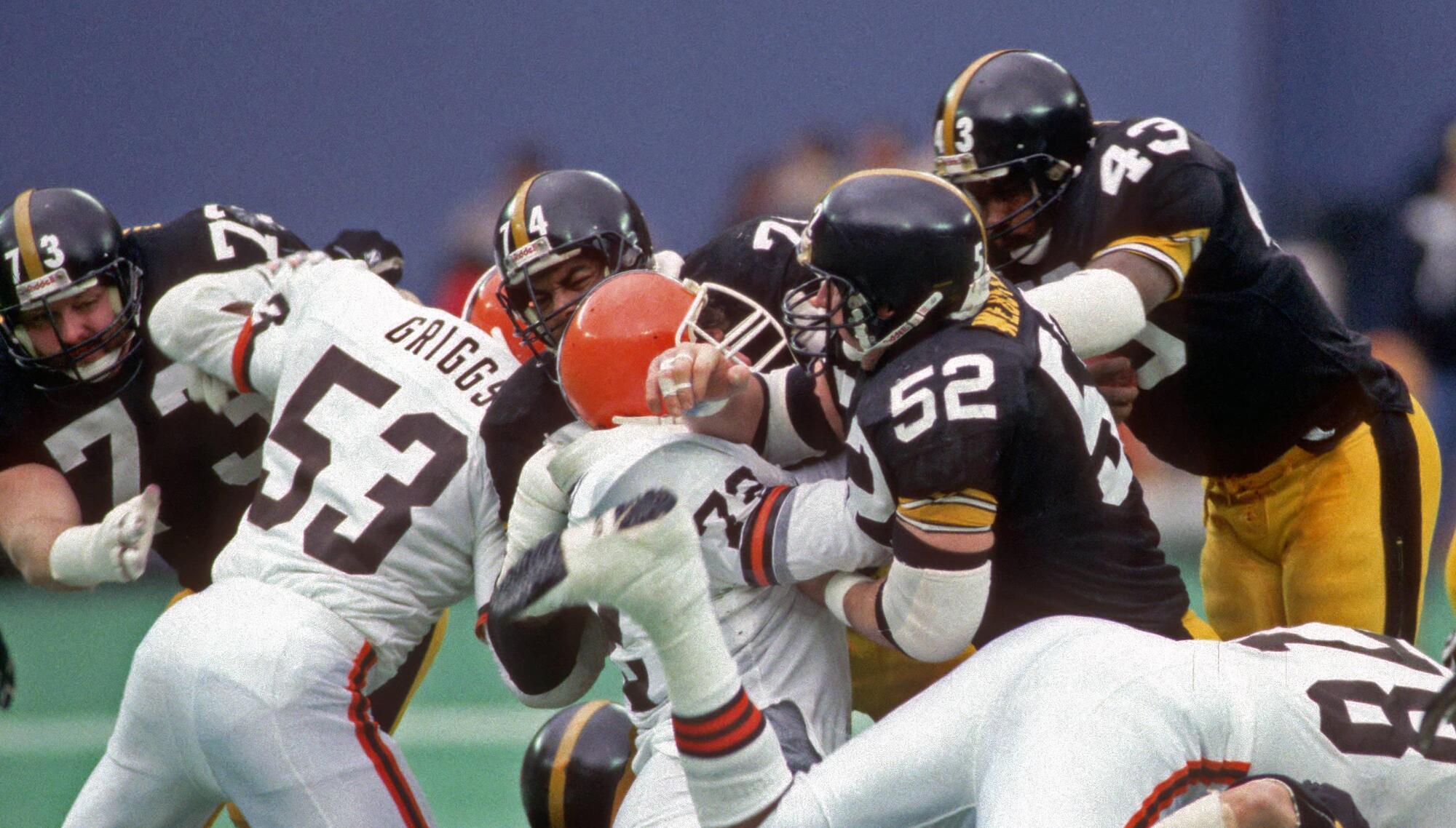
COLLISION COURSE: Center Mike Webster of the Pittsburgh Steelers, seen here playing against the Browns during a game at Three Rivers Stadium on December 26, 1987, was diagnosed with CTE after his death. Pic: George Gojkovich/Getty
Scientists have moved a step closer to diagnosing the degenerative brain condition chronic traumatic encephalopathy in living people, after a study found a blood biomarker that identifies an advanced form of the disease.
As things stand CTE, which is caused by repeated trauma to the head and is especially prevalent in collision and contact sports such as American football, rugby and football, can be diagnosed only after death by examining brain tissue.
However, scientists at Washington University School of Medicine in St Louis have now identified a protein fragment in blood – eMTBR-tau243 – that is elevated not only in Alzheimer’s disease but also in other brain diseases that share the same type of toxic protein buildup, including CTE.
“We are potentially opening a new door for diagnosing and treating CTE in living patients,” said Kanta Horie, the co-senior author of the study in the medical journal JAMA Neurology.
When researchers tested blood from 11 people whose CTE was confirmed at autopsy, they found that levels of eMTBR-tau243 were higher than in healthy people and rose with the severity of the brain disease.
Yet while the test could distinguish people with advanced CTE from healthy people with high accuracy, it could not reliably identify early-stage CTE.

The test has not yet been validated for diagnosing CTE. However, the scientists say that if large studies confirm their findings, clinicians could use such a blood test to monitor people at risk from CTE and enable trials of drugs that could help the condition.
“Our study shows that an Alzheimer’s disease biomarker can be applied to other tauopathies, including CTE,” the neuroscientist Chihiro Sato, who co-authored the study with Horie, said. “This is not going to be a standalone biomarker. But if someone has a history of repeated head injury, tests negative for Alzheimer’s and this biomarker comes up, it might be CTE.”
CTE continues to be a major focus of concern across science and sport. In one recent study of nearly 400 NFL players whose brains were donated for examination after their deaths, 93.5% showed evidence of CTE.
More than 350 NFL players have been diagnosed with CTE after their deaths, including Mike Webster, a hall of fame center; Junior Seau, whose 20-year career included two Super Bowl appearances, and Frank Gifford, who was a former MVP and prominent broadcaster.
Legal action is continuing from a number of living former rugby union and league players who have been diagnosed with Traumatic Encephalopathy Syndrome (TES), including the England World Cup winner Steve Thompson. The boxer Ricky Hatton also had a mild CTE diagnosis after his death.
Earlier this year, the Professional Footballers’ Association recommended that professionals should not head a ball more than 10 times a week in training sessions, and children under 12 not at all, as part of a CTE prevention protocol.

CONNECT WITH US TODAY



Be the first to know the latest news and updates