'You had to face your demons' - racewalker Kate Veale on the rocky road to Paris
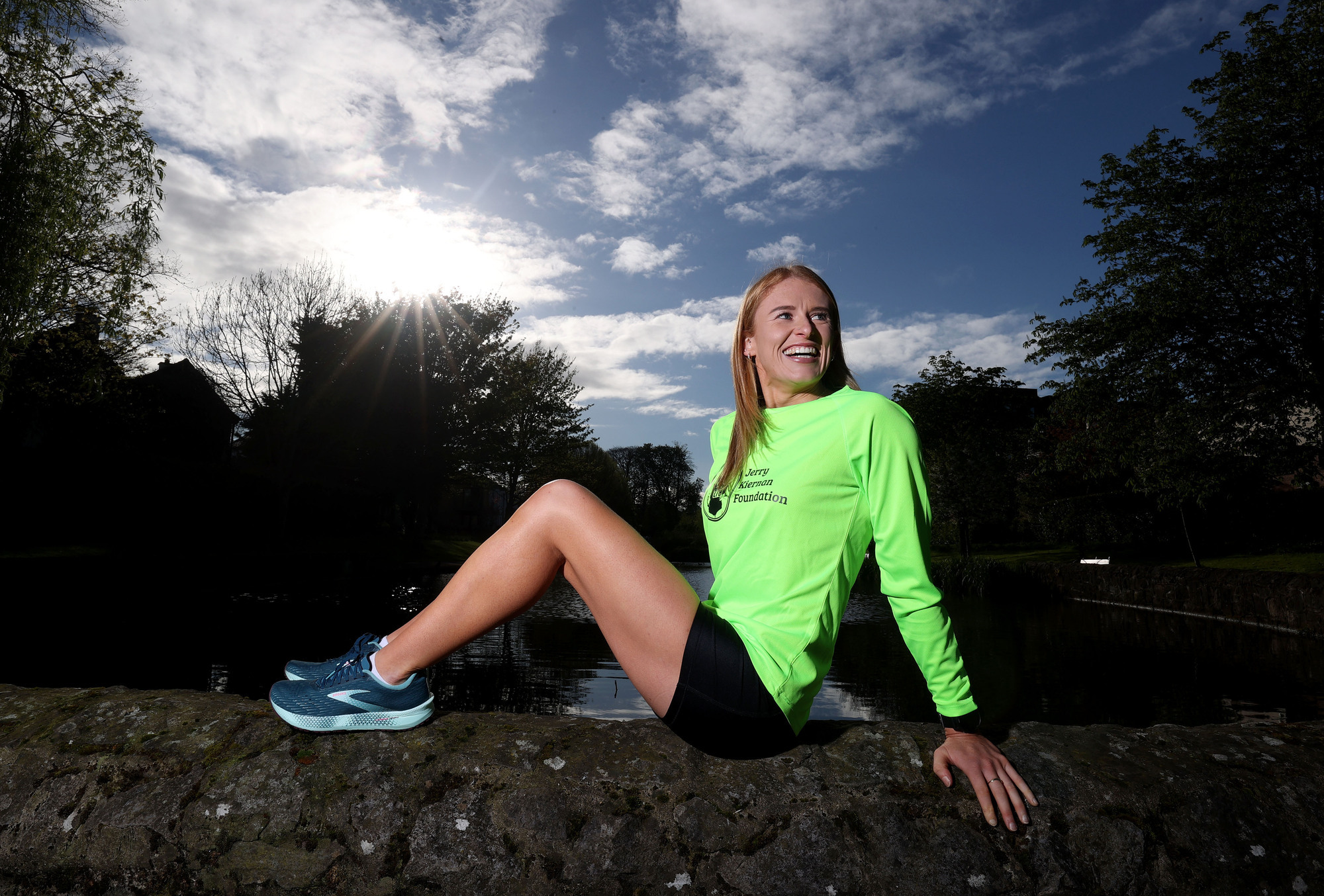
Kate Veale pictured at an event for the the Jerry Kiernan Foundation, a not-for-profit organisation dedicated to supporting aspiring Irish athletes, which has named 12 athletes who will benefit from funding in excess of €30,000 in 2024. Pic: INPHO/Dan Sheridan
The finish line at Antalya. An indiscriminate piece of road in the southern Turkish city that preoccupies Kate Veale. A piece of road with the potential to prove career defining.
The finish line at Antalya seems almost irrelevant. Listen to Kate Veale’s story and you marvel at her presence for Sunday morning’s starting pistol.
Listen to her mental health struggles, her two-month hospital stay, and you think to yourself how unimportant it all makes of something so seismic as Olympic qualification.
Kate Veale has hold of this perspective. Her picture is rounded. She can know the importance of not mentally overextending herself and still give every fibre of her being to qualification. She can know her trigger red flags and still chase wearing the Tricolour in Paris.
It doesn’t have to be one or the other.

She aches to be in Paris. To realise a life’s dream. It’s why she kept returning to the roads, be they in west Waterford or southern Turkey. But Paris is not for her alone.
She wants to be an Olympian to show what can be overcome. To proudly tell her story against the backdrop of the five rings. To inspire and to help. To provide proof that the finish line can eventually be reached.
Antalya is the latest chapter in Kate Veale’s story. It is the first chapter in the story of the marathon mixed relay.
The racewalking community was awash with rumours throughout 2022 and early 2023. The rumours concerned the Paris menu and its make-up. This month last year, the good chefs at World Athletics and the IOC emerged from the kitchen. Along with the 20km favourite, a new marathon relay event was announced.
The relay’s Olympic debut will feature 25 teams. Each team comprises one male and one female. Split into four legs, the male walker will cover the first 12.195km. Thereafter, they alternate over 10km legs.
Twenty-two of the 25 Olympic spots will be filled at Antalya’s finish line. Up to five of those 22 teams can be the second team from the same country.
In sum, Veale and relay partner Brendan Boyce - already a three-time Olympian - need to be among the first 17 nations across that indiscriminate piece of road in the southern Turkish city.
“It is something I've wanted all my life. It would be amazing to achieve it,” the 30-year-old Waterford woman says of attaining five-ring membership.
“There were years where I thought I'd never get there. I thought I was finished. A lot of people would have thought I was finished. If I was a greyhound or racehorse, I'd have been put down long ago.
“But it is never easy. Lots of bumps in the road. A lot of the time I’d have so many doubts, but just that 1% of belief kept me going all the time. I know I can be better.”
As a teenager, she was exceptional. World Youth champion over 5km in 2011. Multiple underage Irish records. Her teenage mindset was Olympic podium rather than Olympic participation.
The spiral began with a hip injury. Her progress stalled. From first across the line to being lapped mid-pack.
Physical issues fed psychological ones. Depression knocked on her door. From 2013-16, she stepped off the road and stopped competing.
Returning was laced with risk. She knew first-hand the danger of wrapping oneself in the athlete identity. She knew how unhealthy it was to base your entire existence on what you did and didn’t do out on the road. How mentally exhausting it was. She’d been a shop window mannequin of this unwholesome approach.
“Definitely just felt I had unfinished business,” Veale says of coming back. “It was weird, there was just something. I had a real love/hate relationship with the sport (as a teenager). Not that the sport was toxic, but it became toxic for me.
“The success and all the good things at a young age came at a price. It was only afterwards and looking back that I can see that, whether it be physically with my body and mentally.
“I just felt I really let people down and that I was a failure. That was hard. And it was still hard coming back. It was trying not to care what people think because, to me, it felt like people are going to be like, this one has let all her potential go to waste, or she could have been this.”
From 2017 onward, she fell slowly back in love with the sport. And with it, her times fell slowly too. But not sufficiently to make the plane for Tokyo in the summer of 2021.
She contracted covid during a training camp in pursuit of Tokyo. She missed races, missed opportunities to climb the rankings ladder. Stress built. Cracks re-emerged.
Post-Tokyo brought a pause. The cracks could be covered over no longer.
“You had to face your demons,” she says of that difficult period.
She travelled to Dublin to meet a psychiatrist. At the end of their meeting, the psychiatrist wanted to admit her. Veale was stunned. She said no. The psychiatrist asked for two weeks. Veale relented.
In the end, she spent nine weeks at St John of God hospital.
“That Olympic year, I ended up back in hospital, a place I never thought I'd end up back in. Then again that feels like a failure because, oh you came out with this story and now you are meant to be all better (Veale first opened up about her mental health struggles in a 2019 interview). But now I understand that everything is a work in progress. You are constantly learning and growing.”
The previous hospital stay had been several years earlier. Veale was young, in a different headspace. She hadn’t been ready to work on herself.
There’s an 800m loop in the garden of the St John of God grounds. Veale ran 10-20km every single day of her two months there. It was a training camp for her mind and her well-being. The same as every other training camp, she went all in.
“The person has to engage and be ready for it. I definitely wasn't the first time. The second time, I understood myself a lot more. It was like I needed a second round (in hospital). It was a completely different experience. You have a lot of time and space to learn and figure things out, which obviously helps.
“During that time in hospital I got diagnosed with ADHD (attention deficit hyperactivity disorder). I was put on ADHD medication and that was life changing.
“My psychiatrist, I really clicked with her. She is brilliant. She said to me, ‘you have these certain tendencies and ways about you, and you are trying to fit into the world in this way, but you have to work with who you are, go with that, and figure out your strengths and weaknesses’.”
Covid regulations meant there was no popping in and out of hospital or up and down the road to Waterford. It was a full nine-week stay.
“It was hard because of covid that you couldn't come out. When you come out of that then, it puts everything in perspective.
“It is not that thing of, oh I am better now. I know I have to keep myself in check all the time. I know I can spiral really quick, so I have to know what my triggers are and my little red flags. You have your toolbox of things that you know you need to do. Being an athlete, that is very important, as well, that you figure out the little things that work for you.
“I think I have to look back and see how far I've come and appreciate everything. And not look at it with the victim mentality, which I would have before. When the hip comes at me, this thing of poor me. There is always shit, that's in everyone's life. You just have to find a way to get around it. It is finding what works for you and your tendencies.
“I definitely feel a lot more resilient and capable, and that definitely transfers over to my racing. When I think of the relay, because of what I have learned, I feel a lot more, not bulletproof, just more sure of myself that I am able to deal with it.”
Herself and Boyce finished second in their debut relay outing last December in Raheny. Their time of 3:11:48 has them seventh in the world rankings. But they know the competition and weather will be significantly hotter this weekend.
No more than any other walker, Veale has spent her competitive life going from gun to tape. The 40-45 minute break in between her two 10km legs is a strange phenomena that has to be judged to absolute perfection.
“It can make or break a lot of teams what they do while they are waiting for their partner to come around again. But that is what makes it really interesting, it opens up all these other things you need to think about.
“In Turkey, it will be about keeping cool, but not shocking your body to the extreme of throwing yourself into an ice bucket after your first leg. You want to conserve energy, but sitting down, stopping, and resting isn't the answer either.
“You need to have the right headspace too. It will be very busy. Teams will have their physios, ice vests, recovery booths, massage guns. You could see another country with some weird gadget, anything, but you can’t allow yourself to get caught up with that. Be clear in your own plan. Focus on yourself and don’t get caught up in the noise around you.
“You do all your meticulous planning, but you also need your bit of luck and for nothing to go wrong.”
Having heard Kate Veale’s story, you think to yourself that if ever someone was due a smidgen of luck it is her.
She is not a Sport Ireland carded athlete. She is not in receipt of funding. Every other type of support, though, she does not want for. She’s not travelled this road alone.
“I have a daughter, Fianna, who already thinks she is going to Paris for the summer! I am not full-time at work. All my family are making sacrifices for me, and the amount of people helping me, including my coach Perseus Karlström, I want to do them proud and make it worthwhile for them. I am very lucky with the people around me and that they believe in me.
“For me, I'd love to qualify for the Olympics and tell my story. That if I can do it, anyone can. That I have had all these things going on, issues, and what you can overcome because myself and other people have said, there is no way back.”
There was. Here she stands on her most important start line. The finish line at Antalya is in sight.
CONNECT WITH US TODAY



Be the first to know the latest news and updates