Philip Doyle: 'I need to give myself the opportunity to be on that start line'
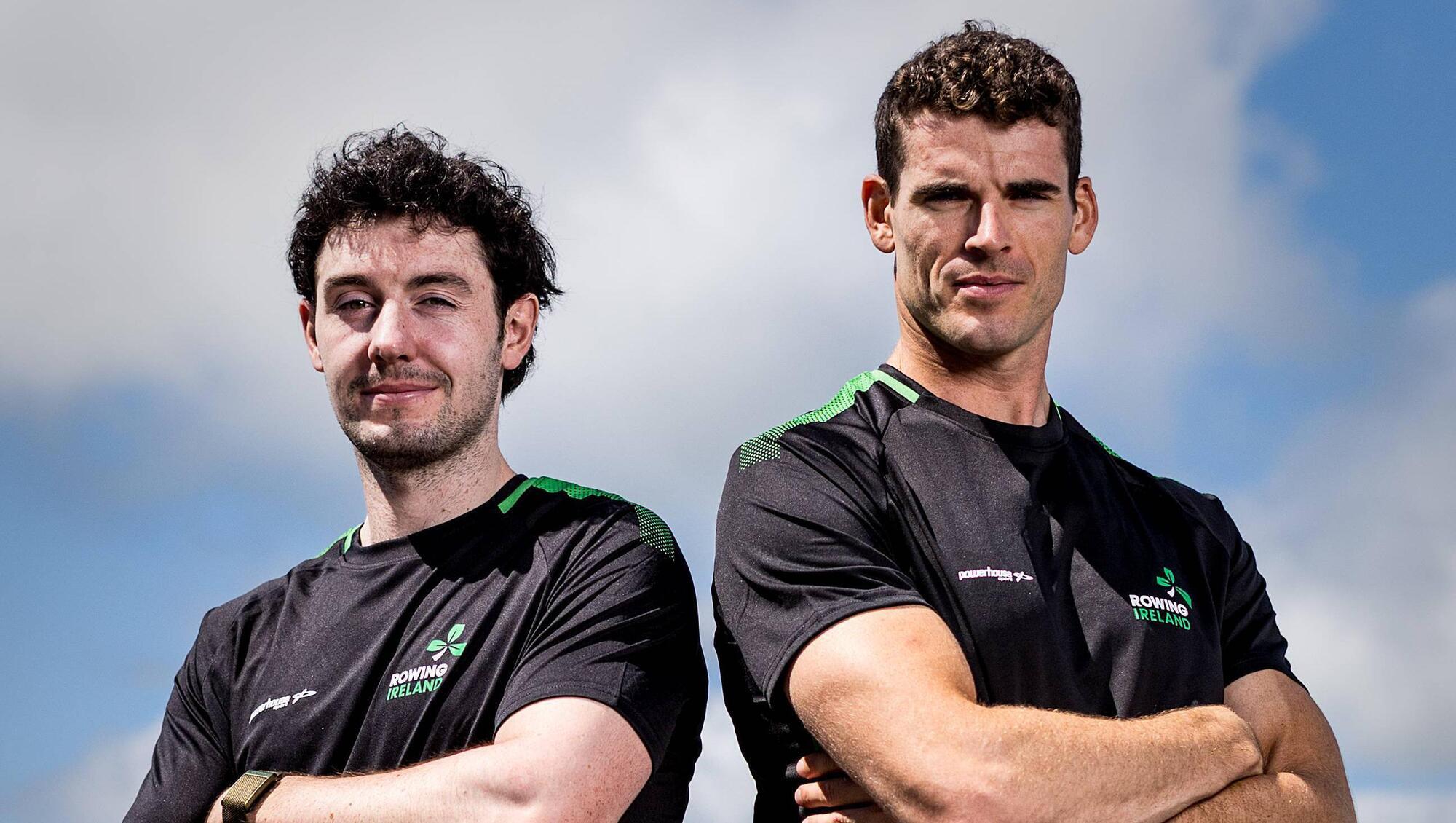
2023 World Rowing Championships Press Briefing, National Rowing Centre, Ovens, Cork 27/7/2023 Ireland's Daire Lynch and Philip Doyle Mandatory Credit ©INPHO/Laszlo Geczo
Martin and Valent Sinkovic are monsters. The Croatian brothers have 51 international medals across the board. They collected an Olympic quads silver in 2012, a gold in the double at Rio and another in the pair at Tokyo.
Ahead of Paris, they are concerned by the challenge from an Irish pair.
Last May in Slovenia, Philip Doyle and Daire Lynch just missed out on a European Championship medal in the final of the double sculls. The margin between them and a spot on the podium was .62 of a second. Two Olympic champions and a Tokyo silver medallist finished in front of them.
The first time they ever raced the Croatians was in the preceding semi-final. Then the brothers approached post-race.
“They came over and were like, ‘fucking Irish. So fast,’” Doyle recalls with a chuckle. “Why you not slow down?’ We started explaining. Well, we are trying to beat you. ‘You might, we think you might.’

“We’d be middle of the pack physiology-wise. We have our strengths and our weaknesses but there is nothing magic that sets us apart. We just race really, really hard. Sometimes when you go that hard you get it right, sometimes it will go wrong. The plan is to get it right more than it goes wrong but the fact we can push it that hard is our biggest strength.”
Doyle is speaking from the National Rowing Centre in Cork, where he is training full-time in preparation for the 2024 competition. Ask his mother what her 31-year-old son who qualified as a doctor from Queens University is currently doing and she’ll provide an abrupt answer: “I went home yesterday, and she was like, ‘Look at you. Not even working at all.’ I asked her, what do you think I do every day? She said, ‘bumming around.’ I tried to tell her how hard we were working and she said, ‘That is just physically hard! You aren’t helping anyone.
“One day hopefully I will again. But rowing has to be seven days a week. At the moment we have Sundays off. That will very soon change to a half day on a Sunday. Six and a half days a week. We are endurance athletes.
“This is not a skilled sport like rugby or soccer. They can have technical sessions and work on footwork. For us, if you are fitter and stronger, that is it. We are constantly pushing engine size and aerobic capacity.”
The buildup to Tokyo was complicated by his profession for several reasons. Covid initially distorted all priorities. Post-Olympics he threw himself back into hospital work until he moved south. For a spell, Doyle would journey up and across the border to appease the General Medical Council and keep his licence active.
Qualifying with a UK licence eventually brought infuriating complications. When it lapsed, he strained to transfer for an Irish medical one. Brexit meant the UK was regraded as a Tier 4 country. It became a bureaucratic nightmare.
“The UK went to the bottom of the pile,” Doyle explains. “I was speaking to doctors who went through the same thing. It was ourselves, Nigeria, Sudan, a lot of lower socioeconomic countries. Places where the academic systems weren’t considered as robust. So, I had to prove my credentials, the degree, that I spoke English to an acceptable standard.
“Once I got that I said why am I not working down here, so I was in Cork hospital three nights a week. My aim was to drop it down to one day or two, but the coaches were adamant, no. That is enough. In the end, we decided I could work until December and that was it.
"From a mental point of view, I love work and I see it as a real break, but you would be naïve turning up to an Olympic games without giving it seven days a week. That has my full concentration now.”
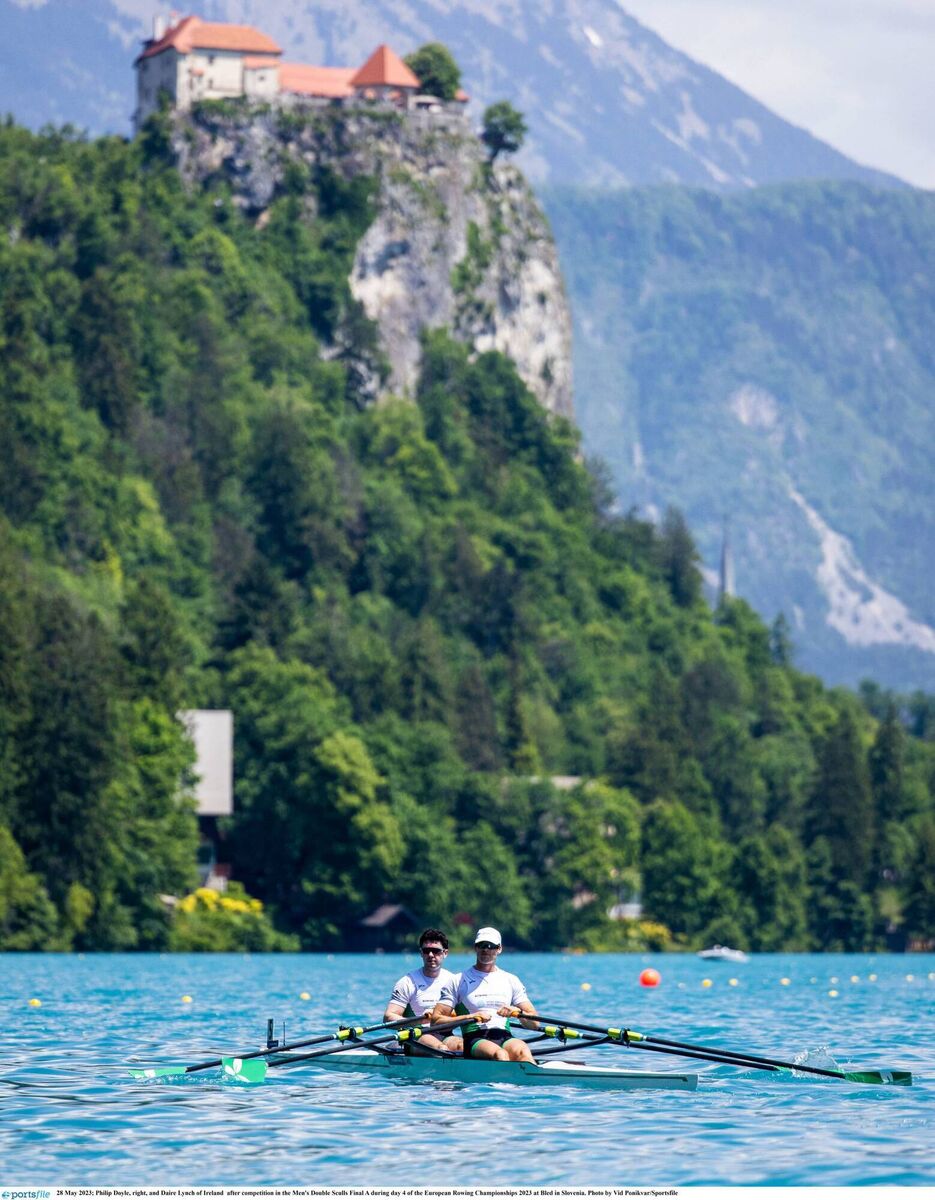
2023 was a season to tick boxes, qualify for the Olympics as part of a new partnership, make an A final and win a medal. The Banbridge man and his new partner, Clonmel's Daire Lynch, delivered on every front, taking bronze at the World Rowing Championships in Belgrade last year.
2024 is about redemption. The first Olympics was bittersweet, joyous to experience and laced with stinging disappointment at how it finished. Doyle and Ronan Byrne were one of the six Irish contenders included in numerous medal predictions beforehand. They did not qualify for the final. He left Japan convinced he was never going to row again. It wasn’t part of his upbringing and it was never part of the plan for it to dominate his working life.
His rowing origin story is exceptional. As a teenage college student, Doyle attended the Dublin Horse show to watch his cousin eventing and ended up with an offer to work for Abercrombie. For a few months, he boarded the bus from Belfast to Dublin every weekend and was paid handsomely to pose topless outside of the American clothes wear store. A colleague was a rower and after the odd gym session together he began to urge the latecomer to give it a go.
Raw talent was first uncovered on the rowing machine. Every November there is a provincial 2km test, in January there is an Irish one. The Belfast rower won it in successive years, impressing with a sub six-minute time.
“Around 2015 I was showing promise on the rowing machine and said to myself, maybe I could trial for the national team. Once Rio was over, I put that notion to bed really until after my final exams.
“Then a new rowing system came in here. Antonio (Maurogiovanni) took over. That really rejuvenated the team. Before that it was only lightweight rowing. There was no heavyweight team really, 2008 was the last time a boat went to the Olympics. Before us in 2019, there was no medal for 45 years.
“It felt like heavyweights had nowhere to go until this Italian maverick arrived and announced, ‘everyone who wants to come, all the heavyweights, get here now. We need to start something for Toyko.’ What! He said to me, you are the best on the rowing machine in Ireland. What are you at? Are you coming down? I wasn’t planning on it. This was 2018 and he talked me into it. Before that, I was genuinely at the door with my hands out saying let me in and there was no response.”
What caused the Irish rowing renaissance? The obvious answer is the O’Donovan’s triumph and that is true to a point. But that didn’t tangibly benefit Doyle’s class. At the 2017 World Championships, a newly formed heavyweight pair competed and never took off. The lightweights went from strength to strength, essentially self-managed on the side by Dominic Casey while Fintan and Jake McCarthy bolstered the ranks.
Then the iron-willed Maurogiovanni entered as the new performance director. His Italian programme demanded high mileage and absolute commitment.
“What separates us is the fearlessness of how we race. There are lads 10 seconds faster on the rowing machine that I will whip out. That steely head, clear thoughts, we just race aggressively.
“You go hard, get to the edge from probably about the fifth stroke… the idea is to get to that edge as quickly as possible and then just hold it. You hope you kind of tip, tip, tip and fall over the edge on your last stroke. That is the perfect race. Get to the top of the mountain as soon as possible and hang on as long as you can.
“It is a challenge. Every semi-final and final you are battling with yourself, can I afford to ease up? Can I afford not to go harder? In the final last year, we were coming through the halfway point. In my head, I was saying, ‘I am over-reaching. I am putting out effort that will last five minutes in a six-minute race. Jesus. I don’t know if we can sustain this.’
“We hit the halfway point and Daire behind me starts talking. I still don’t know why. He usually doesn’t say much. ‘I feel great. Let’s push!’ I was questioning him in my head, do you? Do you really? But feck if he feels good, I can’t let up. I held that level of effort and intensity. I guess potentially for too long because I ended up in the medicine tent with heat stroke getting ice poured over my back. That is the one where you don’t have another race. There is no next day. You can push it over the limit.”
So, what happened in Tokyo? The team has a detailed understanding of it now. Byrne and Doyle only qualified for the semis via the repechage. It would be senselessly ignorant to boil it down to one element, he stresses now. There are two people in the boat and a hundred factors in how they travel.
They’d never raced outside of Europe before their first race. That was another mistake. Afterwards Doyle tried to leave it behind. On August 2nd they landed in Dublin. On August 4th he emailed work and asked if he could return immediately, instead of the scheduled December comeback.
Fast forward to summer 2022 and a coach was on the phone. His Sports Ireland funding was in jeopardy. He had to get back in the boat. He had more to give. With two weeks training under his belt, Doyle went to the World Championships. The prospect of Paris started to creep into his mind. To move forward they had to finally look back. It was time to parse through the wreckage.
“The team has learned so much from our experience. We’ve been to see the course already. We’ve been to the hotel. We’ve tested the food we’ll be eating. Tokyo is a culture shock for anyone. The Olympics is also a culture shock. The media, the village. We weren’t prepared for all of that.
“We went over to France last Halloween. We’re not staying at the Olympic Village actually; we are staying at a hotel near the course because it would be a 90-minute bus journey. We are in a hotel with the Swiss and New Zealand team. We went to the course and had a row on it. We saw the plans for what is to be built around it. We’ll be back and say been here before, a job has to be done.
“There was so much in it. We performed quite well in our last race, beating lads who were absolutely killing us in the semi-finals and the heats. I was thinking, ‘maybe it was the pressure, maybe we didn't deal with this right. Do we need to look at sports psychology and how we approach things mentally?
“Now we’re working with Cathal Sheridan from Munster rugby. It is funny, we have changed a lot specifically because of what happened to us in Tokyo.”
All of that guarantees nothing. The only thing he wants this summer is to have a chance.
“The ideal for me, the dream is getting ready the night before a race that gives us an opportunity to win a medal. I’d be over the moon to have my name on the starting list because I've had seven races to win medals in my entire career and six out of seven of those I've come away with a medal.
“When I am on form, I am on form. The one loss was by half a second to the Dutch who were world champions. We came fourth in the Europeans. I know that if I can get to that medal race, that means I'm on form.
“I need to give myself the opportunity to be on that start line. The hardest part of the competition for me is getting to that medal race, but once I am there, the nerves seem to clear away. The anxiety clears away. I just get a bit of clearness and calmness about me. ‘You've done yourself proud. Nobody can say you were shit. You didn't bomb out.’ I can say, ‘Now it's time to go hard and take home a medal.’”
CONNECT WITH US TODAY



Be the first to know the latest news and updates